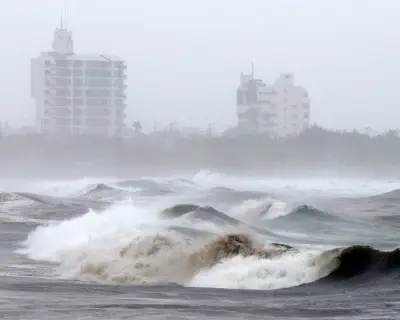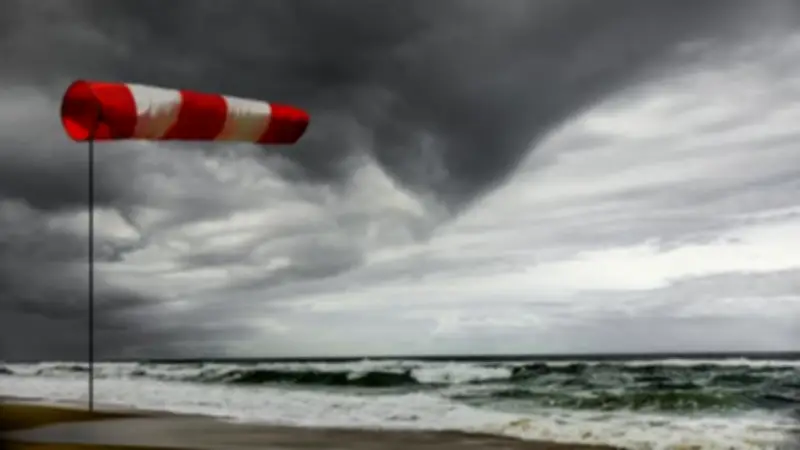
If you have ever stood on a Victorian beach and felt the wind from the Southern Ocean, you know this is not a gentle force. Whipped up across thousands of kilometres of cold ocean, these winds are relentless and powerful. More than that, they represent one of Australia's most valuable untapped sources of energy.
Australia has many wind farms, but all of them have been built on land. The stronger, more reliable winds blowing over oceans now turn truly enormous turbines in nations from Denmark to China. Offshore wind would work particularly well in Victoria. The state government wants large wind farms built out at sea to replace the remaining coal plants. But will these strong winds keep blowing as reliably under climate change?
Our recent research is reassuring. Despite small drops in wind strength, the winds will remain strong and reliable over the next 30 to 50 years.

What is so good about offshore wind?
Offshore wind farms produce power more reliably than onshore wind or solar. They can generate a great deal of power and require minimal land. This is why offshore wind has been seen as a good fit for Australia. Coupled with big batteries and transmission lines, offshore wind could contribute significantly to the energy transition.
Victoria has the most at stake. For decades, it has relied on brown coal and gas. But its gas supplies are depleting fast, and ageing coal plants in the Gippsland region will not be replaced with more coal. Instead, the state wants to tap Gippsland's offshore wind resources, which rank among the world's best.
Despite the interest, the offshore wind sector has been slow to start. Political and economic headwinds have led some projects to be cancelled. But the sector looks set to finally begin in August, when Victoria will host the nation's first offshore auction with a goal of securing 2 gigawatts of capacity. Victoria is not alone. Offshore wind zones have been declared along Australia's entire southern and western coastline, including Victoria, South Australia, Tasmania, and parts of New South Wales and Western Australia.
Will the winds stay strong?
As the climate changes, wind patterns are likely to change too. The powerful westerly winds of the Southern Ocean are forecast to be gradually pushed closer to Antarctica. Wind speeds across southern mainland Australia could drop by up to 5 percent by the end of the century. If wind speeds drop too much, it could pose a problem for offshore wind. Weaker winds would mean less electricity can be generated, potentially making projects less viable and slowing the energy transition.
An offshore wind farm commissioned today will operate for 25 to 30 years. That means it will still be operating mid-century, when climate change is likely to have intensified. To find out what climate change will mean for offshore wind, we worked with climate scientists and offshore wind researchers to simulate winds 30 to 50 years from now using seven high-resolution regional climate models.
We projected future wind speeds at the ocean surface and offshore wind energy production across Australia's existing offshore wind zones under two scenarios: ambitious climate action limiting global warming to around 1.8 degrees Celsius and continued fossil fuel dependence driving warming to roughly 3.6 degrees Celsius by 2100. We validated our projections against the best available records of historical wind speeds, which date back several decades. This is because it is not just about whether wind speeds change, but whether they will change more than the natural variability offshore wind farms can already cope with.
What we found was broadly reassuring. Yes, the winds are likely to weaken over the next 30 to 50 years. But the changes are minor, falling 0.1 percent to 2.6 percent on average. That is within the bounds of natural variability. Unlike projections of future rainfall or temperature, our findings hold across both emissions scenarios. This suggests offshore winds will remain strong and reliable overall.
While reassuring, one area is likely to see a larger drop. Under the high emissions scenario, wind speeds are likely to fall up to 20 percent over winter in Western Australia's offshore wind zones near Bunbury.

Good news for offshore wind?
It is good news that average wind speeds across Australia's offshore wind zones are not likely to change significantly. Our research is not the whole story, however. We did not model whether extreme winds or strong swell conditions will become more likely. These events can stop wind farms from operating, damage infrastructure, and shorten the window of time when turbines can be installed and maintained. To give offshore wind developers full certainty, it will be important to study what climate change will do to these extreme events.