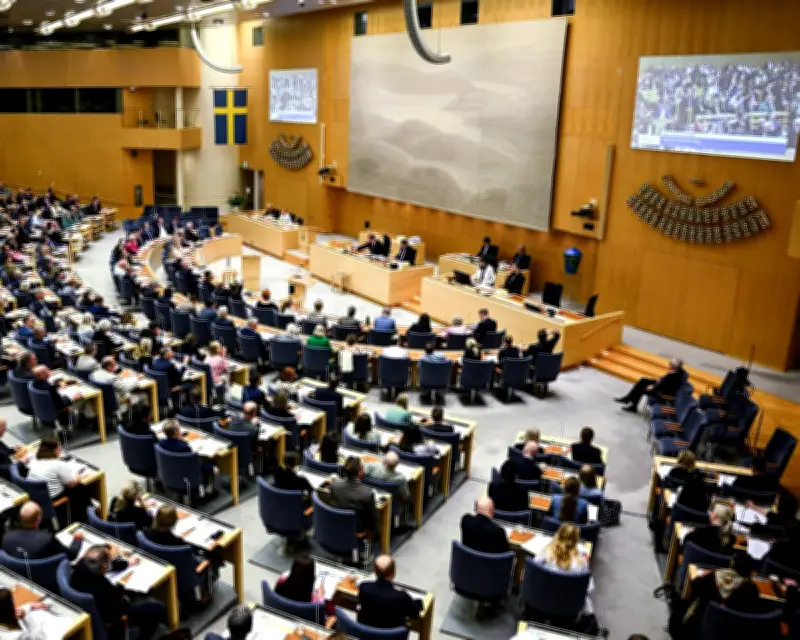
Sweden's parliament has voted to escalate the country's crackdown on immigrant rights, backing laws that allow authorities to revoke residency permits based on a vague criteria of bad behaviour and obliging most public sector workers to report anyone suspected of being undocumented.
The new legislation comes ahead of parliamentary elections in September, pitting the centre-right government, which currently depends on the support of the far-right Sweden Democrats to govern, against a far right that has said its intent is to create one of Europe's most hostile environments for non-Europeans.
Good behaviour law
Late on Monday, parliamentarians voted to pass the so-called 'good behaviour' law, which would cover pending and future residents but also be applied retroactively to many of the country's current residents.

'Anyone who doesn't make the effort to do the right thing shouldn't be able to count on staying,' Sweden's minister of migration, Johan Forssell, said in March when he proposed the bill.
While the law does not specify the types of behaviour that would be deemed unacceptable, the government has previously mentioned examples such as unpaid debts, failing to pay taxes, criminality, and links to extremist organisations. The task of reviewing permits would fall to the Swedish migration agency, and any decisions can be appealed against.
The law has been fiercely criticised by opposition politicians and rights groups, who have described the criteria as arbitrary.
'This would lead to the risk of residence permits being denied or revoked based on behaviour that was neither illegal nor punishable for Swedish citizens,' Amnesty International noted recently.
The Stockholm-based group Civil Rights Defenders said the legislation 'undermines the rule of law'. In a statement it added: 'The good behaviour law leaves people in uncertainty about what actions or expressions can be used against them.'
Snitch law
The country's parliament also voted to narrowly back a contentious, so-called 'snitch law' that will require many public sector workers to report anyone they believe is undocumented.
Critics of the new law, which passed with 174 votes in favour and 172 against, have long warned that it will negatively impact migrants' physical and mental health while also significantly increasing the risk of racial profiling.
'It is a cruel, ineffective policy and opens up the Pandora's box of snitching – a trademark of authoritarian states,' said Jacob Lind, a postdoctoral researcher in international migration at Malmö University, in a statement.
'Today's vote will have devastating consequences for undocumented migrants who will be further pushed into the margins of society as their access to rights is restricted.'
After widespread criticism, teachers, doctors and social workers have been exempted from reporting obligations. Employees of tax authorities and employment and social insurance agencies, however, are among those who would have to notify police when they have reasons to believe they have been in contact with people who do not have residency papers.
Louise Bonneau of the Platform for International Cooperation on Undocumented Migrants, described it as a 'serious setback for human rights' in the country.
'The so-called exemptions for healthcare, schools and social services don't offer sufficient protection: in practice, information will flow between service providers, agencies, and immigration authorities,' she said, meaning some would probably avoid contact with healthcare professionals altogether.
Her view is backed by Swedish researchers who, following interviews with public servants, warned that the law would, in effect, turn public employees into border police. They cited the example of a mother who delivers a child with the help of a midwife; while the midwife is exempt from reporting, they would need to register the baby with tax authorities, who could then report the family to police.
The Swedish government has long defended the measures, arguing that they are needed to ensure that those who are not legally allowed to stay in Sweden can be sent to their home countries.

European context
The new reporting requirements have few equivalents across Europe; Finland has long been considering whether to expand such obligations, while in Germany, social welfare offices have for two decades wrestled with reporting requirements.
In 2012, the UK's Theresa May introduced the 'hostile environment' policies that sought to limit access to work, benefits, bank accounts, driving licences and other essential services for those who could not prove they had the legal right to live in Britain. It later emerged that many who were in the UK legally were unable to prove their status and that the Home Office was frequently misclassifying legal residents as immigration offenders, leading the National Audit Office to conclude in 2018 that hostile environment policies did not provide value for money for taxpayers.
On Monday, the European Public Services Union pushed back against the idea that workers would be forced to act as informants, with Jan Willem Goudriaan of the union saying that now was not the time for a 'new witch hunt'.
Instead, he called for governments to be reminded that 'public services would cease functioning without migrant workers in Sweden and many EU member states.' The new law would fuel a climate of 'suspicion, fear and racism,' he added, while also threatening people's fundamental right to asylum. 'It merely legitimises the far-right, who are all too happy to see their wildest dreams of mass surveillance, detention, and deportation come true at the expense of public service ethics.'