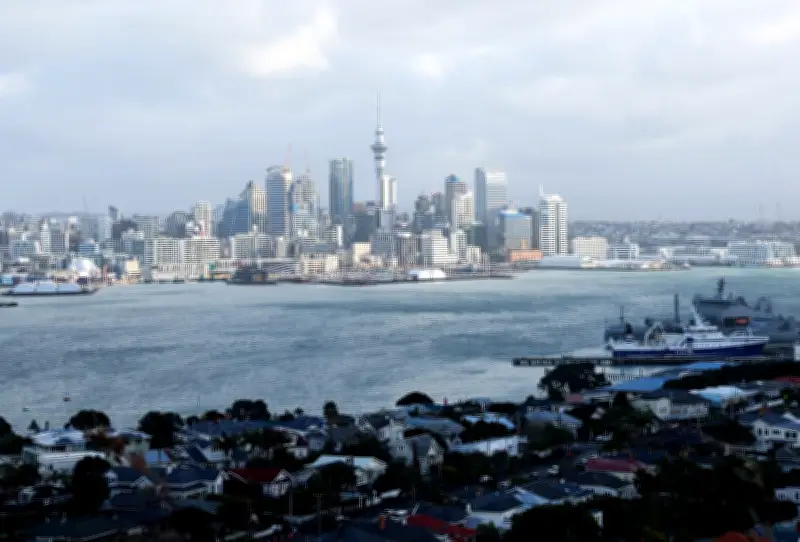
A moderate earthquake that rattled Auckland earlier this week has been linked to a previously unknown fault line, the Mangatangi fault, according to seismologists. The 4.3 magnitude tremor struck near the city on Monday, causing minor damage but no injuries.
Discovery of the Mangatangi Fault
Scientists at GNS Science have identified the Mangatangi fault as the source of the earthquake after analyzing seismic data. The fault is located about 30 kilometers southeast of Auckland's central business district, running beneath the Hauraki Gulf. This discovery adds a new dimension to the seismic landscape of New Zealand's largest city, which has historically been considered low-risk for major earthquakes.
Dr. Emily Parker, a seismologist at GNS Science, said: "This fault was not previously mapped because it shows no surface expression. It was only through advanced modeling of the earthquake's epicenter and aftershocks that we could pinpoint its location."

Understanding the Earthquake
The earthquake occurred at a depth of 15 kilometers and was felt across Auckland, with reports of shaking from as far north as Whangarei. The tremor lasted approximately 10 seconds, prompting some residents to evacuate buildings. Emergency services reported no structural damage or casualties, but the event has raised awareness about seismic preparedness.
Geologists are now studying the Mangatangi fault to determine its potential for larger earthquakes. Preliminary assessments suggest it could generate a magnitude 6.0 event, though such an occurrence is considered rare.
Implications for Auckland
Auckland sits on a volcanic field and is surrounded by several fault lines, but the discovery of a new fault highlights the complexity of the region's geology. The Auckland Volcanic Field is monitored closely, but the Mangatangi fault is tectonic in origin, not volcanic.
Professor James Mitchell, a geologist at the University of Auckland, explained: "This finding underscores the need for continuous monitoring and updated hazard models. While the immediate risk is low, we must incorporate this data into building codes and emergency planning."
Public Response and Preparedness
The earthquake has prompted renewed calls for public education on earthquake safety. Civil Defence officials are urging residents to check emergency kits and practice drop, cover, and hold drills. Schools and businesses across the region conducted evacuation drills in the days following the tremor.
Local resident Sarah Thompson said: "We felt a sudden jolt, and it was quite scary. We're used to small shakes, but this one was stronger. It's a reminder to always be prepared."
Scientific Investigation Continues
GNS Science is deploying additional seismometers around the fault area to monitor any ongoing activity. Scientists are also examining historical records to see if the Mangatangi fault has caused past earthquakes. The data will help refine seismic risk assessments for Auckland, which is home to nearly 1.7 million people.
The discovery of the Mangatangi fault is a significant development in New Zealand's understanding of its seismic hazards, highlighting that even well-studied regions can hold surprises beneath the surface.