Fragmentary whale bones scattered across the Indian Ocean floor have led to a remarkable discovery. A 5.3-million-year-old whale necropolis has been identified in the Diamantina Zone, a deep-sea region in the southeastern Indian Ocean. This finding, published in Nature, sheds light on the mysterious phenomenon of whale falls and the unique ecosystems they support.
A Whale-Sized Find in the Middle of the Ocean
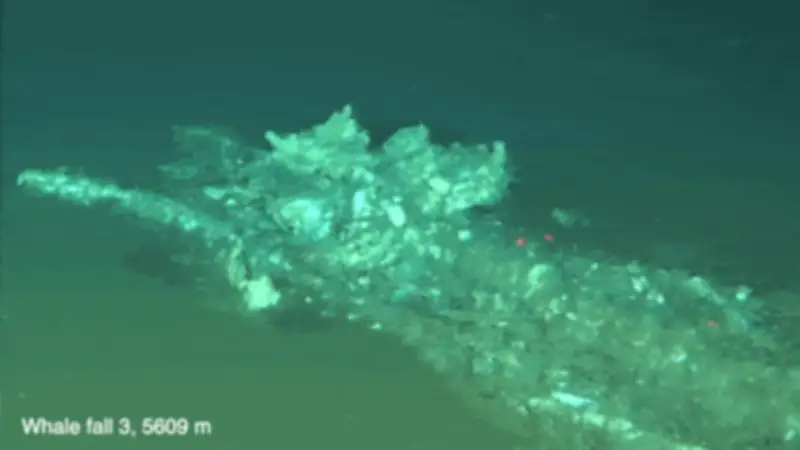
During a special dive mission in February 2023, scientists aboard the submersible Fendouzhe uncovered extensive whale skeletons and fossils partially buried in sediment. Over the next month, 32 additional dives revealed a vast graveyard stretching approximately 1,200 kilometres along the seafloor at depths between 4,200 and 7,000 metres. The site contains 476 whale fossils and five active whale falls.
These active whale falls are teeming with strange creatures, including jellyfish, brittle stars, and bone-boring worms, many of which may be new to science. From 43 recovered fossils, the team identified five beaked-whale species, such as the Andrews' beaked whale (Mesoplodon bowdoini) and the strap-toothed whale (Mesoplodon layardii), as well as one baleen whale species—the sei whale (Balaenoptera borealis). The largest find was a five-metre-long Antarctic minke whale, identified by ear bone shape and genetic analysis. Additionally, a new extinct whale species, Pterocetus diamantinae, was discovered.

How the Graveyard Formed
Isotopic dating revealed that the oldest fossils are about 5.3 million years old. The high concentration of whale remains is likely due to the V-shaped topography of the Diamantina Zone, which funnels carcasses onto the seafloor, combined with the presence of deep-diving beaked whales in the region.
A Reminder of How Little We Know
This research deepens our understanding of whale falls and the ecosystems they support. It also provides an evolutionary window into beaked whales from the Pliocene epoch to the present day. The discovery is a humbling reminder of the deep sea's mysteries—and how exploration can yield unexpected treasures.