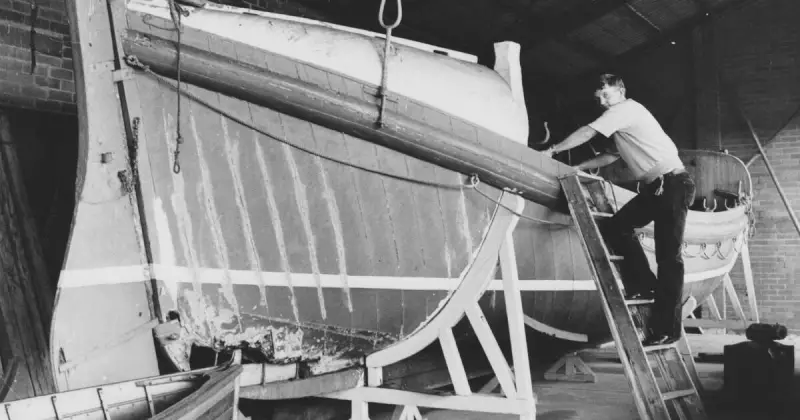
The future of one of Newcastle's most significant maritime artefacts, the historic lifeboat Victoria II, hangs in the balance alongside thousands of other precious items as the city's maritime museum collection faces a looming deadline and lacks a permanent home.
A Lifesaver Stranded on the Highway
For many years, motorists travelling the Pacific Highway near Hexham witnessed a curious sight: a massive, nearly 10-tonne mahogany lifeboat, standing high and dry beside the road. This was the Victoria II, a 39-foot (11.8-metre) vessel that for 49 years was Newcastle's primary hope for rescuing sailors from the notoriously dangerous harbour. Built with a revolutionary double skin of diagonal planking with canvas in between, it was designed to self-right in just 11 seconds if capsized.
Imported from England, the Victoria II was launched in Newcastle's East End in May 1897 and served until its retirement in 1946. Its subsequent placement in an open-air shed near the old Oak Milk Bar was a far cry from its heroic past. Thankfully, by March 1985, the vessel found safer refuge in a weatherproof shed at Fort Scratchley, then home to the Newcastle Maritime Museum (NMM).

A Collection in Crisis With No Home in Sight
The lifeboat's current safety is temporary. Its future, along with that of up to 8500 other items in the Newcastle Maritime Museum's collection, is under a severe cloud. The NMM has been without a permanent base since vacating the historic 'A' shed on Lee Wharf in May 2018 for a proposed commercial winery that never materialised.
In February 2022, as a crisis measure, 19 key items including the Victoria II and a rare 19th-century rocket brigade cart were transferred on loan to the Newcastle Museum. The rocket brigade, active from 1866 to 1974, worked alongside the lifeboat service, firing rescue lines from Stockton beach to stricken ships offshore. However, this is a stopgap solution.
The entire collection now faces a critical deadline. Its storage lease at a Broadmeadow site, controlled by Venues NSW, expires on March 20 and will not be extended. This puts an immense range of history at risk, including:
- Valuable port shipbuilding records
- Numerous paintings and intricate ship models
- Royal Australian Navy (RAN) relics and medals
- A historic carronade gun and shipwreck material
- 18 small boats under eight metres in length
Heroism and History at Risk of Being Forgotten
The lifeboat service, beginning with convict-manned boats in 1808, represents a profound legacy of courage. The first purpose-built lifeboat, Victoria I, arrived in September 1867 and served for 30 years despite an expected lifespan of just 12. Its maiden rescue in May 1869 saw a volunteer crew battle a ferocious gale for 20 hours without food or water.
Author Dr Pamela B. Harrison, who penned the tribute Man the Lifeboat in 2009, estimates that around 350 men served in the lifeboat crews over its 108-year operational history (1838-1946), regularly risking their lives. She describes a history of "heroism and despair, sacrifice and success." The loss of this tangible history, she warns, means these stories of extraordinary community bravery are "largely forgotten."
Among the threatened collection is another unique artefact: Newcastle's historic time ball. This one-metre diameter sphere was mounted atop the Customs House and dropped daily at 1pm sharp, accompanied by a cannon blast, allowing ship captains to set their chronometers for accurate navigation. For decades, it also helped Newcastle citizens set their household clocks.
The clock is now ticking for Newcastle's civic leaders and community to find a solution. Without urgent action, the physical evidence of the city's rich maritime identity—a history of rescue, trade, and shipbuilding that defined its character—could be lost, leaving future generations with only fading memories of the heroes who manned the lifeboats.