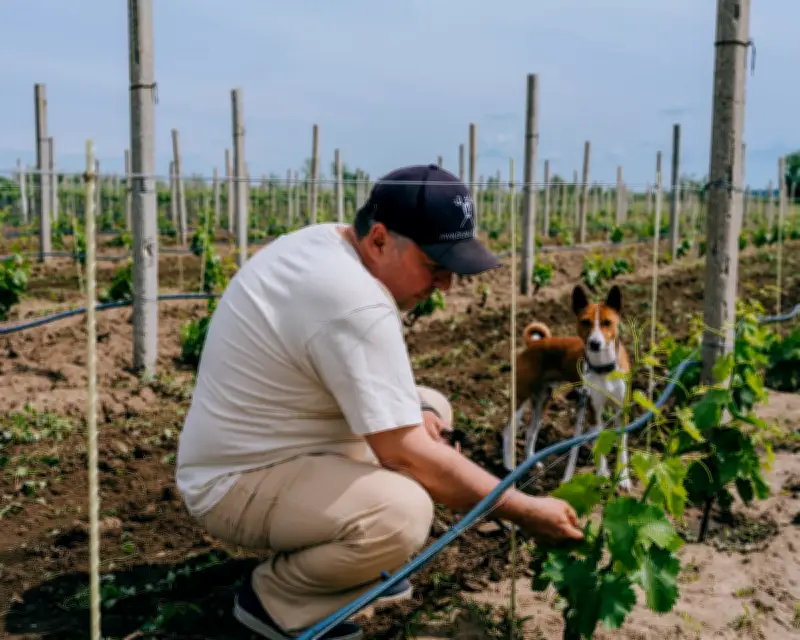
As winemaker Mykhailo Molchanov trimmed foliage from his vines on a warm early-summer day, his dog Direktor at his heels, it was hard to imagine a more idyllic scene. The Molchanovs’ organic vines are planted directly into the richly biodiverse grassland of southern Ukraine, amid silvery feathergrass and wild salvia. The soundtrack was not the familiar buzzing of drones, but bees, cuckoos, and golden orioles. Yet a terrifying reminder of war lurked: an unexploded Russian rocket, nose down, half-buried in the soil between rows of Chardonnay grapes.
Living and Working Amid the War
When Russia’s full-scale invasion began on 24 February 2022, Mykhailo and his wife Svitlana left their home in Mykolaiv and crossed the river to their winery, where vineyards roll down towards the banks of the Southern Buh river. As fighting intensified in early March, they found themselves between the lines, under artillery from both armies. “You could see the rockets going directly up towards space – as if they were launching cosmonauts,” said their son Heorhii, a central part of the winemaking business.
The defence of Mykolaiv was successful, and the Molchanovs had a serviceable bomb shelter: their wine cellar. “Put it this way,” said Mykhailo. “We used to have a pretty decent 2017 Cabernet down there. Not any more.” The capture of Mykolaiv was a key Russian objective; success would have opened the way to an attempt on the vital Black Sea port of Odesa.

Expanding Despite the Odds
Wine growing is uncertain even without war. Grapes face bad weather, rot, disease, and fungus, especially since the Molchanovs use only copper and sulphur as pesticides. Last year, wild goats and pigs ate at least a ton of grapes. Yet the family has expanded their acreage since the invasion and plans to increase production from about 10,000 bottles a year to 30,000-50,000 over the next decade. Mykhailo believes Ukrainian wine has huge potential: “I was listening to Italian wine growers talking at a conference recently, and their situation reminded me of ours – except they were talking about the 1960s.”
Besides familiar varieties like pinot gris and cabernet, the family grows native Ukrainian grapes such as telti kuruk and odesa black. They are involved in a new cooperative that, in happier times, could attract tourists to a winery on the road to Olbia, the ancient Greek settlement on the Black Sea now too dangerous to access.
A Hub for Displaced Winemakers
The Molchanovs run a hub for local winemakers who have lost their own vineyards. Olha Kashchenko, who lives in Kherson under constant drone threat, visited with her young son. She once worked as a wine tour guide and dreamed of becoming a winemaker. She bought land and built a house, but her plot is now in the red zone, and the house has been destroyed. She plans to buy grapes and use the hub to produce wine: “red with strong tannins and whites with good acidity – sauvignon and riesling, I hope. We plan to return, we will rebuild and plant our own grapes. But the area is mined, and who knows how long it will take.”
Devastating Losses Across Ukraine
According to Svitlana Tsybak, president of the Ukrainian Association of Craft Winemakers and co-owner of UA Wines, the country’s vineyard area dropped from 68,000 hectares in 2014 to 47,000 after Crimea’s annexation, and now stands at just 15,000 hectares. Many vineyards have been lost to occupation, the destruction of the Kakhovka dam, and changing farming practices. Large growers have uprooted vines for more reliable sunflowers or wheat. Yet 82 craft wineries have been established since 2022, mostly in safer central and western regions.
Tsybak also runs Beykush winery, on a narrow cape southwest of Mykolaiv, uncomfortably close to the strategic coastal town of Ochakiv, a frequent Russian target. The winery’s underground tasting rooms have been a refuge. Head winemaker Olha Romashko has moved into the winery from her home in Ochakiv for safety. She and deputy Oleksandr Pashkovsky avoid working visibly in the open and observe a blackout after 10pm. Missiles are ubiquitous. “When there isn’t an FPV drone or anything else for a while – then it’s strange, and people start to be suspicious about what’s on its way,” Romashko said.

In November 2022, they planted malbec grapes, having ordered the young vines two years earlier. “People should understand that wine growing has its own cycle,” said Pashkovsky. “You can’t just stop taking care of it. You have to keep on. You can’t miss a single cycle or step – if you do, you have wasted all your work.” He added, caressing the new malbec shoots: “You can see that they started to blossom. When you look at these buds, how could you possibly abandon them?”