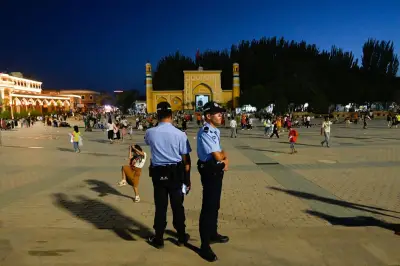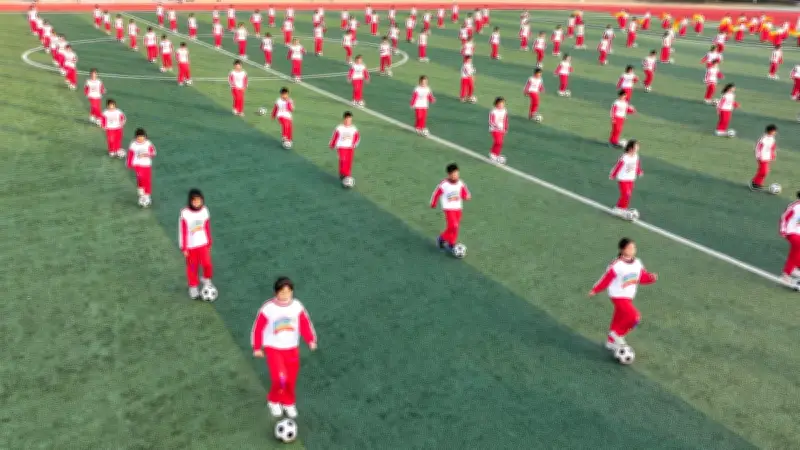
Michael Owen, the former England striker and 2001 Ballon d'Or winner, recently visited Rongjiang county in Guizhou province, China, to play in a match for the local amateur team Rongjiang Niubi. He scored twice in a 4-3 loss, endearing himself to thousands of spectators, though many locals did not recognize him. "Many people didn't know who he was. The older generation doesn't even know who David Beckham or Cristiano Ronaldo are," said May, a Rongjiang local whose family helps run the tournament. "But what left a deep impression was watching him play football with the local players. There were also very young schoolchildren who had been preparing for days to interview him in English. Owen was very patient in communicating with them."
Village Super League Goes Viral
Guizhou's amateur tournament, known as Cun Chao or Village Super League, became an unexpected viral hit in 2023, drawing tens of millions of viewers on social media. Tourists flocked to the rural mountainous community, where crowds of over 10,000 watched farmers, construction workers, and students represent their local village teams. The fourth season of Cun Chao, which kicked off in January 2024, featured 137 village teams. The league's success has inspired similar initiatives by local governments across China, turning amateur football into a national phenomenon with attendances larger than many European professional leagues. Chinese President Xi Jinping praised the league in his 2024 new year's speech, saying it "presents a vibrant and flourishing China to the world."
Grassroots or Government-Led?
Experts remain skeptical about whether this amateur boom can develop China's long-absent grassroots football scene. Mark Dreyer, founder of China Sports Insider, believes authorities will not allow the amateur game to grow organically. "The more successful it becomes, the more it's going to get co-opted by the state and the football association and the sports ministry. Then all of their bad decisions are going to start impacting these more organic leagues," he said. Poor governance has long hindered China's professional game. In 2016, the Chinese Football Association outlined a vision to become a "world football superpower" by 2050, including getting 50 million children and adults playing by 2020. This was followed by an ill-fated spending spree on international stars for the Chinese Super League (CSL), which ended in the early 2020s as clubs folded amid funding issues and corruption scandals. China's men's national team languishes 91st in the FIFA world rankings and failed to qualify for a sixth consecutive World Cup in 2024.

No Pathway to Professional Game
Rowan Simons, a China football expert who founded one of the country's first amateur networks, noted that provincial tournaments springing up in Cun Chao's wake cannot truly be considered grassroots. "It happened [organically] in Guizhou, and other provincial governments jumped on the bandwagon. It has appeared from nowhere in two years ... regional governments saw the cultural and tourism benefits and created these amateur leagues," he said. Crucially, these amateur leagues are not part of a larger pyramid connected to China's professional game, limiting their potential as a talent pipeline. "There still isn't a pathway to go from amateur through to professional," Simons added. Dreyer echoed this, saying China's top-down approach is at odds with football's need for bottom-up development. "Football needs to be bottom-up, but China is fundamentally a top-down country. Everything stems from the top, so they focus on the elites instead of focusing on the base of the pyramid," he said.

Spectacle Over Sport
For regional governments running the roughly 13 amateur leagues that have sprung up since 2023, football is almost a sideshow. Match days serve as hyperlocal celebrations of ethnic heritage, food, and culture. Yuming, a 24-year-old Beijing Guo'an fan, said matches are accompanied by "non-footballing activities like a food market before and after, half-time shows featuring local cultural icons, which makes it more of a spectacle." The most successful Cun Chao clone is Jiangsu province's Jiangsu Football City League, known as Su Chao, with 13 teams. The league's final in November 2024 saw 62,329 fans pack into Nanjing's Olympic sports centre, just shy of China's domestic club spectator record of 65,769. Average attendance in later rounds exceeded 30,000, compared to France's Ligue 1 average of about 27,500. Yuming said, "It's a great way to bring more people into a football stadium to see the beautiful game. Who knows, maybe our next generation of footballers might have gotten into football because they attended Su Chao games as a small kid?"
Community Connection
Despite doubts about transformative potential, Dreyer agreed that "anything that gets people playing or watching football is a fantastic thing." May described Cun Chao's appeal: "These [players] are our own people; it all happens right here among us, and they're all our relatives and friends. Since the players are so closely connected to us, we pay much more attention than to the Chinese Super League, or even the World Cup." The Chinese Football Association was contacted for comment but had not replied by time of publication.