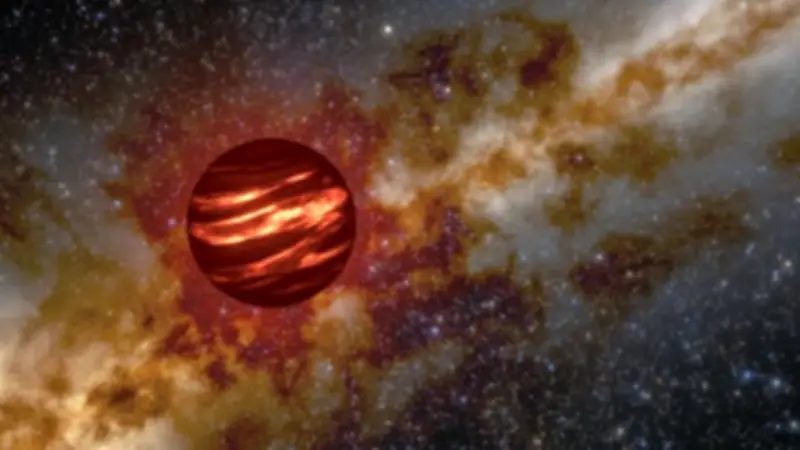
Around 1,350 light years from Earth lies a star called TOI-2155, slightly larger, heavier, and hotter than the Sun. But orbiting it is a far more intriguing object: TOI-2155b, detected by the tiny dips in light when it passes in front of its host star. This object, with a mass of about 80.6 Jupiters, sits precisely on the theoretical boundary between a brown dwarf and a star, leaving astronomers uncertain whether it is a failed star or a true star.
What Defines a Star?
Stars form from huge gas blobs, but the minimum mass required for sustained hydrogen fusion has been debated for decades. The gravitational pressure inside must be sufficient to fuse hydrogen into helium, generating heat and light. Objects that fall short become brown dwarfs—failed stars that glow dimly in infrared as they cool.
TOI-2155b is a rare transitional object. At 80.6 Jupiter masses, it lies within the 75–80 Jupiter mass range traditionally considered the star-brown dwarf boundary. However, modern models show that age, chemical composition, and atmospheric properties also influence fusion capability, complicating the classification.

Precise Measurements from TESS and Ground Telescopes
Using NASA's Transiting Exoplanet Survey Satellite (TESS) and ground-based telescopes worldwide, researchers determined TOI-2155b's size and mass precisely. Despite being nearly Jupiter-sized, it is 80 times more massive. This makes it one of the most massive brown dwarfs or one of the lightest stars known.
"TOI-2155b may be one of the most massive brown dwarfs ever discovered—or one of the lightest stars," said the research team in a recent paper in The Astronomical Journal. "There are very few known objects in this transition zone, and TOI-2155b will help us better understand the boundary."
Implications for Astrophysics
The object's existence highlights the complexity of stellar ignition. While standard theory places the mass boundary near 75–80 Jupiter masses, real-world factors blur the line. TOI-2155b's precise study will refine models of hydrogen fusion conditions, but one object alone cannot determine the exact boundary. More discoveries in this transition region are needed.
"Astronomy often learns the most from its rarest objects," the team noted. Understanding where stars end and brown dwarfs begin is crucial for grasping how the universe's stars ignite and sustain fusion for billions of years.