The United States, Cuba, and Iran have joined forces in an unprecedented global rescue effort following a series of powerful earthquakes that struck Venezuela, killing at least 500 people and leaving thousands homeless. The collaboration, which saw rival nations set aside deep political divisions, has been hailed as a rare moment of unity in the face of disaster.
Earthquake Devastation and Immediate Response
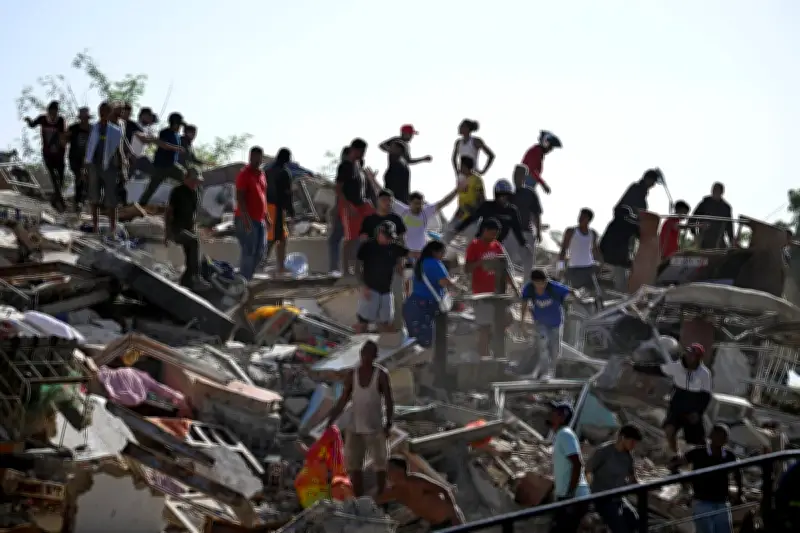
The 7.3-magnitude quake and its aftershocks hit the northern coastal region of Venezuela on Tuesday, destroying entire neighborhoods in the states of La Guaira, Miranda, and the capital Caracas. According to the Venezuelan government, more than 500 people have been confirmed dead, with over 2,000 injured and an estimated 15,000 displaced. Rescue teams from the three nations arrived within 48 hours, coordinating search-and-rescue operations in collapsed buildings.
“This is a humanitarian crisis that transcends politics,” said Dr. Maria Elena Rodriguez, a spokesperson for the Venezuelan Civil Protection agency. “We are grateful for the swift response from all countries, regardless of their historical tensions.”

Unlikely Alliance: US, Cuba, and Iran
The involvement of the US, Cuba, and Iran is particularly striking given their adversarial relationships. The US and Cuba have had strained ties for decades, while Iran and the US are at odds over nuclear and regional issues. Yet, all three nations dispatched specialized rescue teams, medical personnel, and supplies. The US sent a 100-person urban search-and-rescue team from the Florida-based International Response Team, along with $2 million in emergency aid. Cuba deployed 120 doctors and disaster specialists from its Henry Reeve Brigade, a medical team known for international missions. Iran contributed a 50-person relief team and 20 tons of food and medicine.
“We have put aside our differences because saving lives is the priority,” said a US State Department official who spoke on condition of anonymity. Cuban Foreign Minister Bruno Rodriguez echoed the sentiment, stating, “Human solidarity knows no borders.”
Global Coordination and Logistical Challenges
The rescue operation is being coordinated by the United Nations Office for the Coordination of Humanitarian Affairs (OCHA), which has set up a joint command center in Caracas. However, logistical challenges remain, including damaged roads, power outages, and a shortage of heavy equipment to clear rubble. The Venezuelan government has declared a state of emergency and is appealing for additional international assistance.
According to OCHA, at least 30 countries have offered aid, but the US-Cuba-Iran collaboration is the most visible. “This is a test case for how rival nations can work together in a disaster,” said Dr. James Peterson, a disaster response expert at the University of Miami. “If successful, it could set a precedent for future humanitarian cooperation.”
Impact on Regional Politics and Future Cooperation
The disaster has temporarily shifted focus away from political tensions. Analysts suggest that the joint effort could have long-term implications for US-Cuba relations, which have been slowly thawing under the Biden administration. Similarly, Iran’s participation may open a channel for dialogue on other issues. However, experts caution that the cooperation is likely to be temporary and issue-specific.
“This doesn’t mean the US and Iran are about to become friends,” said Dr. Lina Khatib, director of the Middle East Institute at SOAS University of London. “But it shows that even adversaries can cooperate when the stakes are high enough.”
Ongoing Rescue and Recovery Efforts
As of Thursday, rescue teams had pulled 87 survivors from the rubble, but hopes of finding more are fading. The focus is shifting to providing shelter, clean water, and medical care for the displaced. The Venezuelan government has set up temporary shelters in schools and sports stadiums, but many remain without basic necessities.
The international community has pledged further support, with the European Union announcing €3 million in humanitarian aid. The World Health Organization is also sending emergency medical kits to prevent disease outbreaks. For now, the unlikely alliance of the US, Cuba, and Iran remains a symbol of what can be achieved when humanity comes first.