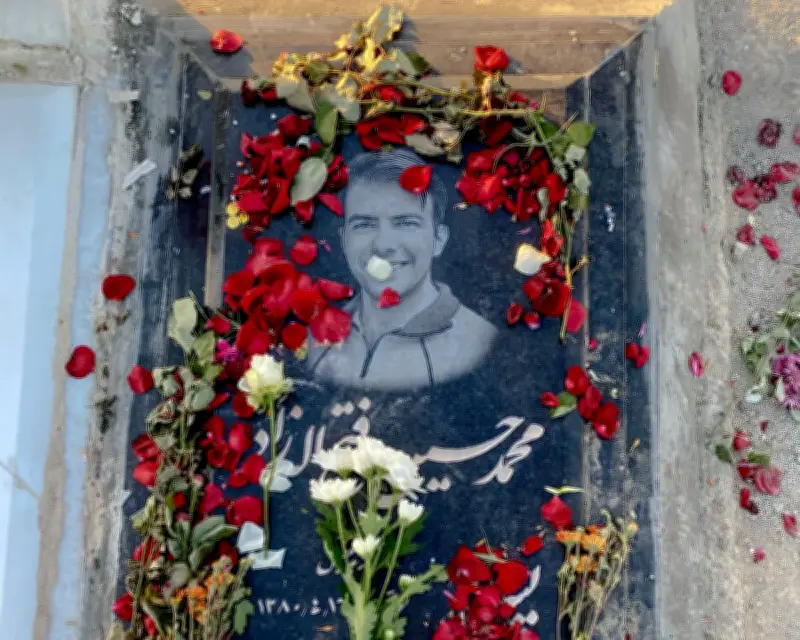
Six months after Iran's bloody crackdown on anti-regime protesters, families continue to gather at Behesht-e Zahra cemetery in Tehran, mourning loved ones and sharing their stories of loss and resilience. The graves of those killed in January's mass street protests serve as focal points for grief and defiance.
Sepehr: A Father's Cry Immortalized
Sepehr, 25, was shot and killed during the January protests in Kahrizak. His father became widely known after a video recorded on his phone showed him repeatedly calling, "Sepehr-e Baba, where are you?"—an intimate Persian address. Those words are now engraved on Sepehr's gravestone. At the grave, his father spoke with courage, gesturing to the crowd and saying, "I'm waiting for these people to fall. Don't doubt it—they're already gone. This regime will not go back to what it was before."
Mohammadreza: A Sister's Hope for Change
Mohammadreza, 38, was killed in Tehransar. His elderly mother, wearing a pale blue headscarf, said, "I cursed [Ali] Khamenei. I was very happy when they [US/Israel] killed him. But my heart aches for these children of ours." His sister noted that his wife sleeps hugging his pillow and his son kisses his grave and cries. She plans to write "javidnam" (Farsi for "everlasting name") on his gravestone but fears police may break it, as they have others. "God willing, by next Nowruz [March 2027] these pieces of shit will be gone," she said.

Sara: A Viral Attack Remembered
Sara, 45, was killed during the protests after being attacked by plainclothes security forces with machetes, captured on CCTV. Her gravestone includes the word "darya" (sea), symbolizing eternity. A nearby woman at her own relative's grave said, "I wish they had seen Khamenei's death. Let those bastards go to hell."
Mohammad: A Boxer's Final Stand
Mohammad, 28, was killed in Ariya Shahr after intervening to save two girls from Basij paramilitary forces. His brother recounted, "Four or five Basijis had surrounded two girls. My brother and his friends beat them and helped the girls escape. But then the Basijis surrounded them on motorbikes and shot him three times." His brother described seeing bodies with headshots and finishing shots. A nearby grave held five unidentified people buried together.
Ali: A Goalkeeper Without a Gravestone
Ali, killed in Moshiriyeh, still has no gravestone due to his family's financial struggles. His father, missing several teeth, said, "My son was a footballer. He was 2 metres tall. A goalkeeper." His mother, wearing a long black manto, smiled softly and thanked visitors. A friend said, "My friend is under the ground and I'm alive."
Danyal: A Father's Anguish
Danyal's father described searching through body bags at the morgue, which were full of bodies. "At one point I lost hope. I said: 'That's enough, leave it,'" he wept. His aunt recounted seeing a naked girl in an open body bag, exclaiming, "You killed so many people over a few strands of hair, and now you've left her here like this?" Security forces pressured the family to declare Danyal a martyr of a terrorist attack, which they reluctantly accepted for the sake of his surviving son.
Across Behesht-e Zahra and other cemeteries, families of the unknown dead sit alone at graves, their grief overshadowed by fear of arrest. Recognition brings some comfort but also danger, as security forces constantly threaten and watch.