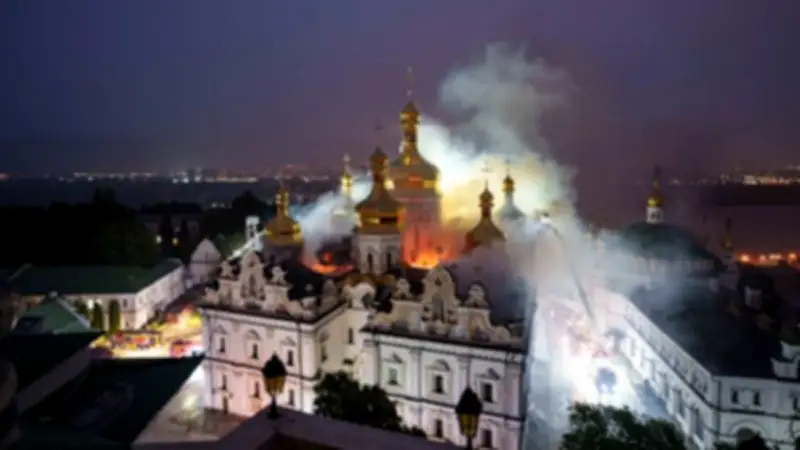
Rescue workers rushed to extinguish a fire at the Dormition Cathedral within the thousand-year-old Monastery of the Caves, known as the Kyiv Pechersk Lavra, following a Russian drone strike on Kyiv on Monday, June 15. The attack, part of a large-scale assault on the Ukrainian capital, set the historic cathedral ablaze, prompting monks, clergy, and rescuers to hurriedly evacuate ancient and sacred items from the burning structure.
A Symbol of Ukrainian Identity Under Attack
The Dormition Cathedral has long served as a symbol of Ukrainian cultural identity. This strike is widely interpreted as a Russian attempt to eradicate Ukrainian identity by targeting a site of profound spiritual importance. The cathedral had already suffered damage in a Russian attack earlier this year. Russia's ongoing targeting of Ukrainian heritage sites highlights its inability to achieve meaningful gains on the battlefield, suggesting a growing desperation to demoralize Ukrainian civilians and people of faith.
Historical Significance of the Kyiv-Pechersk Lavra
The Kyiv-Pechersk Lavra is a cornerstone of Ukrainian ancient heritage, Orthodox influence, and a refuge for the faithful. Founded in 1051 by the monk Anthony and his disciple Theodosius during the reign of Yaroslav the Wise, it is the oldest monastic complex of Kyivan Rus, the first East Slavic state. The complex expanded over centuries with funding from various leaders. The Dormition Cathedral was completed in 1078 but suffered damage during conquests, including the Golden Horde siege of Kyiv in the 13th century.

A remarkable feature of the site is its vast underground network of caves—pechersk derives from the Ukrainian word for caves. These caves served as a holy retreat for monks, with the most devoted buried there. The site also houses ancient religious texts, publications, woodwork, and iconography. Over centuries, it became a base for spreading Orthodox faith and a place of refuge for monks. Today, parts of the site remain consecrated for religious practice, especially the Dormition Cathedral.
For many Ukrainians, the Kyiv-Pechersk Lavra stands as proof that Ukraine descends from Kyivan Rus, not modern Russia. While Ukraine and Russia share some common history, the Russian Empire, the Soviet Union, and today's Russia have tried to claim Kyivan Rus history as their own. This monastery symbolizes a rejection of that monolithic historical narrative.
A History of Religious Struggle
My research into Ukrainian religious history highlights that the complex's survival represents Ukrainian historical and current resistance against Russian oppression. The rise of Russian Orthodox authority, tsarist expansionism, and Russification policies have long oppressed Ukraine. Constantinople formally approved Russian authority over Ukrainian Orthodoxy in 1686, a control that lasted until 2019 when a new Orthodox church in Ukraine gained independence from Moscow. Thus, Russia's targeting of sites like this cathedral is part of a centuries-long effort to erase Ukrainian religious identity.
From World War II to the Present
The last time the monastery experienced vast ruin was in 1941 during Nazi occupation, when it was destroyed by mines believed left by retreating Soviet forces. The Kyiv-Pechersk Lavra gained UNESCO World Heritage status in 1990. The Ukrainian government rebuilt the Dormition Cathedral from 1998 to 2000. From 1988, the site was used by the Ukrainian Orthodox Church of the Moscow Patriarchate under lease. After 2009, Russia began tying religious politics to neo-imperialist ideology. Russia's occupation of parts of the site aimed to control Ukrainian self-determination and religious freedom. Since January 2023, all worship has been conducted under the Orthodox Church of Ukraine, which split from Moscow in 2019.
Targeting the Kyiv-Pechersk Lavra now is no coincidence. Russia's Orthodox Church, led by Patriarch Kirill, has described the invasion as a holy war. Even the burial of Yury Dolgoruky, Prince of Kyivan Russia and founder of Moscow, at the site did not deter the attack. This bombing demonstrates Russia's growing urgency to erase Ukrainian history and identity.