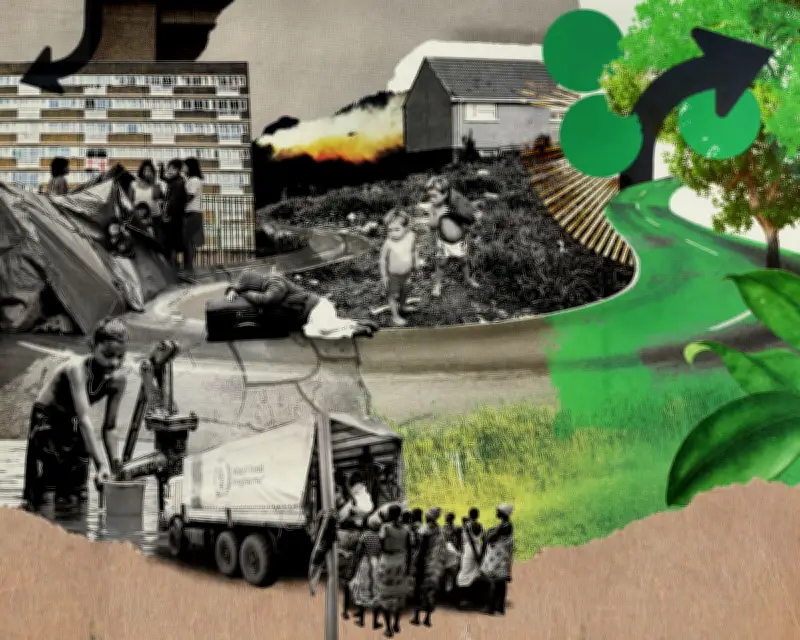
In a world of unprecedented wealth, roughly one-tenth of the global population still lives in extreme poverty. Millions lack adequate food, housing, and healthcare, while a tiny minority amasses enormous fortunes. Simultaneously, droughts, megafires, floods, and heatwaves underscore that our economies are pushing the planet beyond its limits.
These crises are not separate. They are symptoms of an economic model that has reached its limits. Poverty and inequality are not accidents but predictable outcomes of policy choices: tax systems, labor market regulations, care valuation, public service structures, and whose needs matter. If governments can manufacture poverty, they can dismantle it.
For decades, the recipe was simple: grow the economy, and poverty would disappear. But growth has not lifted all boats. While national incomes expanded, wages stagnated, work became precarious, and public services were cut. Fortunes ballooned at the top, while families turned to food banks. Growth has become decoupled from shared prosperity.

It has also become ecologically unsustainable. We are nearing a "hothouse Earth" as emissions and biodiversity loss destabilize life-support systems. About 92% of excess global carbon emissions come from the global north, and the wealthiest 10% produce nearly half of global emissions, while the poor face crop failures and rising food prices. An economy dependent on endless expansion on a finite planet is dangerous.
Many low-income countries still need growth for infrastructure, renewable energy, and decent jobs. But the dominant growth path—based on resource extraction, cheap labor, export dependence, and deepening debt—has widened inequality and degraded the environment. The real question is what kind of economies we build, who they serve, and whether they allow dignity within planetary boundaries.
That is why we have developed the "roadmap for eradicating poverty beyond growth." It offers alternatives to the narrow "grow-tax-transfer" approach. Over 18 months, more than 400 people from UN agencies, governments, academia, civil society, trade unions, and grassroots movements worked to answer: how can we end poverty and reduce inequalities without treating GDP growth as the primary condition for progress? Over 350 signatories, including Jean Drèze, Pavlina Tcherneva, and Tim Jackson, have endorsed it.
We do not agree on every detail, but we are united in the conviction that economies must be redesigned around rights and collective wellbeing within planetary boundaries. Human rights are the organizing principle for measuring progress, setting priorities, and resolving trade-offs. Social protection and public services cannot indefinitely compensate for economies that generate poverty wages, insecure jobs, and unaffordable housing.
We need to change the rules upstream. This includes decent work and employment guarantees, living wages, stronger unions, workplace democracy, and valuing care work. It means investing in children, housing, health, education, and transport through universal public provisioning. It requires public control of strategic assets, credit guidance for social and ecological priorities, and support for the social and solidarity economy.
Implementing this vision means changing global economic rules. Today, global south governments are criticized for not tackling poverty while being squeezed by sanctions, restrictive trade agreements, unequal exchange, and debt burdens rooted in colonial dispossession. About 3.4 billion people live in countries spending more on debt servicing than on healthcare or education. Global supply chains enable a net transfer of labor and resources from south to north. International solidarity is a legal and moral obligation, rooted in the historical reality that rich countries built wealth by impoverishing the south through extraction that continues today. A just transition must include debt justice, south-south cooperation, reparative climate finance, and support for universal social protection floors, based on non-domination and self-determination.

Equally crucial is who shapes this transition. Policies affecting people in poverty are often designed without them—and sometimes against them. Welfare systems built on suspicion and sanctions deepen stigma. Those living in poverty know how systems fail; their expertise must guide anti-poverty strategies from local councils to international forums.
We are not starting from zero. Indigenous struggles, feminist organizing, trade unions, and climate justice movements are building alternative futures. New coalitions of states are advancing new visions of global economic governance, and governments are experimenting with rights-based anti-poverty strategies, citizens' assemblies, and community wealth building. The UN and partners are exploring beyond-GDP indicators and new institutions, such as an international panel on inequality.
Our roadmap builds on these efforts, connects them, and pushes them further. We offer it as a common reference point for those who refuse to accept that poverty and ecological breakdown are the price of current economic "success." Governments and multilateral institutions have a choice: double down on a failing growth-first model or commit to eradicating poverty by transforming the rules that produce it.
Poverty is manufactured. That is the bad news and the good news. What has been manufactured can be dismantled and replaced. We put concrete options on the table, backed by detailed policy profiles with evidence and real-world examples. We call on political leaders at all levels to use them, listen to those most affected, and treat the end of poverty, reduction of inequalities, and realization of human rights as the measure of economic policy.
Olivier De Schutter is chair of New Economies for Eradicating Poverty; Joseph Stiglitz is a Nobel laureate in economics; Jayati Ghosh is professor of economics at University of Massachusetts Amherst; Thomas Piketty is professor at Paris School of Economics; Kate Raworth is an economist at Oxford University's Environmental Change Institute; Jason Hickel is author of The Divide: A Brief Guide to Global Inequality and its Solutions.