The Guardian's global tech reporting team has increasingly turned its attention to the physical world of AI datacentres, moving beyond screen-based coverage to investigate the tangible infrastructure powering the AI revolution. This shift has led to revelations about misrepresented renewable energy plans, local tensions, and the sheer scale of these developments.
Investigation Reveals Misleading Claims in Scottish AI Complex
Earlier this week, the Guardian published an investigation into an £8.2bn AI complex in rural Scotland, revealing that its plans to be powered entirely by on-site renewables were misrepresented. Aisha Down, who covers AI for the Guardian, trekked around Lanarkshire to visit potential datacentre sites, spoke with local residents, examined public records, and obtained internal documents. 'Our reporting is showing that you can't simply wave a magic wand and have a datacentre appear,' Down said. 'There are a lot of huge physical constraints and reality checks. These physical, tangible things are what makes or sinks the AI boom.'
Physical Constraints Challenge AI Boom
The investigation highlights the growing intersection of tech reporting with energy and environment stories. Down noted that her work involved interrogating the reality of infrastructure proposals, including whether datacentres are feasible, energy and water commitments are genuine, and promised job creation is real. In a similar investigation earlier this year, she found that a site outside London slated for an AI supercomputer complex was still being used as a scaffolding yard. Dan Milmo, the Guardian's global technology editor, published an article about the number of large datacentre projects worldwide being challenged or cancelled. 'I remember going out to a site in Wales that was about as well-organised and well-funded as you can get, and I still got a sense of how difficult it is for tech companies to pull off these big infrastructure projects,' he said.

Scale and Sensory Impact of Datacentres
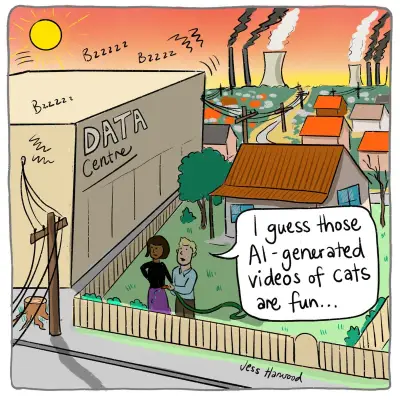
Blake Montgomery, the Guardian's US tech editor, emphasised that the AI boom has radically changed the physical presence of tech companies. 'These AI datacentres are some of the most massive and complex structures that humanity has created,' he said. 'So we're now also reporting on physical infrastructure and real places that exist, not just the digital landscapes in the more social media-focused era of tech reporting.' The sheer scale of these developments is accompanied by a sensory assault. Last month, Down visited Slough, home of the largest datacentre park in Europe, to experience the sweltering heat-island effect. Some research suggests that temperatures in the immediate vicinity of datacentres can increase by an average of 2C, and as much as 9C. 'It was baking hot and there was this audible whine. If you were sleeping or working nearby everyday, I think it'd wear you down,' she said. Robert Booth, the UK technology editor, experienced even louder volumes when reporting on mammoth datacentres in Santa Clara, Silicon Valley. 'They call those datacentres screamers because they're louder than an aircraft taking off,' he said. 'I had to pack my ears with protection and, even with that, I was still left with ringing ears.'

Local Tensions and Backlashes
Local tensions and backlashes against datacentres are a big part of today's tech story. Last week, the Guardian published an interview with Erin Brockovich about her work helping communities affected by datacentres' impact on energy and water resources. Dan Milmo noted that protests against datacentres are becoming a manifestation of voter and public concern about tech and AI. 'It's very difficult for people to protest against technology or to make tangible their feelings about things that are transmitted over the internet. But while it's hard to protest against ChatGPT and what it means for your undergraduate kids' employment prospects, it's easier to protest against the infrastructure that facilitates its existence and how that infrastructure functions,' he said. Milmo pointed to key turning points such as the inquest into the death of Molly Russell, a London teenager who died after being overwhelmed by online content. In the US, tech reporters have attended courtroom hearings about social media's physical and emotional harms, with further cases on the horizon. The UK has announced a ban on social media for under-16s, following a ban introduced in Australia last year. Last month, Milmo went to west London to interview children and teenagers about the ban. 'I was struck by how I hadn't heard enough of those voices, and I personally hadn't written enough about what these children think and how important their perspective was,' he said.
Shoe-Leather Reporting Essential
Booth emphasised that shoe-leather reporting is essential for covering the AI revolution. 'It's only really possible by getting out and reporting on the pace of change, the tensions it creates, how it impacts people. I've also gone to kids' clubs to see how children are grappling with AI. It's a really important part of the job to make sure we're reporting from somewhere rather than from the digital ether,' he said. Aisha Down suggested that the shift reflects a broader interest in reality. 'Perhaps because unreality has become so pervasive, reality has become a lot more interesting to people. Did a child harm themselves because of their social media feed? How hot is it next to a datacentre? People are now more interested in those kinds of stories,' she said.