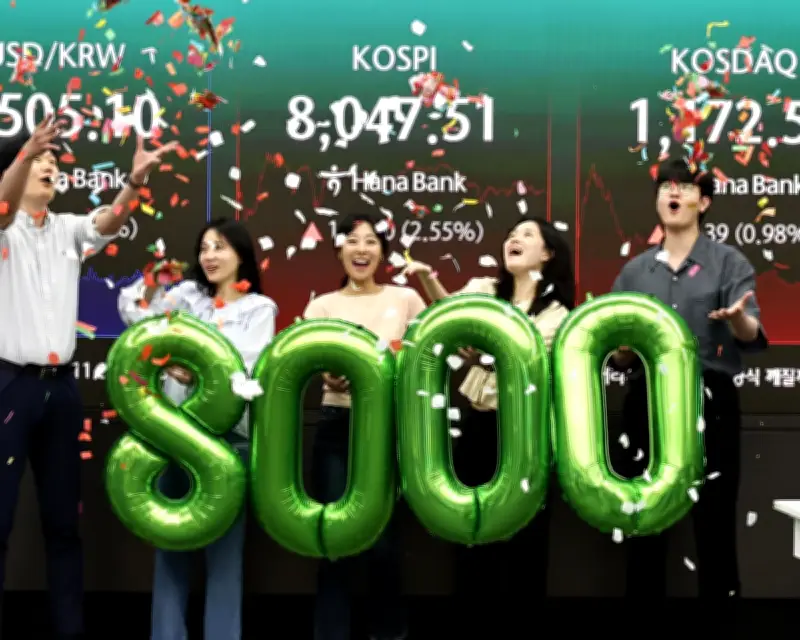
South Korea's Kospi stock market has surged past the 8,000-point milestone, reaching an all-time high of 8,880 on 26 May 2026, driven by a 'once-in-a-generation surge' in semiconductor earnings fueled by artificial intelligence demand. The rally has propelled South Korea to become the world's sixth-largest share market, overtaking India, the UK, Germany, and France. However, experts caution that the market's heavy reliance on two chipmaking giants—Samsung Electronics and SK Hynix—poses risks of a boom-bust cycle.
Trillion-dollar chipmakers lead the charge
SK Hynix joined Asia's trillion-dollar company club last week, alongside Samsung Electronics and Taiwan's TSMC. SK Hynix's share price skyrocketed 1,000% over the past year, while Samsung soared 500%. The explosive demand for AI chips has propelled these companies past the $1 trillion valuation threshold. The Kospi index capped a 220% rise in 12 months, with Goldman Sachs raising its 12-month target to 9,000.
Global market reshuffle
South Korea and Taiwan's stock markets have vaulted over India in a reshuffle of the global pecking order. Japan's Nikkei 225 also hit an all-time high, with SoftBank Group overtaking Toyota as Japan's most valuable listed company. Peter Kim, global investment strategist at KB Securities, described a 'dramatic shift' from platform investments to hardware, as AI drives demand for chips.

Nvidia, the world's first $5 trillion company, outsources chip production to TSMC in Taiwan. Nvidia CEO Jensen Huang visited Taiwan in late May, announcing plans to invest $150 billion annually in the region, which he called the 'epicentre' of the AI revolution. He is due to visit South Korea this week.
Concerns over concentration and volatility
Despite the rally, analysts warn of an AI bubble. Russ Mould, investment director at AJ Bell, noted that share price charts of Samsung, SK Hynix, and Micron resemble those of companies during the 2000 tech bubble. The chip sector has a history of volatility, but Mould believes AI demand may have ended those cycles.
Kim's research indicates Samsung and SK Hynix contributed up to 70% of the Kospi's growth in 2026, an unprecedented concentration. The Kospi's VIX volatility index hit 75 this week, historically hovering around 20. Ipek Ozkardeskaya, senior analyst at Swissquote, said the spike indicates investors are 'buying in panic, scared to miss out on something big.'
Kim added that traditional institutional investors once believed Asia 'picks up the scraps' from the US, but that sentiment has shifted. However, the Kospi remains highly exposed to global AI spending cycles and supply chain issues.