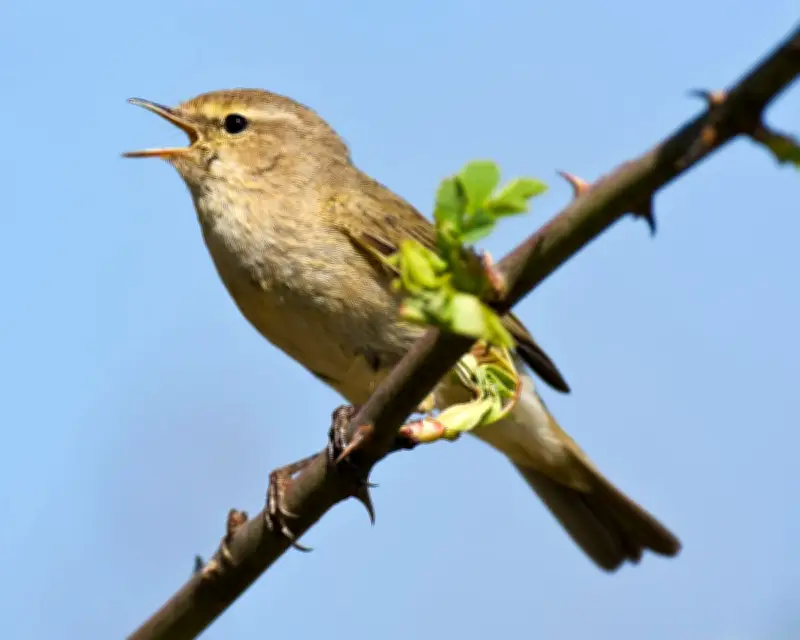
The Merlin bird identification app will soon allow users to automatically contribute real-time bird identifications to one of the world's largest citizen-science biodiversity projects, a move expected to aid conservation of at-risk bird species.
Since 2021, the free Merlin app, developed by the Cornell Lab for Ornithology, has used machine learning to provide near-instantaneous sound identification for birdsong, displaying an image for each species identified. In a forthcoming update, the app will automatically collect and upload species detections to the global online database eBird, which already holds more than 2 billion bird observation records.
Declining bird populations and Merlin's reach
In the UK, the total bird population has declined by over 70 million individuals in the past 50 years, according to the British Trust for Ornithology. Nearly 2 million people in the UK used Merlin in May this year to identify birds in gardens, woodlands, and countryside. Different birdsong patterns create distinct spectrograms, and Merlin has been trained to recognize these shapes and assign them to species.

Cornell also operates the eBird platform, launched in 2002, which gathers millions of bird observations from citizen scientists, building one of the world's largest environmental science databases.
Integration with eBird
Jessie Barry, one of the leaders of the Merlin project, said: “The eBird mobile app will soon have the ability to upload recordings, which can be recorded in Merlin. Upcoming feature developments will make an even better link to the eBird systems so that we can use the data from what users ‘hear’ with Merlin to monitor bird populations. This data helps create tools that can be used to further conservation, inspire support and inform ecological management strategies.”
Currently, Merlin can identify 2,066 bird species, covering most birds in the US, Canada, and Europe, as well as common and widespread species in India, Central America, and South America. “It is always an ongoing project to collect additional species. There’s a few we would like to add but we are always adding more and improving the performance of the models,” Barry added.
User growth and global impact
The app has been downloaded more than 40 million times across 240 countries, up from 33 million downloads as of December last year. Britain has the second highest total number of users, with nearly 2 million on the app in May this year. Canada, Germany, France, Spain, and the Netherlands are among the top 10 countries with the highest usage.
The Merlin app is praised for connecting more people to nature and supporting conservation efforts. However, concerns persist about misidentification. The European Bird Census Council recommends against using Merlin in official breeding bird surveys and has set up a monitoring group to coordinate acoustic bird monitoring across Europe.
Expert perspectives and caution
Prof Richard Gregory of the RSPB said it was very positive that Merlin was connecting people with nature, but warned the app had identified his dachshund as a mallard. “If you aren’t an expert, you wouldn’t necessarily know there was an error,” he said. “It is interesting to hear that Cornell is making changes which mean that recordings from Merlin will go to eBird more easily, so that’s great if the species recognition is correct [but] a problem for conservation when it is not.”
Moira Forsyth, a Merlin user from Muir of Ord in Scotland, said she used the app alongside other identification methods. “We have been astonished to discover we had a much wider range of birds here than we thought,” she said. “Armed with the app, the RSPB book of Scottish birds, my trusty old copy of Collins Complete British Wildlife and the binoculars we keep on the kitchen windowsill, we are getting a bit better at this.”
Data quality and future direction
Barry acknowledged that research teams using these data sources would address challenges with data quality. “Our ability to understand changes in bird populations will be better served with more data to work with than if we don’t collect it at all,” she said.