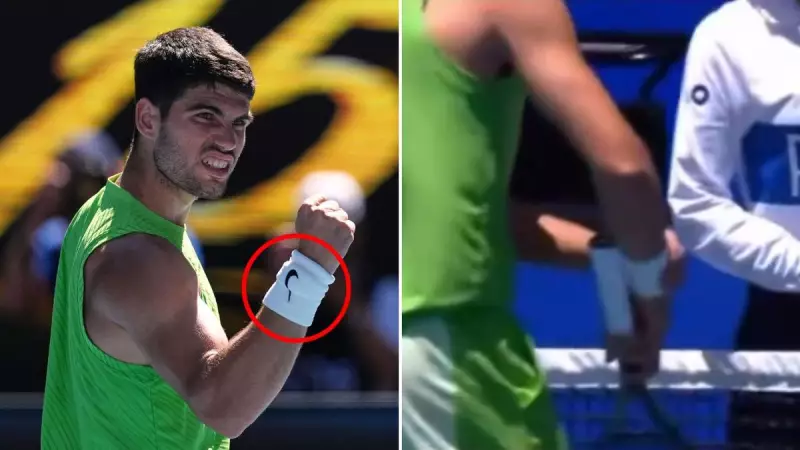
A significant controversy has erupted at the Australian Open after world number one Carlos Alcaraz was instructed to remove his fitness tracking band during his fourth-round match on Sunday. The incident has ignited a heated debate regarding athlete data rights and the approval of wearable technology in professional tennis.
Match Interruption Over Wearable Device
Carlos Alcaraz secured a hard-fought victory over American Tommy Paul with a score of 7-6 (8-6) 6-4 7-5 at Rod Laver Arena, avenging two previous defeats. This win sets up a highly anticipated quarter-final clash against Australian hope Alex de Minaur on Tuesday.
However, the match began under unusual circumstances when chair umpire Marija Cicak requested that Alcaraz remove his Whoop band. The device was concealed beneath his sweatband, a practice the Spaniard had maintained throughout earlier tournament matches. Alcaraz complied without protest, but the incident did not go unnoticed.

Similar Incident With Women's Top Player
Earlier on Sunday, women's world number one Aryna Sabalenka faced an identical request to remove her Whoop band before her match. Veteran tennis commentator Mark Petchey clarified the situation, stating, "You're not allowed to play with a Whoop watch here or anything that monitors your vitals or anything else."
Whoop Founder's Strong Response
Will Ahmed, founder of Whoop, swiftly responded on social media platform X, asserting that the device has official approval. "Whoop is approved by the International Tennis Federation for in-match wear and poses no safety risk," Ahmed posted. He added a powerful statement: "Let the athletes measure their bodies. Data is not steroids."
Understanding the Whoop Band Technology
Whoop bands are screenless wearable devices designed to monitor an athlete's physiological data, including:
- Recovery metrics
- Physical strain levels
- Sleep patterns and quality
The device focuses exclusively on health data and does not function as a timepiece. However, its capability to transmit data in real-time may have prompted officials to intervene, despite the device appearing on the International Tennis Federation's list of approved equipment.
Whoop's Official Statement on Athlete Rights
The company released a formal statement defending athletes' access to their personal health information. "WHOOP believes athletes have a fundamental right to understand their own performance and health – including during competition at events like the Australian Open," the statement read.
It continued: "WHOOP is approved by the International Tennis Federation for in-match wear and poses no safety, fairness, or competitive risk. Blocking access to personal health data does not protect sport. WHOOP will continue to stand with athletes and our members to defend their right to their data."
Official Silence and Historical Context
Neither Alcaraz nor Australian Open officials have commented publicly on the matter following the match. At just 22 years old, Alcaraz remains focused on his pursuit of tennis history, with one final opportunity to surpass American Don Budge as the youngest male player to achieve a career grand slam.
Alcaraz's Serve Adjustment and Djokovic Banter
The two-time Wimbledon, French Open, and US Open champion revealed he has modified his service action in pursuit of completing the grand slam, even if it meant adopting techniques reminiscent of his great rival Novak Djokovic.
"To be honest, I wasn't aware that it was really similar to Nole's," Alcaraz admitted with amusement. He shared that Djokovic had sent him a playful message: "Novak's like 'Wait, that's my serve. He's gonna have to pay me some money for that serve.'"
Alcaraz continued: "I just woke up and I took out my phone and had, you know, a Djokovic message. Like, 'All right, you have to pay me for the serve before the season'. Yeah, yeah, he sent me the message, so it was fun. I mean, these kind of things in the locker, it's fun to share with another player. It's especially fun when it works out and you're serving better."

The fitness band controversy adds an unexpected dimension to what promises to be an electrifying quarter-final round at Melbourne Park, raising important questions about technology, regulation, and athlete autonomy in modern professional sports.