Jessica Hull to Star as Australian Athletics Faces Selection Storm
Middle-distance sensation Jessica Hull is poised to spearhead a formidable Australian team at this week's world indoor championships in Poland, yet the squad's composition has ignited fresh controversy over selection policies. Hull will compete in both the women's 1500m and 3000m events, with Linden Hall joining her in the latter, while Adam Spencer stands as the sole male representative in the men's 1500m.
Anstey's Omission Sparks Outcry Among Peers
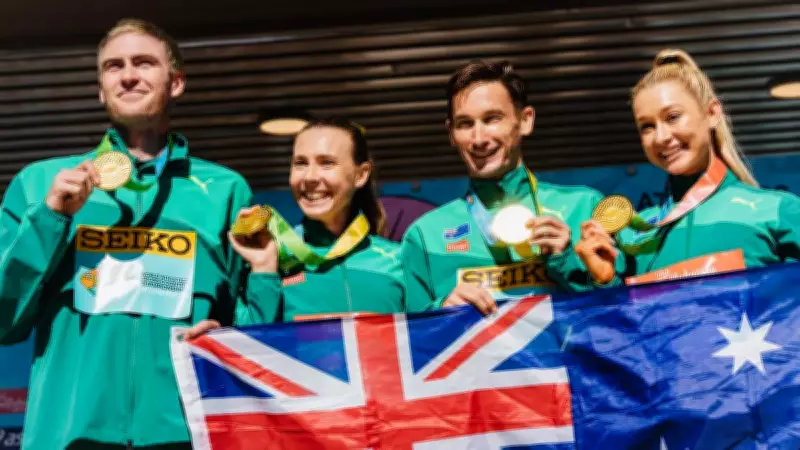
Notably absent is Jack Anstey, who partnered with Hull, Hall, and Ollie Hoare to clinch gold in the 4x2km mixed relay at the world cross country championships in January. Despite posting times comparable to Spencer's, Anstey was overlooked for selection, a decision that has drawn sharp criticism from fellow athletes.
In a statement supported by several top Australian runners, Anstey expressed his disappointment, highlighting that he met World Athletics' quota and qualifying standards. "I'm well within the athlete quota based on the ranking system, and I've run under the World Athletics qualifying standard in all three of my 1500m/mile races this season," the 28-year-old wrote. He argued that Athletics Australia's custom policy, which prioritizes success at the 2026 Commonwealth Games, undermines fair qualification frameworks and hampers athlete development.
Anstey's sentiments resonated widely, with teammates like Ollie Hoare offering encouragement: "Onwards and upwards. Good fuel for the fire mate." Cameron Myers added, "Gutted for you mate, you earned it," while Lauren Ryan urged, "Get this guy his Australian jersey!!" The backlash underscores ongoing tensions within Australian athletics over transparent and equitable selection processes.
Selection Policy Under Scrutiny
Athletics Australia's selection criteria for the world indoor championships emphasize choosing athletes with medal potential and alignment with future goals, such as the 2026 Commonwealth Games. The policy grants selectors broad discretion, stating they may consider any relevant factors, effectively allowing them to override standard qualifications.
Both Anstey and Spencer have achieved the world indoor championships' 3:36.00 standard, but neither has yet met the stricter 3:33.00 marker for the Commonwealth Games this season. This discrepancy has fueled debates about the fairness and consistency of the selection approach.
Lisa Weightman, who faced her own selection battles for the Paris 2024 Olympics, voiced support for Anstey, recalling her fight for adherence to World Athletics systems. "I fought hard in 2024 for Australian Athletics to follow the World Athletics system and the policy in which they wrote," she noted, adding that despite winning an appeal, recommendations were ignored.
Australian Squad Highlights and Ambitions
Beyond the controversy, Australia's team boasts strong contenders across multiple events. Hull aims to upgrade her bronze medals from last year's indoor and outdoor world championships, while world No.1 high jumper Nicola Olyslagers seeks a third consecutive world indoor title. Olyslagers, who triumphed in Glasgow two years ago and secured Olympic silver in Paris, is coming off a stellar 2025 season with wins at major events.
Eleanor Patterson will challenge in the high jump, and pole vaulter Kurtis Marschall, recently joining Australia's elite six-metre club, is confident of medal contention. "If I can put myself in the position to jump as high as I can, I am definitely in medal contention," Marschall stated, acknowledging the competitive field.
The full Australian team for the world indoor championships includes:
- Women's 800m: Hayley Kitching
- Women's 1500m: Jessica Hull
- Women's 3000m: Linden Hall, Jessica Hull
- Women's 60m Hurdles: Michelle Jenneke
- Women's High Jump: Nicola Olyslagers, Eleanor Patterson
- Men's 800m: Bob Abdelrahim, Peter Bol
- Men's 1500m: Adam Spencer
- Men's Long Jump: Liam Adcock
- Men's Pole Vault: Kurtis Marschall
As the championships unfold, the focus will be on both athletic performance and the broader implications of selection policies for Australia's sporting future.