Frustrations are mounting over the AFL's new interpretation — or lack thereof — of the high contact rule. The league tightened the rule ahead of the 2026 season, announcing that players with the ball who are tackled high but have contributed to the tackler's high contact by dropping down will no longer be awarded a free kick.
Players had become adept at drawing free kicks by dropping their knees or lifting their shoulders, prompting the AFL to introduce the refined interpretation to protect players and discourage them from playing for free kicks.
However, after a first half filled with high contact free kicks in the Western Bulldogs' clash with Fremantle on Friday night, commentator James Brayshaw expressed doubt that the rule tweak was working.

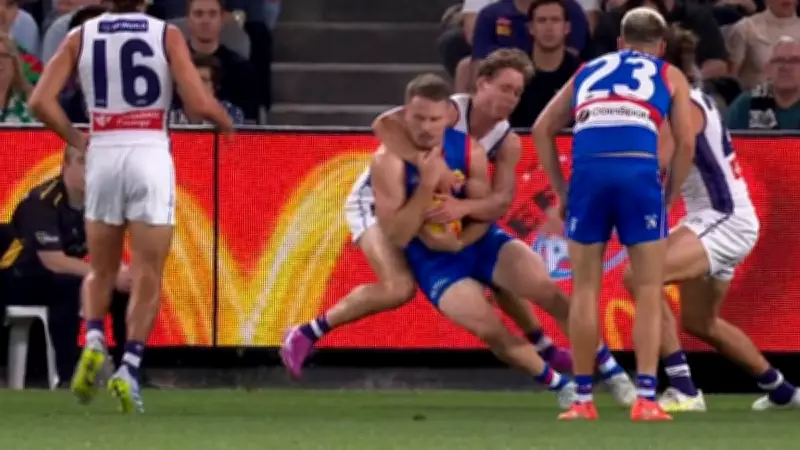
"That was the 11th high contact free kick inside a half of football," Brayshaw said when Bulldogs forward Arty Jones won a free kick on the wing. "We were told (in the) pre-season they were going to officiate this differently. The evidence is not showing that."
Moments later, Bulldogs forward Will Lewis earned a shot at goal from a high contact free kick inside 50 after appearing to lower his centre of gravity to draw the whistle, precisely the action the AFL had aimed to legislate against.
"That's the lowering of the centre of gravity, they're the ones that we were told would be looked at a little bit differently," Nick Riewoldt said. "I'd like that to be your prior opportunity. If you're going to drop like that, I reckon that should be holding the ball. It just makes it impossible for the tackler who's coming in to execute the tackle and you drop — he's got no choice but to get you high."