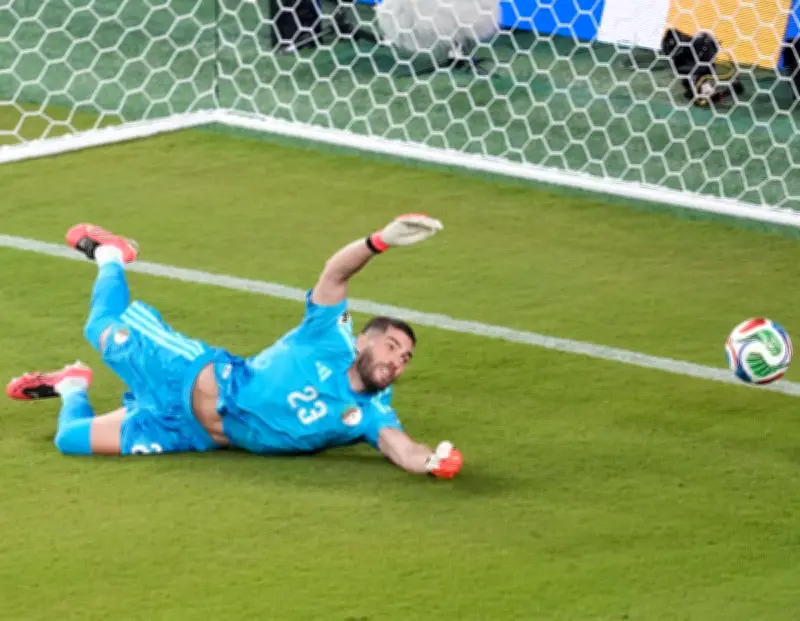
Algeria goalkeeper Luca Zidane has endured a turbulent start to the 2026 World Cup, conceding five goals in two matches, including two that slipped through his fingers—first from Lionel Messi and then from Jordan's Nizar al-Rashdan. While Zidane has likely received support from his father, the legendary Zinedine Zidane, his struggles are not unique. Senegal's Édouard Mendy and Iraq's Ahmed Basil have also failed to stop shots they got hands to, raising questions about the tournament ball.
Joe Hart's Concerns Echoed by Academic Study
Former England goalkeeper Joe Hart, now a BBC pundit, has frequently highlighted issues with the Adidas Trionda ball. 'The ball is coming into the keepers a lot faster than it feels when it comes off the foot,' Hart said. 'Zidane is more than capable of saving that ball [from Messi]. When goalkeepers get up to speed with these World Cup balls we’re going to see these shots saved.' Hart's assessment came before Zidane's second match, where al-Rashdan's outside-of-the-boot effort again beat the keeper.
A new academic paper provides scientific backing for Hart's observations. Titled 'Orientation-Dependent Drag Crisis and Flight Response of the Fifa World Cup Match Ball Trionda,' the 18-page study by researchers from Seoul Women’s University and the University of Tsukuba examines the ball's aerodynamics. The team fired the Trionda through a wind tunnel from six angles and found a consistent outcome: at a certain velocity, the ball experiences a 'drag crisis,' causing it to fly faster than expected.

Drag Crisis Explained
Drag crisis occurs when airflow around an object shifts from smooth (laminal) to turbulent, reducing drag and increasing speed. The Trionda's design, with its four-panel construction and deep seams, enables this crisis at lower speeds. The researchers noted that 'upstream seam and groove arrangements' play a key role. The effect varies depending on whether the ball is struck on a seam or panel, with seams creating lower drag. Altitude also influences the crisis, with higher altitudes reducing its likelihood.
Fifa acknowledged the ball's aerodynamic properties at launch, highlighting the four-panel construction—a first for the tournament—and 'intentionally deep seams' for optimal in-flight stability. Adidas stated the Trionda underwent over 300 laboratory tests, ensuring 'a more predictable trajectory,' a nod to the infamous Jabulani ball from 2010, which was criticized by goalkeepers like Iker Casillas and Gianluigi Buffon for erratic flight.
Impact on Goalkeepers and the Tournament
The drag crisis affects both trajectory and velocity, but at the 2026 World Cup in the US, Canada, and Mexico, velocity appears the primary issue. Goalkeepers, caught unawares by balls that do not slow as expected, may benefit from the academic paper now freely available in the journal Fluids. As the tournament progresses, teams may study the findings to adapt their training. For now, Zidane and his peers face a unique challenge from a ball that, according to science, behaves differently at key speeds.