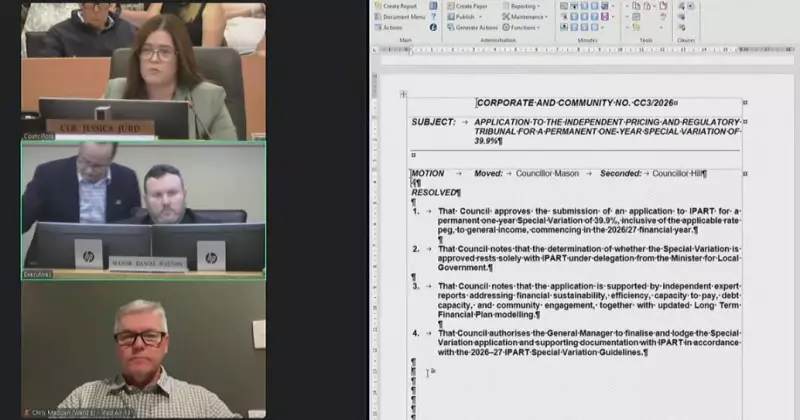
Cessnock City Council has voted to proceed with a controversial application to increase rates by almost 40 per cent, following a heated and lengthy debate on Wednesday, January 14, 2026.
Financial Strain Drives Major Rate Hike Proposal
The council's decision means it will now seek approval from the Independent Pricing and Regulatory Tribunal (IPART) for a special rate variation. If IPART grants the application, the permanent increase could see residential ratepayers paying nearly $600 more in 2027 compared to their 2026 bills. The impact on businesses and farmers would be even more severe, with potential rises of $2,070 and $1,360 respectively.
The push for the increase stems from a financial health check commissioned by the council, which in April 2025 identified "serious financial sustainability challenges." By September 2025, the council had engaged the author of that review, retired economist Professor Joseph Drew, alongside other local government finance experts, to advise on the application to exceed the annual rate peg.

Councillors Clash Over "Feast to Famine" Finances
The vote did not pass without significant dissent and probing questions from several councillors. Councillor Jessica Jurd, a second-term representative of Ward A, challenged the narrative of financial crisis, pointing to previous council statements boasting of a strong surplus.
"Our previous council and mayor said we had a surplus for three years up to September 2024," Cr Jurd stated during the meeting, directly questioning the chief financial officer, Matthew Plumridge. She asked, "Did we actually have a surplus?"
Mr Plumridge explained that while headline surpluses were recorded, they were heavily reliant on capital grants and contributions—income streams that have fallen sharply. An analysis of balance sheets from 2019 onwards reveals a pattern of grant-dependent growth masking an underlying operating loss. For the 2024-25 financial year, the council's core operations reported a $33.8 million deficit, despite a combined headline surplus of $38.1 million.
Councillor Quintin King, a first-term mining mechanic representing Ward B, was "violently opposed" to the proposal. He criticised the council for swinging from one extreme to another, referencing headlines from just over a year ago that suggested the council had "cash to splash."
"I'm the guy that was pointing out we have a deficit issue... But now we've completely gone to another extreme where we want a nearly 40% increase in one hit that's permanent," Cr King argued.
The Case For and Against the Increase
Supporting councillors argued the increase was a necessary, albeit painful, step to secure the council's future. First-term councillor Mark Mason, a banker, conceded there is "never a good time" to raise rates but warned that scrapping the proposal would be tantamount to "putting this noose on the next generation."
He emphasised the critical need to maintain the local road network, which is under strain from rapid population growth. "When roads deteriorate beyond a certain level, the result is complete renewal which costs around 10 times as much as routine maintenance," Cr Mason stated.
The council's long-term financial plan frames the rate rise as essential to funding a significant infrastructure backlog. Without it, the council warns it would face "significantly reducing all maintenance expenditure and pause all new infrastructure work."
CFO Matthew Plumridge highlighted a systemic issue, noting the council's hands are tied by the state government's rate peg system. "While ever the state government doesn't allow us to increase our rates each year by an amount equivalent to our expenditure, there is always a possibility that this will happen in the future," he told the chamber.
The state government has recently moved to simplify the application process for special variations following an Upper House review, which found IPART's annual pegs often fell far below council expenditure needs.

Cessnock is the fastest-growing council area outside of Sydney, a factor repeatedly cited as a key driver of financial pressure. After nearly 45 minutes of debate, the council voted to proceed with the IPART application. Councillors Jurd, King, Chris Madden, and Susanne Dixon recorded their dissent.
The application will now be independently assessed by IPART, with a final decision expected between February and May 2026.