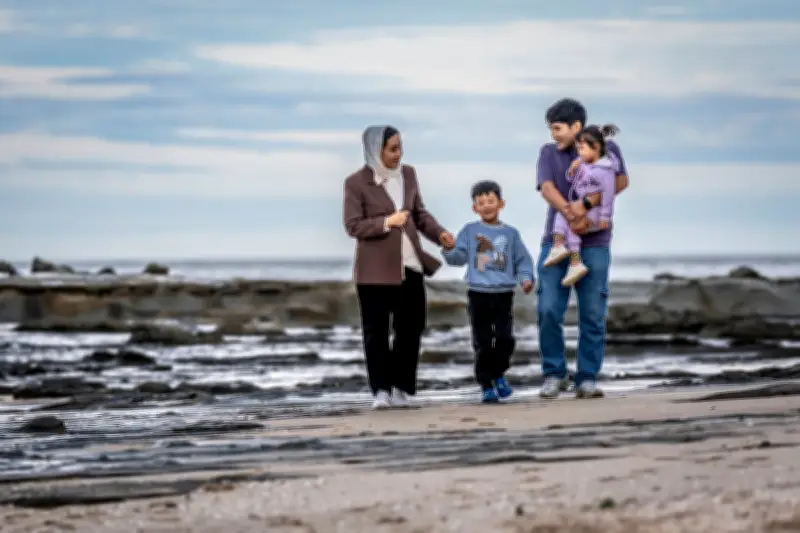
The Afghan family who are safe at last and full of hope, thanks to an Australia Pauline Hanson will never know. In International Refugee Week, two speeches paint starkly different visions of the country.
They came in the chill of winter to hear their speaker, a man known to most only as a name. “Thank you,” Mohammad Ibrahim told the people of Apollo Bay. “Today I am proud to call Australia my home.”
Here, assembled before him in the Mechanics Hall, was the town that made that happen. A town that raised money so he could eat and his children could be clothed, raised hell with members of parliament, ministers, bureaucrats, journalists – anyone who would listen, and many who wouldn’t – to see that Australia upheld its obligation to him. Four years on behalf of a family they’d never met.

“Never underestimate the power of kindness,” he said. “Because what may seem like a small action to you can become the difference between hope and despair for someone else.”
Branded an ‘infidel’
During this country’s longest war in Afghanistan, Mohammad Ibrahim worked on Australia’s behalf, as an interpreter for a government-sponsored aid project in Uruzgan province. The program built and ran schools for children in one of Afghanistan’s poorest provinces, it taught girls to read in places where few ever set foot in a classroom. It vaccinated children who’d never visited a hospital, and trained midwives and doctors in a country with one of the highest infant mortality rates in the world.
Ibrahim was proud of the difference his work was making: “Working on those projects was an honour for me to serve my country and also help the Australian government.” But when Afghanistan fell with terrifying swiftness to the Taliban in August 2021, Ibrahim was abandoned.
Like thousands who had believed in the mission of Republican Afghanistan, who’d trusted the promises of peace and prosperity, who’d been repeatedly assured by the countries they served they would be protected in the event of calamity, he and his family were forsaken. International hopes for a reformed Taliban, that their desire for international legitimacy would restrain their most grotesque excesses – their brutality towards women, their violent persecution of minorities – were short-lived. The Taliban were unreformed.
In their eyes, Ibrahim was an “infidel” – a member of the Hazara ethnic and religious minority, and one who’d served the western invaders. With his young family, he was forced to flee into the mountains.
Over four long years in hiding, the family lived in caves in the highlands of Bamyan, walked over precipitous mountains to remote villages where the Taliban’s reach was limited. They also rented tiny rooms in Kabul, too afraid to go out, even to buy food, uncertain that the anonymity of the capital would be any protection. Sometimes they had a few weeks in the same place, once a couple of months. Some days they were forced to move more than once in a single day, as Taliban sweeps drew closer. There were no schools for the children, no hospitals when they got sick.
The family then fled over the border into Pakistan, spending three freezing nights standing before the gates, hoping they could get across. They had one stroke of fortune. Having appealed to contacts online for assistance, Ibrahim was put in touch with the Apollo Bay Rural Australians for Refugees group in south-western Victoria.
On behalf of a family they’d never met, this small band of Australians wrote countless letters to politicians and repeatedly called ministers’ offices. They emailed department officials relentlessly, seeking updates on Ibrahim’s application for a humanitarian visa. They raised money to send to him so he could buy food and clothes for his children, and rent small rooms for his family to hide in. They put him in contact with reporters – including this one who was invited to the event – who wrote articles trying to bring the issue of those abandoned to public and political attention.

And they managed to have Ibrahim recognised under Australia’s locally engaged employee program, a formal recognition for those who worked with and for Australia in Afghanistan “and are at risk of harm as a result of their work”. His case would be prioritised. Later, a welcome, high-level government intervention made sure it would be so. Slowly but inexorably, the people of Apollo Bay willed Ibrahim’s freedom into existence.
Two and a half hours to spare
Hiding over the border in Pakistan, Ibrahim – with his wife, Amina, their son, Daniel, and toddler, Helen – had been told his cards were marked. Police knew where they lived. With 36 hours to go before their visas expired, they were preparing to be marched back into the hands of the Taliban. Then, in the middle of the night, an email arrived bearing four Australian humanitarian visas.
Flights were rapidly booked. The meagre possessions the family had carried between dozens of hiding places were packed. Their flight out took off at 9.30am on a Thursday: the family’s visas to stay in Pakistan expired at midday. Two and a half hours to spare.
‘Kindness changed everything’
In the months since their arrival, Ibrahim and his family have quietly built a life in Australia. Schools – for the first time – for their children, English lessons for Ibrahim and Amina. They have met and made friends, and found a community.
In Apollo Bay this week, Ibrahim had a speech prepared: “Many times we lost hope. Many times we thought nobody cared. Many times we wondered if our story would simply disappear among thousands of other stories. But then something extraordinary happened. People we had never met decided that our lives mattered. People here in Apollo Bay wrote letters, made phone calls, spoke to politicians, contacted journalists, shared our story, and refused to give up. They did not help us because they knew us. They helped us because they believed that every human life has value. That kindness changed everything. Today, my children can go to school safely. They can dream about their future. They can sleep without fear.”
Quieter Australians, gently changing the world
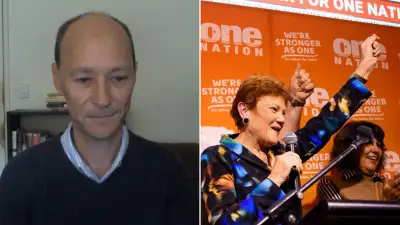
A few hours before Ibrahim spoke, Pauline Hanson took the stage at the National Press Club, demanding that Australia return to some mythical past, a fictional golden age of narrow imagination. She pined for a nation of “monoculturalism”, a uniformity of ill-defined “Australian values”. “We cannot be a multicultural society,” she said. “We are a multiracial society, but we must be monocultural. Australians must live under the one cultural umbrella.”
Hanson is fond of insisting she speaks for real Australians. But here, in Apollo Bay, is a real Australia for whom the One Nation leader doesn’t speak. It is an Australia she doesn’t represent, doesn’t even know. There are places like this all over the country. This is the Australia that many choose to believe in and to be a part of. An Australia that is welcoming and generous, that celebrates difference and diversity.
So much of increasingly scattered public attention is dominated by the loudest and angriest voices, by a political class obsessed with polls and politicking and personalities. A tired electorate wearies of an arms race of escalating rhetoric – ever louder, more extreme. But there are other, quieter conversations going on across this land, in another, more generous Australia, that are gently changing the world, sometimes one family at a time.