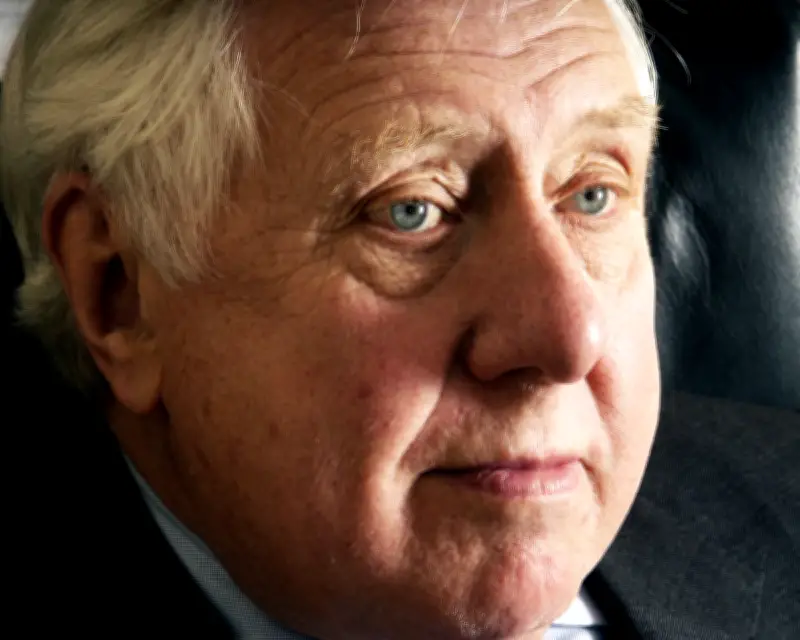
Roy Hattersley, the former Labour deputy leader and author, has died at the age of 93, his family has announced.
Political Career
Hattersley was a councillor at 23, an MP at 31, and a minister by 33. He served in the cabinets of Harold Wilson and Jim Callaghan. He was the MP for Birmingham Sparkbrook from 1964 until his retirement from the House of Commons in 1997.
In the 1960s, he held posts as employment minister and as deputy to Denis Healey in defence. From 1974 to 1976, he served under Wilson again as minister of state for foreign and commonwealth affairs. He was appointed a privy councillor in 1975. From 1976 to 1979, he joined Callaghan's cabinet as secretary of state for prices and consumer protection.

The Labour grandee was made deputy leader under Neil Kinnock and was created a life peer in 1993 as Baron Hattersley of Sparkbrook.
Writing and Other Pursuits
As well as contributing to numerous national newspapers, he wrote many books, including The Edwardians; Borrowed Time: the Story of Britain between the Wars; In Search of England, and acclaimed biographies of John Wesley, Lloyd George, and the Devonshires.
Alastair Campbell paid tribute to Hattersley on X: “Very sad. Labour through and through, a fine mind and gifted writer, a loyal and hard working deputy to Neil at a vital time in Labour history, and a critical friend to New Labour. Sheffield Wednesday to the very end! RIP Roy.”
Hattersley's brother-in-law, Norman Pearlstine, said: “Roy was one of the most intellectually curious politicians I ever met. In addition to writing frequently for the Guardian, he wrote more than 20 books, including thoughtful studies of Catholicism in Britain, Lloyd George, and the Edwardians. Roy also displayed a humorous touch after his dog Buster killed a goose in one of London's royal parks and Roy was fined. The dog's encounter with the goose led to publication of Buster's Secret Diaries as discovered by Roy Hattersley, written in the dog's voice. The book, in which Buster claimed he had acted in self-defence, was a bestseller that was subsequently translated into several languages.”
After the 2010 general election, Hattersley offered advice to newly arrived MPs: “The House of Commons is workshop, not shrine … without clear convictions life at Westminster is a boring waste of time. With them it is a great and glorious adventure.”
Hattersley was also a visiting fellow of Harvard's Institute of Politics and of Nuffield College, Oxford. In 2003, he was elected a fellow of the Royal Society of Literature.
Early Life and Influences
He was born into a Labour family in Sheffield in 1932 and had strong Yorkshire roots. He was a supporter of Sheffield Wednesday Football Club and Yorkshire County Cricket Club. He gained a scholarship to Sheffield City Grammar School and went to the University of Hull, where he read for a BSc in economics and participated in student politics. After graduating, he worked for a Sheffield steelworks and then for two years for the Workers' Educational Association.
Among his first forays into politics was serving as chair of the housing committee when he was a member of Sheffield City Council. He was renowned for being a longstanding supporter of the Common Market and Britain's role in the European Economic Community. In 1981, Hattersley founded Labour Solidarity to help prevent the break-up of the Labour Party, famously declining to join the MPs who left to form the short-lived Social Democratic Party.
In 2017, he declared in an article for the Observer: “The Labour party faces the greatest crisis in its history. Momentum – a party within the party which is dedicated to moving Labour to the far left of the political spectrum – is on the point of winning control of Labour's policy, programme and constitution.”

Hattersley lived in Derbyshire with his wife, Maggie Pearlstine. In an interview with The Lady, he said his greatest influence was his mother, Enid, who was a Labour city councillor and mayor of Sheffield. He said: “She was a very dominant, very positive, aggressive figure. I was always closer to my father, but he was very gentle, unlike my mother. She would never say you could do better, just how badly you were doing. And that stimulated me to do better. I think she had a painful, but very important influence on me.” When asked when he is at his happiest, he said: “When I'm writing. Especially when I'm here in Derbyshire, as I am now with the dog sleeping at my feet.”