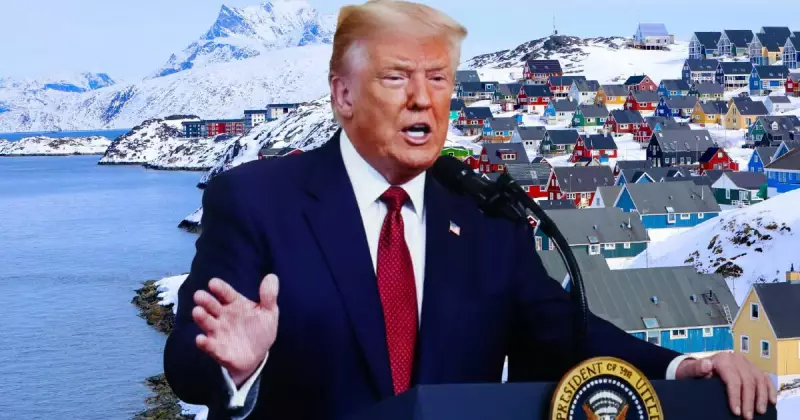
Europe finds itself on the edge of a strategic abyss, with the very foundations of its post-war security architecture under direct threat. The catalyst is a renewed and aggressive campaign by the administration of US President Donald Trump to acquire Greenland, an autonomous territory of Denmark. This comes hot on the heels of a controversial American military operation in Venezuela, creating a crisis of credibility and principle for European leaders.
A Clear and Present Danger to Sovereignty
President Trump has moved beyond mere speculation, making his intentions for Greenland explicitly clear. In a statement to reporters, he declared, "We need Greenland from the standpoint of national security, and Denmark is not going to be able to do it." He ominously added, "Let's talk about Greenland in 20 days," setting a tense deadline. These are not isolated remarks but part of a coordinated pressure strategy.
The Trump administration has appointed Louisiana Governor Jeff Landry, a known supporter of US annexation, as a special envoy to Greenland. In a further provocative move, Katie Miller, the wife of top Trump adviser Stephen Miller, posted an image of Greenland coloured in the stars and stripes of the US flag with the caption "SOON".

Greenland's own Prime Minister, Jens-Frederik Nielsen, has issued a firm rebuke, stating, "That's enough now. No more pressure. No more insinuations. No more fantasies of annexation." Danish officials have gone further, warning that any US attack on Greenland would signal "the end of NATO" and the security order established after the Second World War.
Europe's Feeble and Confused Reaction
Despite the grave implications, the collective response from European capitals has been notably weak and indecisive. NATO's Article 5, which treats an attack on one member as an attack on all, would theoretically oblige the alliance to defend Denmark against the United States itself—a paralyzing prospect.
European leaders are grappling with an unthinkable reality: the founding member of NATO may now be its greatest threat. Yet, their actions have failed to match the scale of the challenge. British Prime Minister Keir Starmer exemplified this subordination by admitting he wanted to speak to President Trump before condemning the US actions in Venezuela.
A letter signed by the leaders of Denmark, France, Germany, Spain, the UK, Italy, and Poland did affirm that only Greenland and Denmark should determine the territory's future. The European Union also pledged to defend members' territorial integrity. However, these statements lacked any concrete counter-threat or consequence for Washington's aggression.
The equivocation extends to Venezuela. German Chancellor Friedrich Merz called the "legal classification of the US intervention [in Venezuela] is complex," suggesting Germany needed more time to consider it. This hesitation on a clear violation of international law undermines Europe's moral authority when it invokes the "rules-based order" against Russia's war in Ukraine, crippling its ability to rally global support.
Strategic Windfall for Russia and a Choice for Europe
This European vacillation plays directly into the hands of the Kremlin. Russia has been quick to label US actions as "armed aggression," highlighting Western hypocrisy. Moscow benefits in two fundamental ways: first, by having its narrative that international law is a tool of the powerful validated, and second, by watching NATO potentially unravel from within without firing a shot.
The scenario presents an existential dilemma for NATO members. If the US were to annex Greenland, Denmark would have to choose between accepting a catastrophic violation of its sovereignty or leaving the alliance created to protect it. Every other member would face the same impossible choice, as the alliance cannot function without shared fundamental values.

Analysts draw a stark parallel to the 1938 Munich Agreement, where Britain and France appeased Nazi Germany by sacrificing Czechoslovakia's sovereignty. Today, Europe again faces the temptation of political expediency over principle. The coming weeks will test whether European leaders will defend the rules-based order universally or tacitly accept a world where might makes right, determining the continent's security future for decades to come.