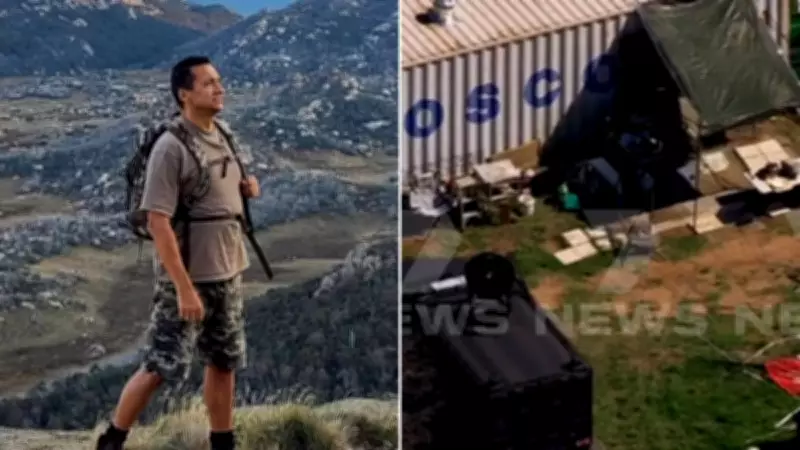
The Death of Dezi Freeman and Australia's Sovereign Citizen Movement
The violent death of fugitive Dezi Freeman has cast a stark spotlight on a rapidly expanding movement within Australia, one fundamentally built upon the conviction that governmental authority holds no legitimate power over individual citizens. Freeman had evaded capture for over seven months following accusations that he ambushed and killed two police officers while seriously injuring a third at his rural property in Porepunkah, located in Victoria's northeast region.
Police officers arrived at the location to execute a legal warrant when they were suddenly met with intense gunfire. Detective Leading Senior Constable Neal Thompson and Senior Constable Vadim de Waart-Hottart lost their lives in what has become one of the most severe attacks on Australian law enforcement in recent history. Freeman subsequently fled into the surrounding bushland, initiating an extensive manhunt that lasted for months, involved hundreds of officers, and generated thousands of investigative leads.
He managed to avoid capture within rugged terrain he knew intimately, surviving off-grid in remote sections of Victoria's high country. The prolonged search concluded when police tracked him to a secluded property near the New South Wales border on Monday. After a tense standoff lasting several hours, Freeman refused to surrender and was ultimately shot dead by officers.

Understanding the Sovereign Citizen Ideology
This case has sharply renewed focus on the so-called sovereign citizen movement and the underlying anti-government ideology that propels it—beliefs Freeman had openly associated himself with in the years preceding the violent attack. Experts indicate the movement has gained significant traction in recent years, driven by escalating distrust in institutions, mounting financial pressures, and the proliferation of fringe ideas through online communities where such beliefs are reinforced rather than critically examined.
While the majority of individuals who experience anger or frustration toward government will never resort to violence, experts caution that for a small minority, such frustration can deepen into a far more extreme stance: a complete rejection of authority, legal systems, and those tasked with enforcement.
Dr. Josh Roose, a political sociologist and associate professor of politics at Deakin University, explains that the movement is constructed around a foundational belief that government itself lacks legitimacy and its laws are not obligatory. "In effect, they're anti-government extremists who believe the government's a corporation that enslaves the people, in part through law, and part through the legal system, hence they develop their own form of pseudo-law," he stated.
He elaborated that adherents think they can liberate themselves by rejecting the legal identity assigned at birth. "In that context, they have a deep hatred of government, law enforcement in particular, police, and are highly active online, influenced by transnational ideas and conspiratorial thinking."
According to Roose, it is less a single, organized group and more a loose network of individuals connected by shared governmental distrust. "It's a very fluid, diverse movement. It's made up primarily of individuals who gather online or in local context, who have a similar sort of distrust of government but then enact this in different ways among themselves."
Dr. Michael Zekulin, a senior lecturer in the ANU School of Politics and International Relations, noted the ideology exists on a broad spectrum. "The more extreme versions of this ideology are more than anti-government, as in, I don't like government—it's basically now that government is illegitimate," he explained. "And of course, not just government, but any agent or agency of government."
In practical terms, this means police, councils, courts, and any other entities perceived as representing state power can become targets of that anger, not merely as institutions but as individuals.

Factors Fueling the Movement's Growth
The movement has accelerated notably in recent years, particularly during and after the pandemic when lockdowns, vaccine mandates, and governmental intervention in daily life pushed more people toward anti-government sentiments. Roose emphasized that the subsequent cost-of-living crisis has rendered the anti-government message even more appealing to those already struggling.
"People are drawn to these ideas because the narrative of 'the government's at fault, the government's bad, police are bad' becomes really more attractive to people who are experiencing financial hardship, who are on the fringe of society, who are spending more time online engaging with conspiratorial content," he said. "For people who are feeling disempowered and vulnerable and like they're on a downward social trajectory, sovereign citizen ideas actually offer them a form of empowerment."
Zekulin pointed out that COVID-19 served as a major accelerant because it rendered government power highly visible in everyday life. "When you are suspicious of government, and you are concerned the government is trying to trample your rights or putting rules and laws onto you that you don't necessarily believe you must adhere to, then of course, that's a tremendous amount of tension."
He added that the pandemic simultaneously attracted new individuals to the movement and pushed existing believers further toward extremism as restrictions, mandates, and uncertainty intensified distrust and reinforced grievances.
Both experts identified the internet as a critical factor behind the movement's sudden surge. Roose described the movement as "highly active online," while Zekulin highlighted how online spaces have transformed dynamics by enabling people to find both ideas and community.
"The internet, their ability to spread content, to meet up, to form chat rooms, these have very significant socio-psychological powerful forces," Zekulin noted. "If you go on to any of these social media sites, within six or seven clicks, you're really gone down the rabbit hole here. The algorithm takes you down, it takes you places."
He expressed concern over the increasingly transnational nature of the movement. "You do become concerned that there's actually now a sort of transnational—people with this ideology in Canada are talking to people who have this ideology in Australia, who have this ideology in the UK." This matters because fringe beliefs no longer remain isolated; individuals can rapidly find reinforcement, validation, and radical ideas.
From Distrust to Dangerous Rejection
It is uncommon for individuals to leap directly into extreme beliefs. More frequently, the process begins with ordinary feelings of being fed up, ignored, or left behind. For many, initial frustration arises from issues like rising costs, institutional distrust, or a perception that the system is failing them—sentiments that are not unusual on their own.
Over time, however, these frustrations can deepen, especially when reinforced within online communities that provide simplistic explanations and identifiable scapegoats. Roose indicated the shift typically occurs when frustration becomes persistent and personal, linked to a sense that the system is no longer functioning in one's favor.
"Most people have upward social trajectories where they're seeking to build better life and they feel like they're making progress," he said. "And that's part of the social compact, work hard, get rewarded. But if you feel like you're working hard, and you're not being rewarded, or you're going backwards, and you feel like you're not being acknowledged, maybe you're feeling invisible."
He suggested this dynamic can be particularly acute in regional Australia, where residents may feel economically excluded from their hometowns and marginalized from the lives they anticipated building. "People feel the world is leaving them behind. And so, they immerse themselves in these subcultures, and these subcultures, for some, can turn very violent."
Zekulin agreed, observing that many are initially drawn through ideas that do not appear extreme. "Your point of entry is, I'm upset at government. The government is not doing what it used to be able to do. Why does the government keep taking my money, but nothing happens to me? Or nothing good?" he remarked.
This is where the online environment becomes especially perilous. "One of the terms we're using now as it relates to groups related to far-right extremism or sovereign citizen movement is the idea termed breadcrumbing," Zekulin explained. "The public face of this is not designed to be extreme. It is not designed to be antagonistic. It's getting you in the door. And then once you are in the door, then these forces of meeting up with other people, often in private chat rooms where the rhetoric and the language and the ideas may become more conspirational, might become more aggressive."
When Ideology Turns Violent
It is important to recognize that not every adherent of sovereign citizen beliefs becomes violent, but risks escalate when anger, resentment, and ideology converge in direct confrontations with authority. "The key driver in terrorism, for example, is anger. Anger is focused on the present. It's based on a specific disempowerment," Roose stated.
"When you tie that into an attempt to shape the world around you, and you're constantly experiencing failure, there's a sense of resentment that ties in. Sense of shame, sense of humiliation, a sense of having been treated poorly, and that becomes a personal response. But the narrative offers empowerment."
Zekulin noted that danger often increases when believers encounter individuals they view as agents of an illegitimate system. "When it becomes confrontational is when they come into a position where they're in a direct interaction with agencies of government or law enforcement," he said.
He referenced that in the United States, such confrontations frequently involve routine police interactions that spiral dangerously because the individual does not accept the officer's authority. Roose added that the broader anti-government ideology underpinning sovereign citizen beliefs has a lengthy history of violence internationally.
"The anti-government extremist ideology that underpins it has been responsible for well over 100 attacks on law enforcement in the US, including many deaths," he said. "There's an explosive rage in some, because of their extreme hate and contempt for government and authority."
Why Australia Cannot Ignore This Trend
Roose observed that Australia possesses a long-standing tradition of skepticism toward authority, which in itself is not problematic. The issue arises when this skepticism mixes with economic distress, online radicalization, and profound grievance. He asserted Australia is at a "critical point" as the cost-of-living crisis deepens and pressures mount in regional and outer suburban areas. "People are increasingly desperate," he warned.
Zekulin emphasized that in such an environment, initial steps into these ideologies become easier, as growing frustration and distrust make narratives challenging governmental legitimacy more accessible. "When you have concerns with an ideology that is related to a growing distrust or mistrust of government, and a belief that government is more than ever actually not the solution, but is a problem, then yes, you start to be concerned that this idea ... become much more accessible, and people become more susceptible," he explained.
Roose pointed to the online reaction from some sovereign citizen adherents following Freeman's death as evidence of the issue's severity. "You can see the response of sovereign citizens online, praising Freeman, expressing their hatred of police and their happiness that police died," he said. "This speaks to the seriousness of the problem and its embedded nature."
He stressed that addressing this challenge will require efforts extending far beyond law enforcement. "Significant work needs to be done across government over a prolonged period of time to regain trust." This may be the most unsettling lesson from the Freeman case. While most individuals will never embark on this path, the conditions enabling it—frustration, distrust, and a sense of being left behind—are becoming increasingly prevalent. As experts caution, when these feelings take root and are reinforced, the transition to an extremist belief system becomes markedly easier to make.