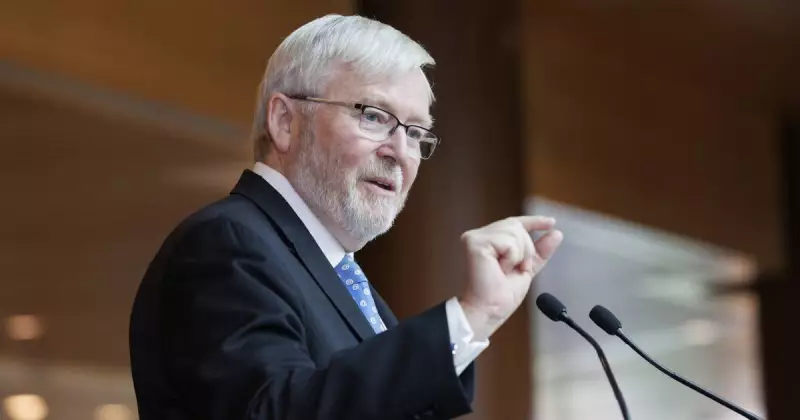
As Kevin Rudd concludes his tenure as Australia's ambassador to the United States, a chorus of public opinion in The Canberra Times has praised his diplomatic efforts while also turning a critical eye to local planning failures and global political tensions.
Rudd's Diplomatic Mastery in a Turbulent Era
In a letter published on January 17, 2026, reader Peter McLoughlin from Monash argued that Rudd's considerable achievements should not be ignored. McLoughlin commended the former prime minister for doing a "brilliant job" working with the Trump administration during its second term, managing to achieve a great deal while keeping his personal opinions private—a feat labelled a "major achievement."
McLoughlin dismissed media speculation that Rudd was pushed out after a "US humiliation," lamenting a perceived decline in the link between media reporting and truth. He also noted the irony that more than 12 months into the Trump administration's second term, America had yet to appoint a new ambassador to Australia, quipping that we might have been saddled with an unsuitable celebrity appointee.

The letter concluded with a stark reflection on the Australia-US alliance, citing surveys that show Australians hold the third lowest opinion of President Trump globally, behind only Mexico and Sweden. McLoughlin suggested it may be time to rethink the alliance given the President's "irrational behaviour."
Canberra's Uninhabitable Apartments Spark Outrage
Shifting focus to a local issue, Gordon Fyfe from Kambah expressed fury over recent media reports detailing uninhabitable apartments in Canberra. Fyfe questioned how the ACT government could approve designs featuring west-facing, floor-to-ceiling glass walls without adequate heat mitigation.
Some bedrooms are reportedly reaching 45 degrees Celsius, with insufficient or non-existent air-conditioning. Fyfe accused the government of disregarding citizen welfare, implying that such oversight might be "profitable." This criticism highlights a growing concern over building standards and livability in the nation's capital.
Climate, Health, and a Call for Media Courage
The interconnected crises of climate change and health were prominent in other correspondences. Roderick Holesgrove from Crace supported an earlier article by Dr Arnagretta Hunter on climate health risks, urging for stronger global action on climate change. He warned that despite growth in renewables, increasing temperatures could lead to "the most catastrophic event ever to hit humankind."
Echoing this sentiment with palpable anger, Ray Peck from Hawthorn, Vic, described the "hotter more dangerous world" being passed to grandchildren. Peck condemned ongoing government approvals for new coal and gas projects and challenged fossil fuel executives and shareholders to prioritise planetary health over profit.
In a historical note, Aidan Moore from Melba drew parallels between today's journalism and the legendary courage of Ireland's Skibbereen Eagle, which in 1898 declared it was "keeping an eye on the tsar of Russia." Moore expressed hope that The Canberra Times would display similar fortitude in holding power to account.
Global Perspectives: From US Lawlessness to Political Discourse
International events also drew sharp commentary. Ross Hudson from Mount Martha, Vic, described the United States as "fast becoming a lawless autocracy," referencing a controversial shooting in Minnesota. He argued that certain actions by law enforcement seemed like "an angry agent administering his form of justice."
Meanwhile, Athol Morris from Forde pushed back against claims that criticising Israel's government is inherently anti-Semitic, stating it is a legitimate act often performed by Israelis themselves. He clarified that criticism crosses into anti-Semitism only when employing double standards or stereotypes.

Finally, Vasily Martin from Queanbeyan offered a philosophical critique of materialism and its supposed endpoint in communism, arguing that Western society's turn away from spirituality has left a void filled only by consumption.
This collection of letters paints a vivid picture of a concerned and engaged readership, grappling with issues from local planning failures to the very future of Australia's key international alliances and the planet's health.