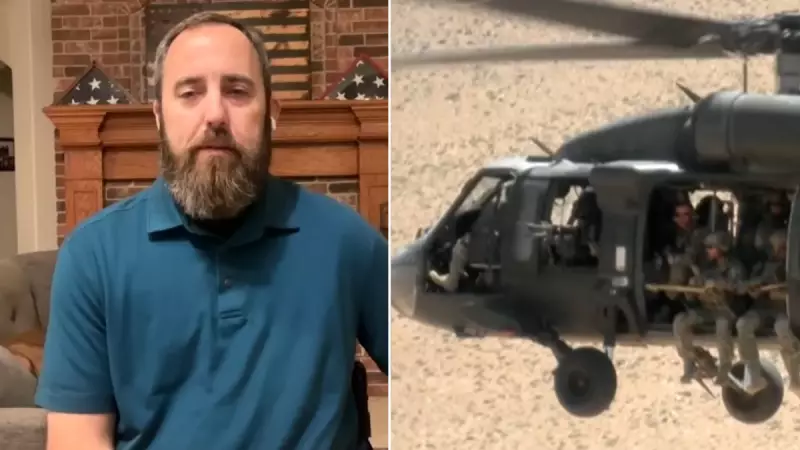
An American Blackhawk helicopter pilot has shared a gripping account of flying elite Australian troops into one of the most daring and dangerous battles of the Afghanistan war, revealing new details about the mission's peril and its enduring legacy.
From 'Glorified Uber Driver' to the Heart of the Fight
For US Army pilot Trevor Baucom, his first deployment to Afghanistan in 2008 felt routine. Based at the Soviet-built Bagram airbase north of Kabul, his missions involved supply runs and transporting VIPs, a role he wryly described as being a "glorified Uber driver." However, his second deployment in 2010 with the 101st Combat Aviation Brigade was profoundly different.
This time, Baucom was tasked with inserting Australian Special Forces, including the SAS and 2nd Commando Regiment, directly into combat zones. "It felt like we were helping to win the war," Baucom recalled, describing a deep sense of job satisfaction from supporting the Aussie troops and hearing of their successes.

The Audacious Descent into Shah Wali Kot
Baucom was a key pilot in the Shah Wali Kot offensive in 2010, a mission now scrutinised for its intelligence gaps. He remembers descending into the Taliban stronghold with a level of respect he calls "next level." "I'd never landed into anything like that," he said, noting that flying in Afghanistan was always dangerous, but this landing was in a class of its own with few ways to mitigate the threat.
Recent analysis, including from author Aaron Patrick's book "The Last Battle," suggests the mission was an intelligence failure, with troops given little warning of the enemy force's size. Baucom's memory supports this view: "As far as I can recall, we got no warning of any more danger than any other operation we'd flown."
However, Retired Colonel Paul Burns, Australia's task force commander at Shah Wali Kot, offered a different perspective on military intelligence. "I can tell you right now that all intelligence is wrong," Burns stated, emphasising the inherent "fog" of combat.
Miraculous Survival and Tragic Loss
Despite the ferocious battle, all Australian troops and their American pilots survived Shah Wali Kot, though not without severe damage. Burns revealed that three of the Blackhawks were so badly damaged by enemy fire they could not fly again. Baucom's aircraft took a bullet in the rotor blades, while a round pierced the cockpit of another, landing in the lap of the pilot, who still carries it as a memento.
The luck ran out just ten days later. Baucom's Blackhawk crashed in a subsequent operation, killing three Australian commandos: Private Timothy Aplin, Private Scott Palmer, and Private Benjamin Chuck. Baucom himself was initially listed as killed. He was saved by Australian commandos who used a piece of the wrecked helicopter as a stretcher to evacuate him. "They saved my life... they are the reason I'm sitting here now," he said.
Confined to a wheelchair since the crash, Baucom has dedicated much of his life to helping fellow veterans. Now living in Houston, he still holds a strong bond with the Australians he served alongside, a connection that brings a smile to his face. His story is a powerful testament to the shared sacrifices and unbreakable bonds forged in the heat of conflict.