The United States Navy's highest-ranking officer has publicly endorsed the capabilities of Austal's American shipyard in Mobile, Alabama, as the Australian defence contractor positions itself to secure a larger share of the rapidly expanding US defence budget.
High-Profile Visit Yields Strong Endorsement
Admiral Daryl Caudle, the US Navy's chief of naval operations, recently toured the Mobile facility, and his subsequent comments have provided a significant vote of confidence in Austal's operations. The admiral specifically praised the company's advanced use of modular shipbuilding techniques, a method proving crucial for expediting the delivery of the Navy's next-generation nuclear-powered submarines.
Understanding Modular Construction
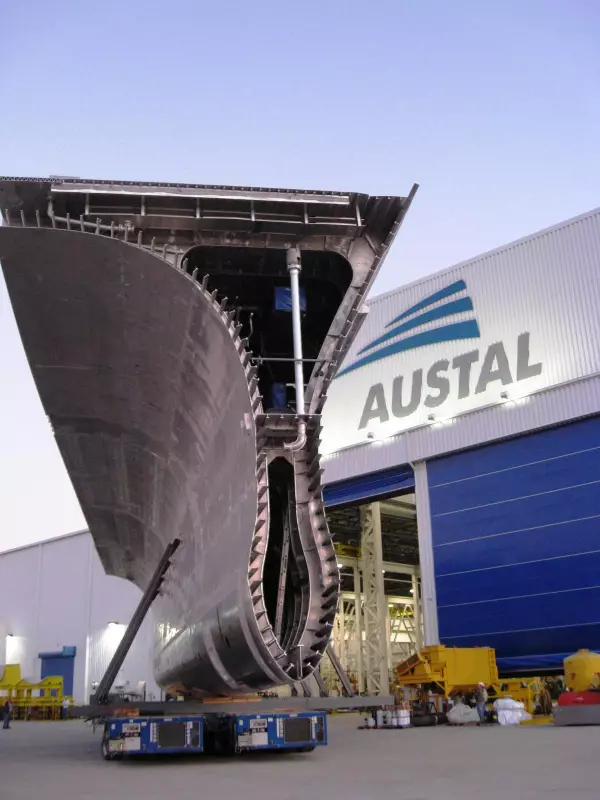
This innovative shipbuilding approach involves assembling major sections of a vessel with as many internal components installed as possible before these large modules are finally joined together to form the complete ship. This methodology offers several strategic advantages for complex naval projects.

- It allows multiple shipyards to contribute specialised modules to a single vessel.
- It significantly reduces the risk of manufacturing bottlenecks and delays.
- It streamlines the final assembly process at the primary shipyard.
Austal, in partnership with its prime submarine contractor General Dynamics Electric Boat, has made substantial investments to upgrade the Alabama yard. This investment enables the facility to produce critical command deck and electronic deck modules for the US Navy's Virginia-class and the future Columbia-class nuclear submarines.
Admiral's Direct Testimony on Efficiency Gains
While modular construction is not a new concept, Admiral Caudle pointed to Austal USA and the submarine program as a model for how this efficiency can be expanded across other US Navy shipbuilding initiatives. Speaking at a recent US submarine conference, as reported by defence industry newsletter TWZ, the admiral shared his firsthand observations.
"I was just down on the Gulf Coast to see how they build three modules there for the Virginia class, and they're going to start building for Columbia as well," Admiral Caudle stated. "One of the main modules they build is the entire command and control suite for Virginia class. And when you see that module... it's like walking into a Virginia class submarine control room. The thing is completely done, built, and the only thing that's missing is really the computers that we put in for the sonar and fire control system."
Quantifiable Impact on Production
The admiral quantified the impact, noting that Austal's module construction has "offloaded hundreds of thousands of man-hours" from Electric Boat. This massive labour saving allows Electric Boat to redeploy its skilled workforce to other critical areas of submarine production, enhancing overall program capacity.
Admiral Caudle emphasised that this represents a fundamental shift in naval manufacturing philosophy. "There's going to have to be some paradigm shifts with things like modularity," he said. "We are, I think, at just the tip of the iceberg on how we're starting to utilise modularity more effectively." This statement suggests the Navy sees Austal's work as a blueprint for future efficiency across its entire shipbuilding enterprise.
This strong endorsement from senior US Navy leadership comes at a pivotal time, as Austal seeks to capitalise on increased American defence spending. The company's proven ability to deliver complex, high-quality modules for the nation's most sensitive nuclear submarine programs positions it as a key industrial partner in the modernisation of the US fleet.