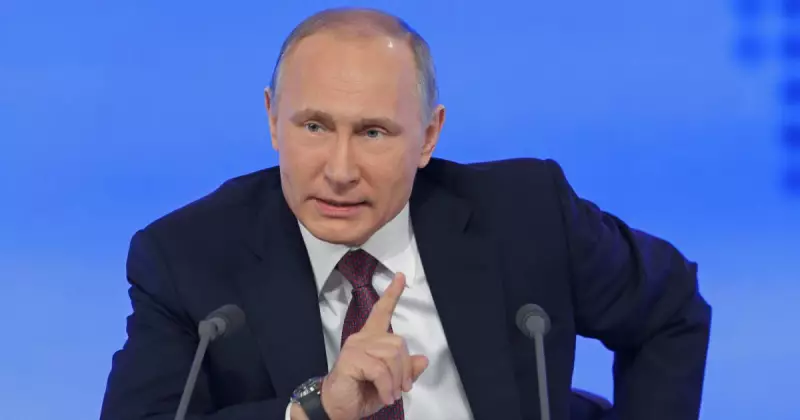
The conflict in Ukraine has escalated beyond a regional tragedy, evolving into a critical examination of Western resolve that, according to many observers, is currently falling short. The recent collapse of American-led peace negotiations in Moscow underscores a brutal truth: Russian President Vladimir Putin appears uninterested in any peace that does not equate to Ukraine's total surrender.
The Illusion of Diplomacy and a Flawed Plan
Efforts at mediation led by former US President Donald Trump, which involved dispatching personal associates and family members to bargain with the seasoned former KGB officer, were widely criticised as fundamentally misguided. The so-called "28-point plan" they promoted was so heavily skewed towards Moscow's demands that it was promptly rejected by Kyiv and European allies, who viewed it as little more than a blueprint for Ukrainian submission.
By engaging with what many see as Putin's deliberate delaying strategies, the US administration has arguably provided the Kremlin with valuable time to reconstitute its forces while Ukraine continues to suffer immense losses.

Australia's Essential $95 Million Commitment
Against this stark backdrop, the announcement from Prime Minister Anthony Albanese's government of a new $95 million assistance package is not merely supportive but fundamentally necessary. This pledge, comprising $50 million directed to NATO's priority fund and $45 million in vital military equipment, sends a clear signal that Australia comprehends the global implications of this war. The security of Europe is inextricably linked to our own.
Analysts warn that a victory for Putin in Ukraine would likely be just the beginning. Nations like Estonia, Latvia, and Lithuania could find themselves next in the firing line. The Russian leader's recent declaration that he is "ready right now" for a conflict with Europe is taken as a serious warning, not mere rhetoric, with Russia's economy now fully mobilised for prolonged warfare.
The Path Forward: Strength Over Appeasement
The core reality is unambiguous: Russia will not stop while it perceives an advantage, and Ukraine cannot stop without facing national obliteration. This sets the stage for a potentially endless conflict unless Western nations provide the sustained resources required to alter Moscow's strategic calculations.
Financial support and military hardware form the essential foundation. However, for nations like Poland on NATO's eastern frontier, discussions may inevitably progress to the more difficult question of personnel. The prevailing view is that brute force is the only dialect Putin truly understands, where he interprets negotiation as frailty and compromise as a chance to rearm.
Australia's latest contribution is a concrete and welcome step, but it cannot be mistaken for a conclusive solution. The world is observing a gradual erosion of international stability. The failure of Trump's peace initiative stems from a mistaken belief that a dictator can be placated. True peace will only be achievable when Putin's aggressive war becomes prohibitively expensive to maintain. Until that point is reached, the international community must stand unequivocally with Ukraine—not merely in rhetoric, but with the tangible steel and financial support necessary to defend the line.