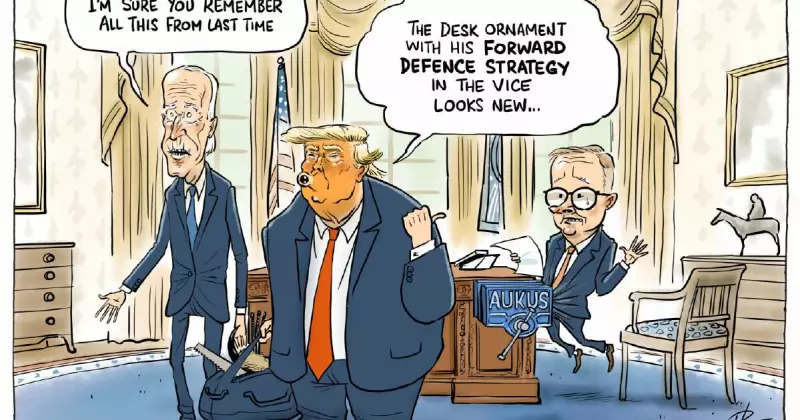
In a significant development for Australian defence strategy, a recent Pentagon review has firmly endorsed the AUKUS security pact, effectively removing a major point of uncertainty that had lingered in Canberra. The review, concluded in late 2025, has given the trilateral agreement with the United States and United Kingdom a definitive green light.
Ending Months of Strategic Anxiety
For months, Australian officials had harboured concerns about the stance of the new Trump administration in Washington. There were fears that a strict "America First" policy might view the multi-billion dollar submarine agreement as unfavourable or that severe industrial constraints in US shipyards could cripple the critical transfer of Virginia-class nuclear-powered submarines.
Instead, the review has identified pathways to place the pact on its strongest possible foundation. The Trump administration has signalled a "full steam ahead" approach, providing much-needed reassurance to Australia's strategic planners.

Navigating the Critics and the Challenges
Inevitably, the ambitious project faces vocal critics. They highlight the daunting industrial mathematics, noting American shipyards currently produce submarines at a rate of 1.2 per year, far below the 2.33 vessels per year required to fulfil commitments to Australia without degrading US capability. The staggering $368 billion price tag and the extended timeline—with Australian-built submarines not expected until the early 2040s—are also frequent points of contention.
Yet, proponents argue the alliance's value transcends hardware. It guarantees a vital capability for decades and locks in technological collaboration through "Pillar II" advancements in quantum computing, artificial intelligence, and hypersonic systems. Crucially, the pact has now survived three changes of government across the three partner nations, demonstrating a rare bipartisan resilience.
AUKUS Stability Amid a Volatile Regional Landscape
This affirmation arrives at a critical juncture. Australia is concurrently deepening strategic partnerships with Indonesia, Papua New Guinea, and other regional nations at a time of increasing complexity and danger. The geopolitical ground across the Indo-Pacific is shifting rapidly.
China's sharp diplomatic rebuke to the Japanese prime minister this week underscores the persistent volatility in North Asia. Simultaneously, India's ongoing engagement with Russia highlights the unpredictable nature of regional alignments. Russian President Vladimir Putin's recent visit to New Delhi—his first in nearly four years—emphasises this complexity.
Despite its membership in the Quadrilateral Security Dialogue (Quad), India is actively strengthening economic ties with Moscow, aiming for $100 billion in bilateral trade by 2030. This pragmatic relationship, driven by New Delhi's need to balance against aggressive US tariffs and secure energy supplies, frustrates Washington but reflects a world where traditional alliances are tested by economic self-interest.
It is a stark reminder that Russia, often viewed through a European lens, is a Eurasian and Pacific power. Putin's efforts to leverage relationships to bypass sanctions mean conflicts in Europe create direct ripples in the Indo-Pacific.
With India balancing its Quad commitments against deep-rooted Kremlin ties, and China asserting its dominance, regional stability is paramount. The confirmed steadiness of AUKUS provides a foundational pillar for Australia. While the industrial challenges related to workforce and supply chains are formidable, the strategic logic is compelling.
Australia cannot navigate this era of intensifying great power competition alone. By solidifying the alliance with the US and UK, the nation is acquiring more than submarines; it is purchasing essential insurance against a hostile and uncertain strategic environment. Critics who dismiss AUKUS as a relic of the "anglosphere" overlook its role within Australia's broader network of strategic relationships. The Pentagon's review is complete; the arduous task of meeting critical industrial and strategic deadlines now begins in earnest.