Driving along the Solway Coast as far as Maryport, D and I turn inland and head for Cockermouth, the birthplace of poets William and Dorothy Wordsworth.
Then it is on to the Bassenthwaite Lake Station, to dine at one of the most unusual cafes you are likely to encounter.
Finally, we take the A66 along Bassenthwaite Lake, then the A591 along the edge of the vast Thirlmere and thence to Grasmere, where William and Dorothy lived from 1799 until 1813.

It is November and rain, rain, rain all the way. Not ideal for sightseeing. But we manage.
Cockermouth: Gateway to the Lake District
Cockermouth, gateway to the Lake District, sits where the Cocker and Derwent rivers meet. The historic market town is prone to flooding, and on this day the waters of the Derwent are perilously close to the footbridge which takes us from the carpark to the centre of town. A half-destroyed dwelling serves as a warning to all who enter.
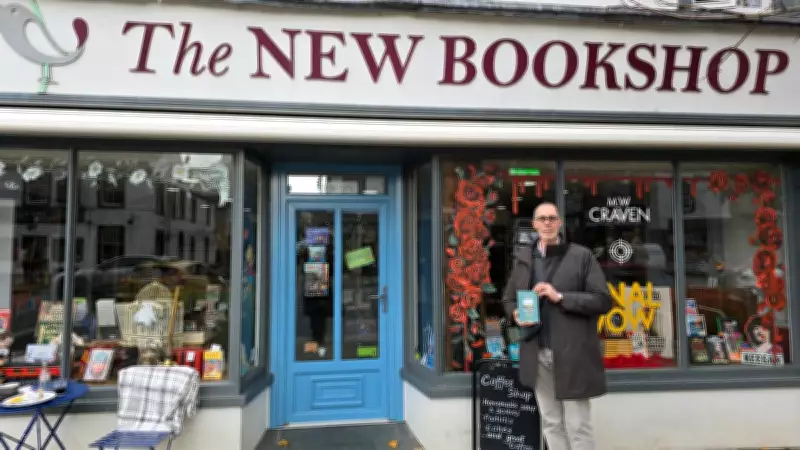
Of course the Wordsworth House and Garden is closed until spring! I should have consulted the website. We console ourselves by taking some photos of the exterior before making a purchase or two at a nearby church craft market, including a hand-knitted Shetland wool beanie. I also obtain a Lake poets anthology from the local bookstore. Time to relax over an ale at Jennings Brewery before being on our way.
Bassenthwaite Lake Station: The Orient Express Cafe
When I first heard that the entire replica Orient Express train used in the 2017 Kenneth Branagh film Murder On The Orient Express was now part of a Lake District cafe, I could not quite get my head around it.
Yet here we are.
The station, on the old Cockermouth, Keswick and Penrith railway line, ceased operations back in 1966 before falling into disrepair. In 2019, Simon and Diana Parums bought the site, restoring it to its former glory with the support of the Lake District National Park Authority.
Looking for a way to expand the bustling Bassenthwaite Lake Station cafe’s capacity, Simon and Di did an eBay search for a train carriage. Visiting a specialist hauler, they were offered the salon carriage used in the aforementioned movie.
A bit later, the same hauler alerted them to the fact that the rest of the train, including a replica French SNCF Class 241 steam engine, had come on the market.
After some deliberation — well, they basically sold their house to buy a train.
It is a great story and a great place, quirky and comfortable and full of character. The train was apparently built a little wider than the real thing to accommodate the film crew. Today, the 36-seater restaurant carriage offers menu meals — the excellence of which I can attest to — and afternoon teas while the salon carriage, which seats 40, is reserved solely for afternoon teas. There is also a splendid bar.
Naturally, there is plenty more seating in the main building, which houses the kitchen, as well as along the platform and in the gardens’ picnic areas, where local flora and fauna flourish. The weather being what it is today, there are few visitors. Apparently, during the spring and summer you cannot move for the crowds. It is definitely worth booking in advance.
Grasmere: Dove Cottage and the Wordsworths
I was not disappointed to arrive at Grasmere in the sublime, melancholy, teeming rain, although D wished I had parked closer to Dove Cottage, its orchard garden and superb museum. We arrive sodden yet still able to soak up the spirit of this sacred place.
I am not sure whether I tremble from a chill or the excitement of seeing manuscripts of William’s I Wandered Lonely As A Cloud and The Prelude, as well as Dorothy’s Grasmere Journals.
One passage in the journals, which I cannot quite make out but read later in the anthology I bought, reveals the origins of her brother’s most famous poem:
“I never saw daffodils so beautiful. They grew among the mossy stones about and about them, some rested their heads upon these stones as on a pillow for weariness and the rest tossed and reeled and danced, and seemed as if they verily laughed with the wind, that blew upon them over the lake . . .”

Dove Cottage itself is small and dark. Humble indeed. I am not sure whether I bow out of reverence or for fear of banging my head on the low beams. Look! Here is the very table where William wrote some of his most experimental poetry. Here is the window seat where he and Dorothy sat, making the most of the daylight to read each other’s work. I cannot resist sitting there for a moment and gazing out at the grey day as time stands still.
It cannot have been that peaceful though, with William’s wife Mary and their first three children also living there, along with Mary’s sister Sara and a maid.
Then there were the frequent guests, including fellow poets and writers such as Samuel Taylor Coleridge, Robert Southey and Walter Scott. Unsurprisingly, overcrowding saw the Wordsworths move, in 1808, to Allan Bank, a villa just outside Grasmere.
As D and I drive back, we vow to revisit Cockermouth, Bassenthwaite and Grasmere when the weather admits of more extensive exploration. Until then, I have my Lake poets’ anthology on my bedside table.
Fact File
For more information on the places mentioned in this story, see:
- cockermouthonline.co.uk
- nationaltrust.org.uk/visit/lake-district/wordsworth-house-and-garden
- basslakestation.co.uk
- wordsworth.org.uk