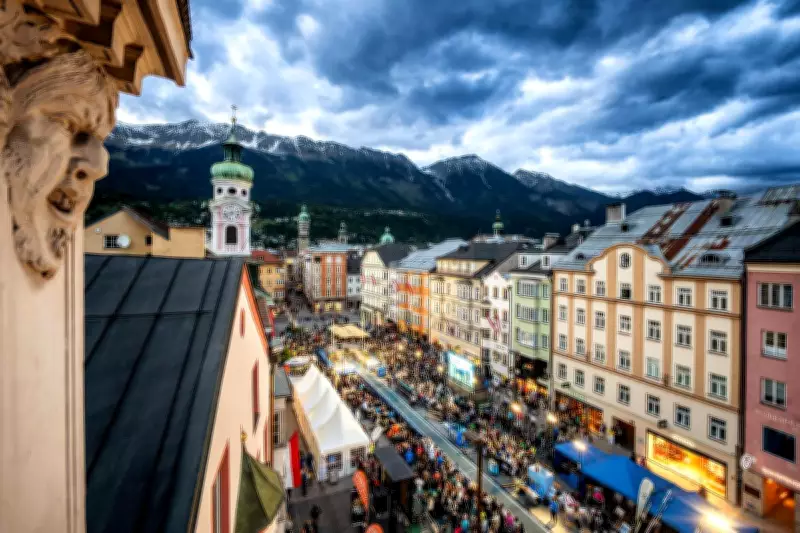
When our taxi journeyed from the train station through the ancient streets of Innsbruck, Austria, it became immediately clear we had chosen wisely. This stopover en route to Italy, intended to combat jetlag and uncover new sights, revealed a city where cobblestone lanes intersect with broad promenades adorned with statues and outdoor cafes. Alluring bakeries displayed pretzels and strudels, while arched colonnades sheltered intriguing shops, and church spires pierced the sky, all set against a backdrop of rugged, inviting mountains.
A Skyline Dominated by Olympic Legacy
Pointing to a sleek, curved tower that dominates the skyline, reminiscent of a Bond film set, we learned it was the Bergisel Ski Jump. This award-winning, 50-meter-high structure on Bergisel Hill, a site of Tyrolean historical pride, replaced earlier wooden versions from the 1920s and served in the 1964 and 1976 Olympics. Its 90-meter vertical ramp challenges daring skiers who accelerate to 100 km/h. For those less inclined to speed, the top houses a restaurant offering panoramic views over Innsbruck and the Nordkette mountains.
Historic Charm and Year-Round Appeal
Perched along the River Inn, famed for its "Bruck" bridge, Innsbruck presents an idyllic scene of colorful Hapsburg architecture with shuttered windows, ornate medieval squares, sidewalk bars, and lush parks. While winter attracts crowds to its 12 ski areas, as the gateway to Tyrol, just 30 minutes from Italy, it thrives as an alpine-urban destination year-round, merging urban life, history, and outdoor pursuits.

Arriving before snowfall, we found parks vibrant with chess players, cyclists, and students reading in dappled shade. Our riverside apartment, opposite the old town, greeted us each morning with church bells and balcony views of the mountains—perfect for sipping tea or enjoying a craft beer from our Airbnb host.
Exploring the Ancient Heart of the City
To ward off jetlag, we strolled into the old town, established in 1237 as a market town. Here, Baroque opulence blends with Rococo and Gothic vaulted arches, showcased in painted buildings, balconies, and wrought iron signs that whisper tales of a storied past. Over a spritz at a bar near the Cathedral of Saint James, day faded into a balmy evening.
Inside the cathedral, a Baroque masterpiece awaited, with pink marble columns, gold filigree, painted domed vaults, bronze tombs, and a central organ. Dating back to 1180 and rebuilt after fires, earthquakes, and war, its sacred grandeur reflects centuries of intricate craftsmanship and engineering.
Iconic Landmarks and Mountain Escapes
Revived the next morning, we sought coffee and visited the Golden Roof, Innsbruck's renowned landmark with 2,657 gilded copper shingles, where Emperor Maximillian once watched festivals below. Nearby, the City Tower's 148-step spiral staircase rewarded us with 360-degree views of the Alps.
Eager to venture further, we rode the Hungerburg funicular to a postmodern station, ascending above clouds to Hafelekar station at 2,256 meters in Austria's largest nature park. Hiking trails crisscrossed jagged ridges, with blustery winds reminding us of nature's dominance. Opting to hike down, we shared paths with bell-adorned alpine cows and discovered an "alm," a mountainside restaurant, for beer and strudel on a sunny deck.
These rustic timber establishments, once livestock shelters, now serve hikers and offer overnight stays. Losing track of time, we missed the last funicular, prompting a brisk, steep walk back to town as dusk fell—a reminder to plan better.
Village Serenity and Alpine Culture
With sore calves the next day, we joined bustling cafes before taking a bus to Natters, a quaint village with window-boxed geraniums. A forest trail led past meadows and pines to Kreither Alm at 1,500 meters, run by a local family and popular with hikers and bikers. Enjoying schnitzel, homemade cheeses, and beers with views of the Nordkette mountains, we soaked in the authentic Tyrolean ambiance.
Innsbruck itself exudes charm with a genteel, laid-back energy and historical grandeur. Yet, the true essence lies in the surrounding mountainside villages, meadows, forests, and homely alms, blending alpine culture with genuine experiences. Just remember to catch that last funicular!