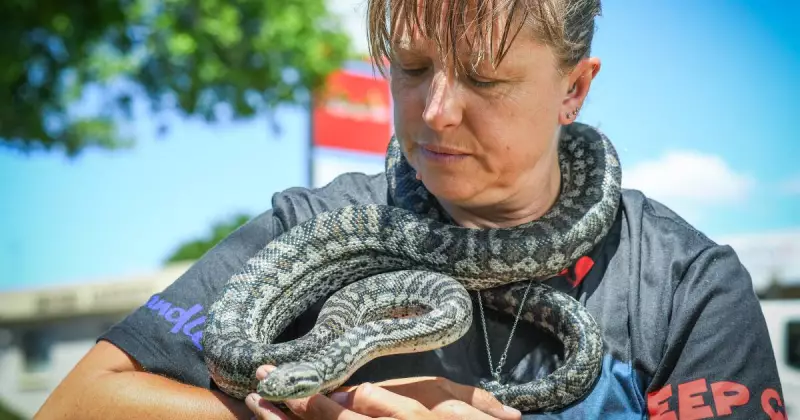
In the quiet parklands of Queanbeyan, Viviean Laycock sits with Layla, a serene Murray-Darling carpet python coiled around her neck. This peaceful scene belies the profound dangers Laycock has faced in her line of work. The professional snake catcher has survived not one, but two venomous bites from Australia's most feared reptiles—a red-bellied black snake and a tiger snake—and yet, her dedication to rescuing them remains unshaken.
The Bites That Changed Everything
The first life-altering encounter happened in Bungendore in 2019. Laycock was attempting to free a red-bellied black snake entangled in netting. Using a standard technique with a heavy, wet towel to calm the creature, she momentarily lost control. "She slipped out from under the towel," Laycock recalls. "And that was it. She said 'I hate you' and went for my finger."
Despite immediately applying correct first aid, including a pressure bandage to slow the venom's spread, the bite had a lasting neurological effect. At Canberra Hospital, she realised she could no longer detect a strong smell that others in the room could. Seven years on, her sense of smell and taste has largely not returned. She can vaguely distinguish sweet, salty, and sour, but specific scents and flavours are lost to her.

The second strike came from a tiger snake in 2024, again in Bungendore. Working in a dark, confined space under a deck, she managed to hook the snake's tail before it turned and bit her. Both incidents required treatment at Queanbeyan Hospital, followed by transfer to the better-equipped Canberra Hospital for antivenom.
A Surge in Snake Calls and a Conservation Ethos
Laycock's rescue tally speaks to a growing demand for her services. Since October this season, she has rescued 55 snakes, a significant jump from 34 in the same period last year and 30 the year before. She attributes this increase not to a boom in snake populations, but to urban expansion. "It may be because of new housing developments on bush land which snakes had been traversing for aeons," she explains.
Her driving philosophy is one of coexistence and compassion. She and fellow catchers strongly advocate against killing snakes found in backyards. "Leave a snake alone, and it will leave you alone, is their mantra," she says. She emphasises that snakes only bite as a last resort when they believe their life is in immediate danger. Her work ensures both human safety and reptile welfare, relocating the animals to suitable bushland rather than leaving them to be "shovelled or run over."
Navigating Fear and Bureaucracy
Has being twice bitten made her snake-shy? "You have to have some element of fear," Laycock admits. "You have to be fully aware of the fact that you may not make it home that night... But you override the fear, I guess." This respect for the animals' power fuels her caution on every job.
Her work, operating as Fangtastic Reptile Services, is also governed by strict regulations that differ across the border. In the Queanbeyan-Palerang council area of NSW where she is licensed, snakes can be released within a 20-kilometre radius. In the ACT, the rule is a much stricter five-kilometre radius. Cross-border releases are prohibited.
In a curious twist to her sensory loss, the tiger snake bite partially restored one specific ability: she can now smell female snakes when they are on heat, a phenomenon neither she nor scientists can explain. It's a small, strange compensation in a career built on risk and reward—where the reward is seeing a snake slither safely back into the bush, and a homeowner breathe a sigh of relief.