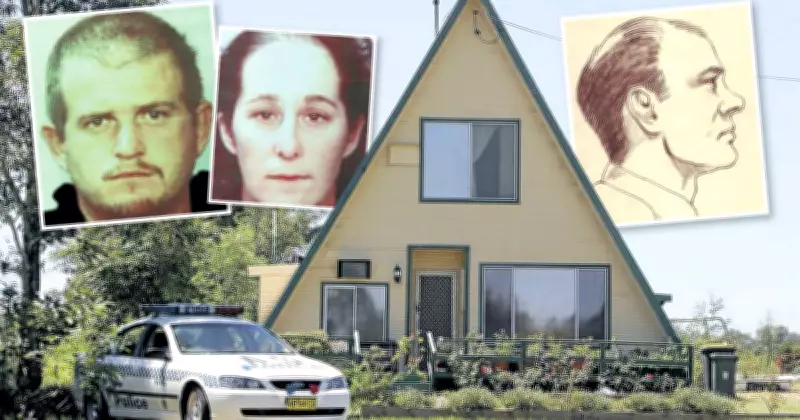
The discovery of smouldering 44-gallon drums in a remote state forest by Rural Fire Service volunteers led to the exposure of a chilling murder plot that shocked the Nowra community. On a Sunday morning in January 2006, volunteers responding to a report from cyclists encountered a scene that would unravel a web of deception and violence.
Gruesome Discovery in the Forest
Rural Fire Service captain Craig Beaumont was among the first to arrive at Tomerong State Forest after two cyclists reported burning petrol drums. "When we arrived we could smell a funny smell," Beaumont recalled. "I had a look in one of the drums and saw what we believed to be a body. It wasn't burning but there was some black smoke coming out of one of the drums."
The grim discovery set in motion an investigation that would reveal the murders of Greg Hosa and Kathryn McKay, a couple who operated the Champagne Shires horse stud at Nowra Hill. Friends described them as "energetic, loving people with a dedication to family and their animals," according to Ms McKay's nephew Phil McKay.

The Trio Behind the Crimes
Three individuals were ultimately charged with the murders: Kim Snibson, Stacey Lea-Caton, and Andrew Wayne Flentjar. Snibson served as the connection between the two men, who previously didn't know each other. She was also the only one of the three who had a direct relationship with the victims, having kept horses at their stud and reportedly owing them money.
In court proceedings, it emerged that Snibson had fabricated different stories to manipulate her accomplices. She told Lea-Caton that the couple had raped her, while informing Flentjar they had molested a child. Both accounts were completely false.
A Night of Horror in Calymea Street
The crimes unfolded at an A-frame house in Calymea Street, Nowra Hill, owned by Snibson. On January 28, 2006, Snibson first lured Hosa to the property, where Flentjar—wearing a balaclava—struck him in the head with a wooden plank. The victim was then bound and dragged to the bathroom.
Snibson subsequently called McKay to the house under false pretenses. Upon arrival, McKay was hogtied and had tape wrapped around her mouth. The situation escalated dramatically from that point forward.
Conflicting Accounts and Brutal Details
Lea-Caton became the first to plead guilty, admitting to aiding and abetting the crimes. He received a 22-year prison sentence and agreed to testify against his co-accused. In Supreme Court testimony, Lea-Caton described how Snibson and Flentjar left him to guard the bound couple while Snibson returned alone with bleach to clean blood evidence—and two 44-gallon drums.
"Ms McKay put up a struggle and they couldn't get her in the drum," Lea-Caton testified. "I was holding the drum. They tried to put her in there before she was deceased, but she struggled, she was grabbing hold of the edge of the drum. So she was suffocated."
Lea-Caton further revealed that he accompanied Snibson to the forest, where she poured petrol into the drums containing the victims' bodies and set them alight. She later returned with additional petrol to ensure complete destruction of evidence.
Legal Proceedings and Sentencing
Snibson eventually pleaded guilty to the murders, while Flentjar maintained he only participated in the kidnapping, not the killings. NSW Supreme Court Justice Terrence Buddin noted the unusual circumstance of Flentjar leaving the house while the victims were still alive without alerting authorities. "He must have been alive to the possibility of further harm coming upon the victims," Justice Buddin remarked. Flentjar received a 10-year sentence for kidnapping.
During Snibson's sentencing, despite her guilty plea, she argued that Lea-Caton actually killed the couple and threatened her to prevent her from going to police. Justice Buddin sentenced her to 32 years in prison, later reduced to 24 years following a 2023 appeal.

Unanswered Questions and Additional Suspicious
The court proceedings left several questions unanswered, particularly regarding the precise sequence of events inside the Calymea Street home. Justice Buddin acknowledged that all three offenders provided conflicting stories to minimize their involvement. "I cannot be sure whether Lea-Caton killed McKay while Snibson was away from the house, and then proceeded to kill Hosa when she returned—as Snibson claimed—or if Snibson killed them both when she returned, as Lea-Caton claimed," the justice stated.
Justice Buddin did, however, characterize Snibson's version of events as "implausible," "quite fanciful," and tailored to fit incontrovertible facts. The case also raised questions about Snibson's possible involvement in other suspicious circumstances, including the 2003 death of her elderly neighbor Judith Palinkas, who changed her will on her deathbed to leave her Calymea Street house to Snibson before passing away the following day.
Snibson denied allegations that she might have accelerated Palinkas's death by lacing her meals with dog tranquillisers, as suggested by her ex-husband. She also claimed ignorance about why Palinkas left her the property, stating simply, "I didn't ask her to do it."
The burning barrels in Tomerong State Forest ultimately exposed a murder plot that might otherwise have remained concealed, bringing a measure of justice to victims whose lives were brutally cut short in a crime that continues to resonate through the Nowra community years later.