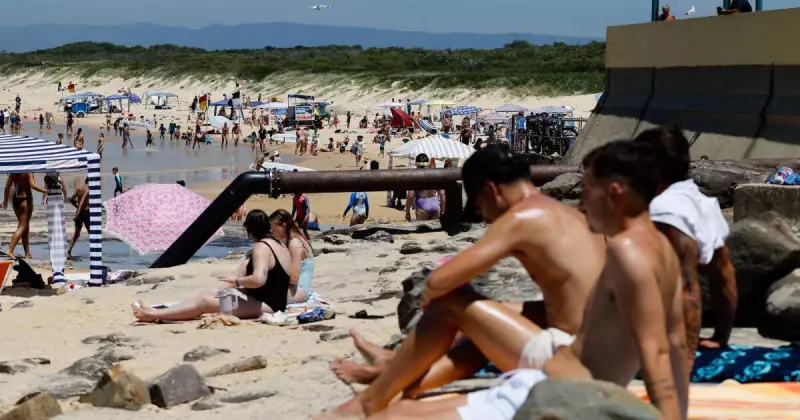
As another summer heatwave sends Illawarra residents scrambling for shade and surf this weekend, a fundamental question arises: just how hot is it actually outside? For many in Wollongong, the answer provided by official weather services can be wildly misleading, creating a unique local frustration tied to the city's geography.
The Two-Station Problem
The core of the issue lies with the Bureau of Meteorology's two primary weather stations serving the region. One is perched on Bellambi Point, jutting into the ocean, while the other sits inland at Albion Park Airport. These locations can deliver dramatically different readings, often failing to represent the conditions experienced in Wollongong's populous residential suburbs.
The station most commonly labelled as "Wollongong" on the BOM website is the one at Bellambi. Being directly on the coast, it is frequently cooled by sea breezes. Conversely, the Albion Park station, further from the water, often records significantly higher temperatures, especially during westerly winds.

Wollongong weather expert Roger Badham clarifies that the stations are not inaccurate, but rather unrepresentative for much of the population. "Bellambi... is representative of anywhere along the coast from Stanwell Park down to Shell Harbour, but it's not representative of what's happening away from there," he explained.
A Real-World Test Reveals Major Discrepancies
The problem became glaringly obvious during a heatwave on December 5. At 2:15 pm, the BOM website stated the Wollongong temperature was a mild 27.1 degrees Celsius, while simultaneously forecasting 35 degrees for that exact hour. Anyone stepping outside knew the forecast was closer to reality.
A check of other weather services revealed chaotic inconsistency. Google Weather showed 37°C, Accuweather said 33°C (feeling like 37°C), while Willyweather reported 24.9°C using a Port Kembla station.
In an informal experiment, the Illawarra Mercury purchased an $8 thermometer from a local shop. Placed in central Wollongong on Market Street, it read 35°C in the sun and just under 34°C in the shade—a far more credible figure than the official reading in the 20s.
Geography and "Heat Islands" Complicate Readings
Wollongong's unique layout, stretching from a coastal strip to suburbs nestled against the escarpment, makes a single reading impossible. Coastal areas from Coalcliff to Shellharbour feel the ocean's cooling effect, while inland suburbs like Dapto, Figtree, and Farmborough Heights bake under significantly hotter conditions.
Weather watcher Gordon Bell notes that the Albion Park airport site itself may be affected by a "heat island effect" from concrete and buildings, questioning its suitability as a proxy for western suburbs. He suggests the public needs clear communication that Bellambi represents the coast and Albion Park represents the west.
The situation is not unique to Wollongong. Badham points out that Sydney has a similar issue with its Observatory Hill station often being cooler than the city's urban sprawl.
The Bureau of Meteorology has defended its observations, stating that on December 5, Bellambi recorded a maximum of 36.7°C and Albion Park hit 37.9°C, with a cool change causing temperatures to drop sharply at the coast from midday. A spokesperson explained that with only 650 automatic weather stations nationwide, it is impossible to have one in every location. Forecasts are created for 6x6 km squares across Australia using data from satellites, radars, and weather balloons, not just ground stations.
However, this response did not address why the BOM's own webpage showed a 27.1°C observation for Wollongong while the city was sweltering in the mid-30s. The spokesperson declined to comment on whether part of the $96 million budget for the BOM's new website could have been used to address Wollongong's structural reporting issues.
With heatwaves becoming more frequent and severe, accurate local temperature data is crucial for public health decisions, school closures, and event planning. The question remains: in a major city like Wollongong in the year 2026, should residents expect better?