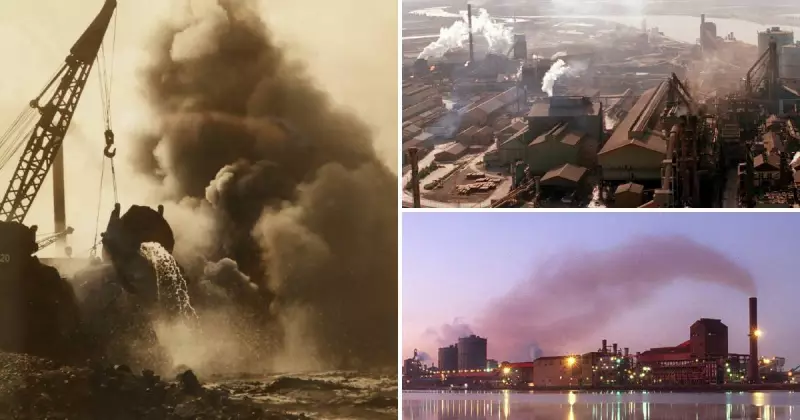
Dangerous levels of toxic contaminants continue to plague public and private land across Newcastle's Lower Hunter region, nearly ten years after scientific research first highlighted the significant health risks to residents.
Studies Reveal Widespread Soil Contamination
Research conducted by Macquarie University in 2017 and 2018 uncovered concentrated pockets of heavy metals and cancer-causing hydrocarbons in suburbs that once neighboured the massive BHP steelworks and other heavy industries. These pollutants, including lead, copper, chromium, and zinc, were historically dispersed through atmospheric dust and industrial waste known as slag.
The studies concluded that these dangerous metals persist in local parks, gardens, and backyards at concentrations considered hazardous to human health. The 2017 investigation, published in the Science of the Total Environment journal, analysed 150 soil samples from areas including Carrington, Mayfield, Newcastle, Cooks Hill, and Merewether.

Lead emerged as the most prevalent contaminant, exceeding Australian Health Investigation Levels in a staggering 88 per cent of samples taken from private homes. A follow-up study in 2018, which focused on domestic dust, analysed vacuum cleaner contents from houses in Carrington, Tighes Hill, and Waratah. It found lead, manganese, nickel, and chromium in every one of the 20 samples collected.
A Stark Contrast in Community Support
While the contamination is clear, resources for affected residents remain scarce. The 2017 study noted that information for landowners about environmental risks is "not extensive and it is often site specific." This stands in sharp contrast to the situation in Wollongong and Port Kembla, where a community-led working group provides free soil testing for residents concerned about legacy emissions from the Port Kembla smelters.
Inner-city Newcastle residents are acutely aware of the issue. Jaci Lappin, manager of the Carrington Bowling Club, observed that while suburbs like Carrington and Mayfield have become trendy since BHP's closure, the pollution from the old industries is a lingering, often unspoken problem.
Cheryl Simpson, who coordinates the Carrington Community Garden, experienced the contamination firsthand during a home renovation. "The dust was horrific. We wore masks and goggles and our faces were pitch black with only the whites of our eyes showing," she recounted. Her community garden, built with support from Port Waratah Coal Services, uses raised beds filled with clean soil to safely grow produce, literally building "a bridge over the contamination."
Regulatory Response and Ongoing Challenges
The NSW Environment Protection Authority (EPA) states that legacy pollution is managed through a site-specific approach under the Contaminated Land Management Act. Several Newcastle sites, including parts of the former BHP Steelworks and the old Pasminco smelter at Boolaroo, are currently being managed under this legislation.
When a site is declared "significantly contaminated," responsibility for remediation falls to the polluter or the current landowner. Potential property buyers in affected areas like Carrington are notified via Section 149 certificates, which also offer practical advice such as using raised garden beds and replacing soil in play areas.
However, the burden and cost of remediation often land on individual homeowners. South of Newcastle, residents near the former Boolaroo lead smelter have faced cleanup estimates as high as $100,000 per property. Since 2016, the state government has provided $3.125 million to Lake Macquarie City Council to support remediation in the Lead Abatement Strategy area, and the EPA funds a grant program for lead mitigation on private land.
Despite these measures, the diffuse contamination from a century of industrial activity remains a complex and unresolved challenge for the Hunter region, highlighting the long-lasting environmental price of its industrial past.