For communities on the New South Wales Far South Coast still bearing the scars of the 2019-20 Black Summer bushfires, the sight of smoke on the horizon can trigger deep anxiety. However, fire authorities are delivering a clear and reassuring message about the current Brassknocker Trail blaze: this is a different fire with a different strategy, aimed at ensuring a vastly different outcome.
A Deliberate and Collaborative Firefight
Chris Allen, the Far South Coast Rural Fire Service (RFS) district manager and incident controller for the fire, is acutely aware of the community's trauma. He acknowledges that the memories of fires like Coolagolite, Yankees Gap, and Tathra are at the forefront of people's minds. Yet, he is determined to shift the narrative.
"The fire scar is very, very different from Black Summer," Mr Allen told ACM's Bega District News. "The fuel load is very different. The water accessibility is very different to what we had to deal with."

He emphasised that the fire service itself has evolved, becoming a more collaborative and better-resourced organisation. Unlike during the catastrophic 2019-20 season, when resources were stretched beyond capacity across the state, the Brassknocker fire is currently one of the major incidents in NSW, ensuring greater availability of aircraft and heavy machinery.
The fire, located north of Yowrie, south of Belowra, and about 20 kilometres north-west of Cobargo in the Wadbilliga National Park, had grown to approximately 3500 hectares by Tuesday, January 13, 2026. Critically, authorities stated this growth was largely due to strategic backburning operations to strengthen containment lines, not uncontrolled spread.
"From 1860 hectares to 2350 hectares, the vast majority of that would have been from our input of fire, not from natural fire progression," Mr Allen explained.
Integrating Indigenous Knowledge into Strategy
A standout feature of the firefighting operation has been the formal inclusion of Indigenous advice. The Merrimans Local Aboriginal Land Council (LALC) has been actively involved in the strategic planning process, a level of collaboration Mr Allen described as unprecedented.
"On that bad fire day, there were five to six questions we went to them and they were able to be part of the decision-making: where we were pulling water from, where we can put a dozer line," he said. "I've never worked in an incident management team that's had this much involvement from our local land council, and my dream is that this becomes a bit of a norm."
Blaan Davies, a proud Yuin man and CEO of Merrimans LALC, said it was a privilege to be called upon by National Parks to help protect culturally significant sites. His team worked to identify registered sites through the Aboriginal Heritage Information Management System (AHIMS) and consult with traditional knowledge holders to locate unrecorded areas of significance.
"We are developing a methodology where we are identifying sites... so that we can embed it into our process," Mr Davies said.
A Long-Duration Operation with a Confident Outlook
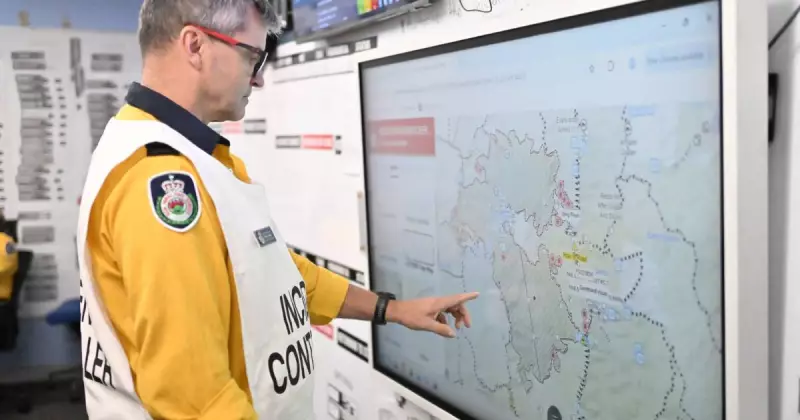
The incident management headquarters in Bega buzzed with coordinated activity. Personnel monitored live aerial footage, studied detailed maps, and managed communications with crews on the ground. At one point, there were 48 fire trucks on site, with crews from Forestry NSW, National Parks and Wildlife Service, and the RFS.
The firefighting tactics were varied and deliberate. Some parts of the fire were being suppressed directly with water, while strategic backburning was being used in other areas, often supported by helicopter-deployed incendiaries and water-bucketing aircraft to control the spread.
Mr Allen confirmed the fire, burning in remote and difficult country, would not be contained within three to four days. "It's a large fire in remote country and it is going to take a lot of time and patience, but we're confident of a good outcome," he stated.

The overarching message from the RFS is one of controlled, strategic management. While the physical footprint of the Brassknocker fire is significant, the approach—bolstered by better resources, evolved tactics, and groundbreaking collaboration with Traditional Owners—represents a new chapter in bushfire response for a region forever changed by Black Summer.