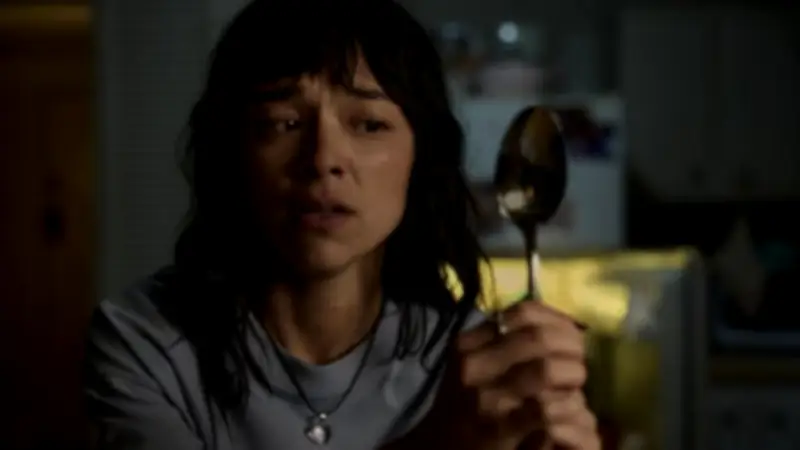
Australian supernatural body horror film Saccharine confronts contemporary anxieties about weight loss and body image, serving as a visceral exploration of one woman's eating disorder in what critics call the Ozempic era. The film, directed by Natalie Erika James, follows Hana (Midori Francis), a Japanese-Australian medical student struggling with compulsive eating and poor body image, who turns to a dangerous weight loss supplement made from cremated human remains.
A Desperate Quest for Thinness
Hana feels trapped between the pressures of medical study, her overbearing mother, social media wellness challenges, her friends' body positive attitudes, and her attraction to her new gym instructor Alanya (Madeleine Madden). An old school friend introduces her to a new weight loss craze: an expensive supplement nicknamed "grey," derived from cremated human remains. Desperate, Hana steals and incinerates parts of a cadaver she is dissecting in anatomy class—a fat woman named Grace, dubbed "Big Bertha" by an insensitive classmate. After starting the pills, Hana is haunted by the cadaver's ghost (Anna Adams), an unwanted side effect. She shrinks rapidly but remains ravenously hungry. The more she eats, the more weight she loses, and the bigger and more aggressive ghostly Bertha becomes.
Exploring Female Relationships and Mental States
Francis delivers an engaging and vulnerable performance, exploring Hana's struggles with care. The role is intensely physical, and hard to watch as Hana gets thinner, backsliding into disordered eating, finding equal parts pleasure and terror in her compulsions. Writer-director Natalie Erika James, known for Relic (2020) and Apartment 7A (2024), excels at probing complex female relationships and unstable mental states. The film's stylish design contributes to Hana's heightened anxiety. Production design and cinematography emphasize candy-coloured pinks and greens, lending a stylized sense of twee femininity, reminiscent of New Zealand body horror Grafted (2024) or the satirical thriller Promising Young Woman (2022). Hannah Peel's evocative soundscape combines electronic scoring with gasps and pants, moving between anxiety and desire.

Food, Beauty, and Disgust
Some sequences involving food, including the closing credits, combine beauty, disgust, and excess in compelling ways. According to the film's press notes, there has not been so much binge eating in a horror film since the infamous pie eating scene in A Ghost Story (2017). Saccharine is sometimes sensual, sometimes revolting, and sometimes both at the same time.
Society's 'Hungry Ghost'
Horror can be an ambivalent genre, effective at addressing cultural fears through metaphor, but its imagery can also reinforce negative stereotypes. Saccharine will be divisive in its treatment of body image, especially fatness and fatphobia. Hana, as a doctor in training, is tangled up with competing messages about her weight. Some characters reiterate that dignity and worth aren't related to body size, which appears to be the film's take-home message. Yet Hana is bombarded with cultural narratives conflating thinness with self-control and fat with moral weakness. The corpulent "hungry ghost" haunting Hana is a powerful metaphorical expression of her eating disorder, making wider social attitudes visible. However, the film frames fat bodies in ways designed to evoke fear and disgust, including the ghost of Big Bertha, first seen as a grotesque distorted image in curved reflective surfaces, later stalking Hana like the unstoppable entity in It Follows (2014). Hana's isolated father sits in the shadows, too big to comfortably leave the house, a source of family shame. While sharing Hana's terrifying experience of body dysmorphia—at her lowest point she lies in a literal pit of trash—the film also recycles dehumanizing cultural narratives about fatness.

Anatomical Venus and Cultural Norms
Saccharine frequently includes images of and allusions to the Anatomical Venus, life-sized wax models designed by Italian sculptor Clemente Susini between 1780 and 1782. These models, shaped like beautiful naked reclining women with long human hair and abdomens that open to reveal organs, reflect a cultural ideal and invite a disquieting, almost necrophiliac gaze. They posit that true feminine perfection is an impossibility only found in death—the ultimate objectification. Hana's time in the dissection room raises uncomfortable questions about where cultural norms and knowledge come from, and what their end point might be.
Timely and Impactful
Saccharine is ultimately a timely and impactful film, even if its initially tight focus dissipates somewhat by the end. It is a stylish take on female-centric body horror with a distinct vision and sensibility, although its approach to bodies may leave viewers queasy. The film is in cinemas now. In Australia, if you are experiencing difficulties with food and body, you can contact the Butterfly Foundation's national helpline on 1800 33 4673 (or via their online chat). In New Zealand, you can contact JourneyED.