Francois Ozon's The Stranger Adaptation: A Modern Take on Camus' Classic
If you studied English literature in high school, there is a strong likelihood you encountered the 1942 Albert Camus masterpiece, The Stranger. Rest assured, watching Francois Ozon's tonally faithful adaptation is significantly more enjoyable than being tasked with writing a thousand-word essay on the novel's exploration of existentialism and its contemporary relevance. However, you might find yourself contemplating that very question, as the film arrives at a time when discovering meaning in one's existence has never felt more elusive.
Faithful Adaptation with a Stellar Cast
Similar to the original book, Ozon's movie centers on the enigmatic Frenchman Meursault, portrayed by Benjamin Voisin, who works a nondescript office job in colonial French Algeria. He leads a nondescript life in a nondescript apartment, embodying ordinariness in every aspect until a telegram arrives informing him of his mother's death. Upon attending her funeral at an old folks' home in the countryside, Meursault is unable to summon any emotion, even as those around him weep over the woman's passing.
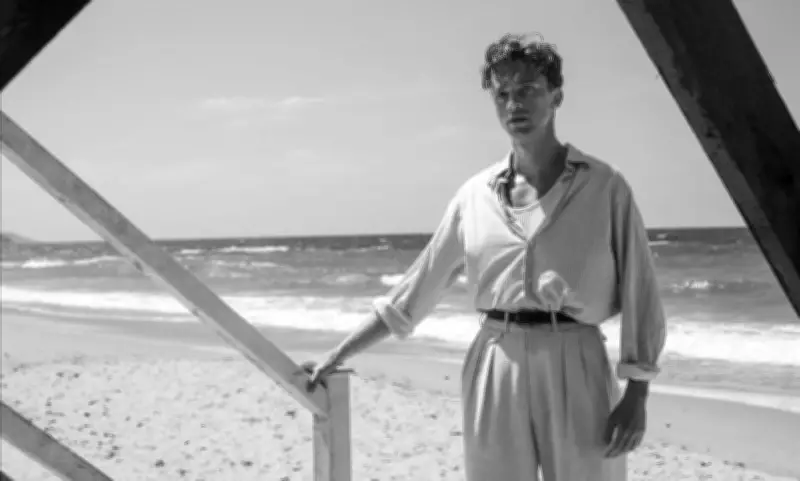
Returning to Algiers, this taciturn character escapes the sweltering Algerian heat with a dip in the ocean, where he encounters Marie, played by Rebecca Marder, a former secretary at his company. Despite wearing the black arm band of someone in mourning, Meursault invites the winsome woman to a movie and then to his apartment, where the two begin a passionate affair. Make no mistake, though, it is Marie who provides the passion, and when she eventually asks if he will marry her, Meursault responds that he does not believe in the concept of marriage or love but will go along with it if it makes her happy.

Plot Developments and Critical Moments
This tendency to be a passive participant in his own life results in Meursault also becoming an accomplice to his neighbor, Sintes, portrayed by Pierre Lottin, a man of louche charm, in a plot to seek revenge on the latter's allegedly unfaithful girlfriend. When this situation turns violent, the girlfriend's brother becomes involved, setting in motion events that lead to Camus' infamous beach murder, which was immortalized by the Cure with their 1980 hit, Killing An Arab. Unfortunately, Ozon fumbles this pivotal moment, robbing it of its surreal nature, which is a notable flaw in an otherwise strong adaptation.
Visual and Performance Highlights
Otherwise, the director excels in his approach, shooting the film in high-contrast black and white, which looks absolutely stunning and enhances the atmospheric quality of the narrative. Ozon also elicits a brilliant performance from Benjamin Voisin in the lead role, with Voisin demonstrating a talent that suggests he is destined for Hollywood success. Mark my words, this actor has a promising future ahead.
Challenges in the Second Half
Ozon struggles somewhat with the second half of the film, when Meursault finds himself at the mercy of a Kafka-esque justice system that focuses more on his lack of emotion at his mother's funeral than on the actual killing. However, the director's decision to name and humanize the victim, portrayed by Abderrahmane Dehkani, was a canny and thoughtful choice that adds depth to the story.
Overall, Francois Ozon's adaptation of The Stranger is a compelling and visually arresting film that stays true to Camus' existential themes while offering a modern cinematic experience, despite some missteps in key scenes.