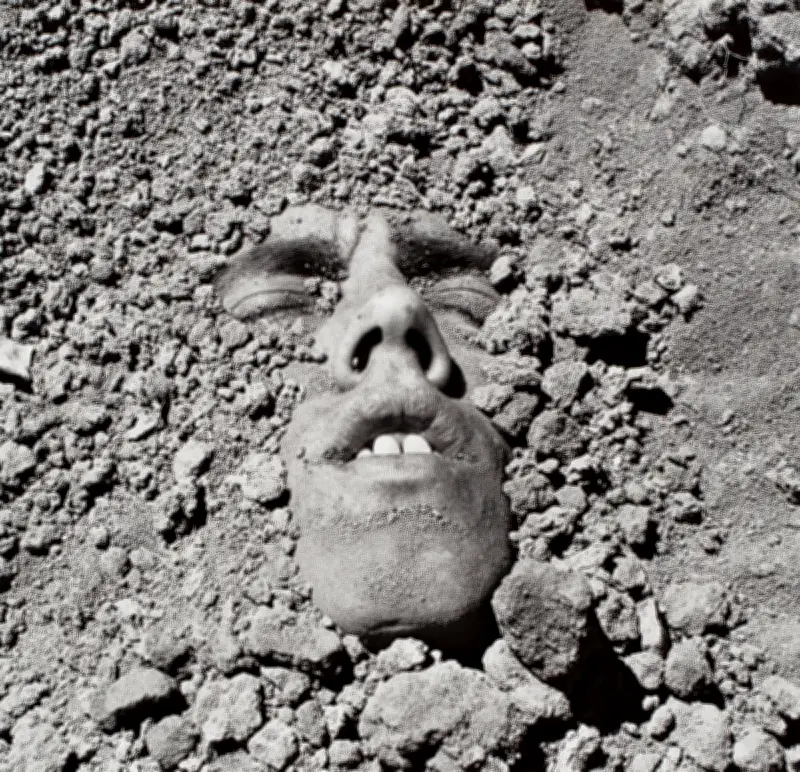
The mood for this year’s Glasgow International (GI) is set by a show dedicated to David Wojnarowicz—artist, writer, and fixture of the 1980s East Village scene. The exhibition, featuring paintings, photographs, and video works, is arranged inside a Georgian terrace house so decayed that visitors can see through perforations in the building’s fabric. Stooping to peer between crumbling bricks reveals a reproduction of a mural of a cow’s head that Wojnarowicz painted on the New York piers. On the top floor, Wojnarowicz’s deathbed photographs of his former lover Peter Hujar occupy an elegiac wall. Looking up through the splintered ceiling, fragments of a film unfinished at Wojnarowicz’s death in 1992, at age 37, play.
Sometimes the artist’s voice permeates the friable architecture, emanating from the soundtrack to Itsofomo (In the Shadow of Forward Motion) playing on a box TV. “I wake up every morning in this killing machine called America and I’m carrying this rage like a blood-filled egg,” he declaims with spitting fury. The words had specific context—New York during the AIDS epidemic—yet Wojnarowicz’s rage at a system that failed to serve or preserve him feels emblematic.
The day after a visit to Glasgow, a vape shop attached to Central station caught fire. Returning months later, the station’s main entrance remains blocked. It is only the latest of many roads, pavements, and buildings in the city now cut off with hoardings, Heras fencing, and scaffolding. Among the no-go zones are cultural landmarks including the Charles Rennie Mackintosh-designed School of Art, which suffered fires in 2014 and 2018, and the Centre for Contemporary Art, which closed earlier this year. As the fabric of the city becomes progressively inaccessible to its people, Glasgow has acquired a contingent atmosphere, as though not fully committed to its present.

Renèe Helèna Browne’s Flat
“Every day is a going on until something happens, and then a going on again in this endless difficulty of staying in sync with the world,” intones Renèe Helèna Browne over her film, Flat. Filmed in Donegal, Flat follows Browne’s uncle as he ekes out an existence on a tumbledown farm, tending cows, constructing a home inside a shed, and lecturing her on the solar system. The film touches on many things: a building materials scandal, masculinity, and our place in the universe. At its base, it is about struggle and survival—a portrait of life as an endless sequence of catchups, mishaps, and repairs.
Tanoa Sasraku’s Tropical Hardware
Tanoa Sasraku’s Tropical Hardware is a terse and elegant sculptural installation. Wooden cases painted in colors of military camouflage and tropical kitsch carry flak-jackets sculpted from dozens of sheets of newspaper, mottle-tanned with the rays of a UV lamp. Trinkets filled with crude oil spill from office boxes—the tchotchkes of warfare. Like Browne, Sasraku explores aspects of masculinity, starting from the viewpoint of the wife of a soldier serving in the Gulf. The result is a cocktail of bravado, mineral wealth, patriotism, and violence, served with a tropical umbrella.
Rehana Zaman’s Plantation
Two intense film installations examine failing social and institutional structures. Rehana Zaman’s Plantation looks at the labor conditions of migrant and seasonal farm workers in Pakistan and Scotland. Their precarious dependence on soil owned by others is sharply exacerbated by the climate crisis. A catastrophic flood takes place while Zaman is filming in Pakistan. She films families crammed together and living on boats on the muddy water, having lost everything.

Naeem Mohaiemen’s Through a Mirror Darkly
Across three screens, Naeem Mohaiemen’s Through a Mirror Darkly pieces together archival footage relating to the shooting of students involved in civil rights and anti-Vietnam war protests at Jackson State College and Kent State University in 1970. Highlighting the relative paucity of archival material—and cultural commemoration—of the black students at Jackson State, the film is punctuated with gaps and silences. In a grim foreshadowing of our own self-serving leaders, a Vietnamese journalist working in the US observes that while Americans call the conflict the Vietnam war, it should properly be called the re-election war, since it motivated ongoing presidential support.
Local Projects and Community Focus
The Wojnarowicz exhibition serves as a fierce reminder that art is worth fighting for and of what can be achieved through community and comradeship by those willing to take risks. Beyond the main exhibition venues, GI honors projects with more local focus. In the northern neighborhood of Springburn, Mandy McIntosh presents a bronze relief made with community members, attached to an empty plinth that once held public art. The plinth stands in a former park, facing yet another boarded-up building that locals long to access. McIntosh is determined to restore her neighborhood’s neglected cultural landmarks. On the nearby station platform is Vincent Butler’s Heritage and Hope—a sculpture from 1989 she found languishing in storage and fought to return to public view.
The fabulous Kinning Park Complex is a significant site of radical action, won for its community in 1996 following a 55-day occupation. During GI, it hosts archive and animated films by the late Katy Dove, a Glasgow artist committed to experimentation and collaboration in equal measure. A historic film of schoolchildren dancing with great concentration and joy, bathed in the colored light of her animations, brought tears to the eyes of viewers.
Rae-Yen Song’s Tua Mak
While explicitly about death and mourning, Rae-Yen Song’s Tua Mak is also supremely life-affirming. Rippling with the neon glow of a deep-sea creature, a vast, gauzy eight-armed structure is surrounded by exquisitely embroidered silk costumes, glass domes carrying Pepper’s ghosts, and giant inflatable tardigrades. At its center is a vitrine filled with critter-infested water from the Song family’s pond and masks to be used in performances during the festival. Tua Mak (“big eyes”) is an ancestor who drowned at sea aged 13, and this lavish and beautifully crafted exhibition performs as a reconciliation with watery spirits, the process of life and death, living and decay. In a local and international context that can seem grim, it is a welcome celebration of cyclicality and interconnectedness.
Glasgow International is at various venues until 21 June.