Some trends whisper their way into relevance. Others arrive wearing diamonds, unapologetically angled, with a backstory and a bank transfer receipt. And it seems divorce rings are here to stay — a jewellery movement that feels like a collective mood shift.
For decades, diamonds arrived with a question attached. Now, increasingly, they arrive with an answer.
Australian jeweller Talitha Cummins, founder of The Cut Jewellery, has seen demand climb steadily, driven by women who no longer want their most expensive pieces tethered to a past version of themselves. The brief is simple but emotionally loaded: keep the stones, lose the story.

That might look like resetting an engagement diamond into something sharper, more directional. A platinum pavé softened into yellow gold. A trilogy ring reimagined to mark not a relationship, but a timeline — past, present, future, all accounted for, just without the groom.
Celebrities Lead the Charge
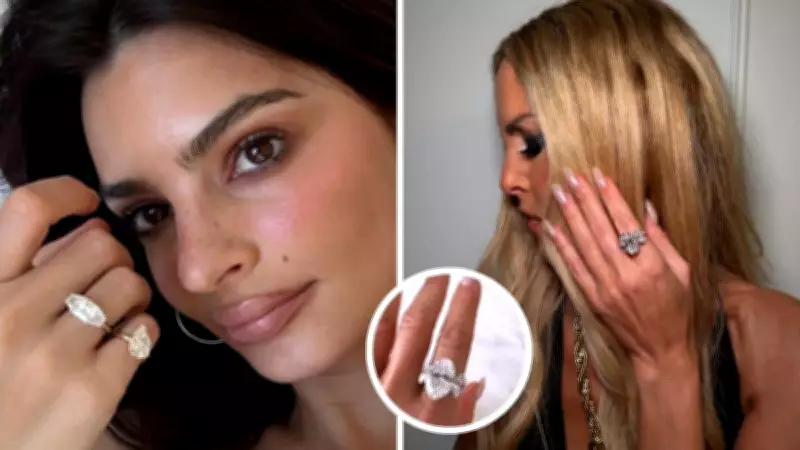
Celebrities have, predictably, helped move the conversation from niche to mainstream. Model Brooks Nader put it bluntly to PEOPLE Magazine when she debuted her own piece: “Why should guys have all the fun? This is my divorce ring — a nine-carat offset pear on a simple gold band — that I designed with my longtime jeweller.” Then, the line that effectively sealed the trend’s fate: “Women deserve to buy themselves something fabulous just because, so why not a sick divorce ring?!”
There is something refreshing about the lack of ceremony. No proposal, no audience, no awkward group reveal. Just a purchase that says, quite clearly, I’ll take it from here.
Rachel Zoe approaches it with equal clarity, if slightly more polish, telling TZR, “I’m happily divorced. You get an engagement ring when you get married, but why can’t we buy ourselves a ring when we’re happily independent?” Her point lands because it exposes the outdated rulebook.
Rings have always marked transitions. This is simply a new one, and arguably a more honest one. Even Emily Ratajkowski, who famously reworked her engagement ring into separate pieces, has helped normalise the idea that jewellery can evolve alongside you. Diamonds, after all, are structurally designed to last. Why shouldn’t their meaning?
Practical and Emotional Appeal
There is also a practical edge to all of this. Gold prices are high, resale can feel like a loss, and heirloom-quality stones deserve better than a rushed marketplace listing. Resetting a ring becomes less about sentimentality and more about smart asset management with a side of emotional closure.
And then there is the fun of it, because for all the symbolism, these are still, fundamentally, beautiful objects.
Notable Divorce Ring Designs
The Cut Jewellery’s Tilted Pear Georgian Ring, priced at $13,900, feels like the poster child of the movement. The centre stone sits deliberately off-centre, a subtle rebellion against symmetry that reads as both elegant and slightly defiant. It is the kind of piece that suggests its wearer is no longer interested in playing things straight.
For something more balanced but still meaningful, Class A Jewellers’ Castor ring starts from $8,249 and features two pear-cut diamonds in a mirrored setting. It leans into duality, which, depending on your mood, can read as closure or coexistence. Not every ending needs to be a clean break.
Minimalists will find comfort in Lindelli’s Cadre elongated cushion solitaire at $8,100. The bezel setting feels modern and contained, a sparkling confidence and a grand statement. The diamond does the talking, and it says enough.
Then there is the Kate and Kole trilogy ring, priced at $8,620, which almost feels like a wink to tradition. Three stones, historically representing a couple’s journey, now reinterpreted as something far more personal. The narrative remains intact, just reassigned.

The Deeper Meaning
What ties all of these together is not just design, but intent. These rings are not consolation prizes. They are not placeholders. They are, in many ways, upgrades. The divorce ring trend sits at the intersection of style, autonomy and timing. It acknowledges that life does not always follow a linear script, and that sometimes the most meaningful purchases are the ones made in the aftermath, when the noise has settled and the decisions are entirely your own.
And perhaps that is the real appeal. Not the diamonds, not the gold, not even the symbolism. Just the satisfying act of choosing something for yourself, no permission required.