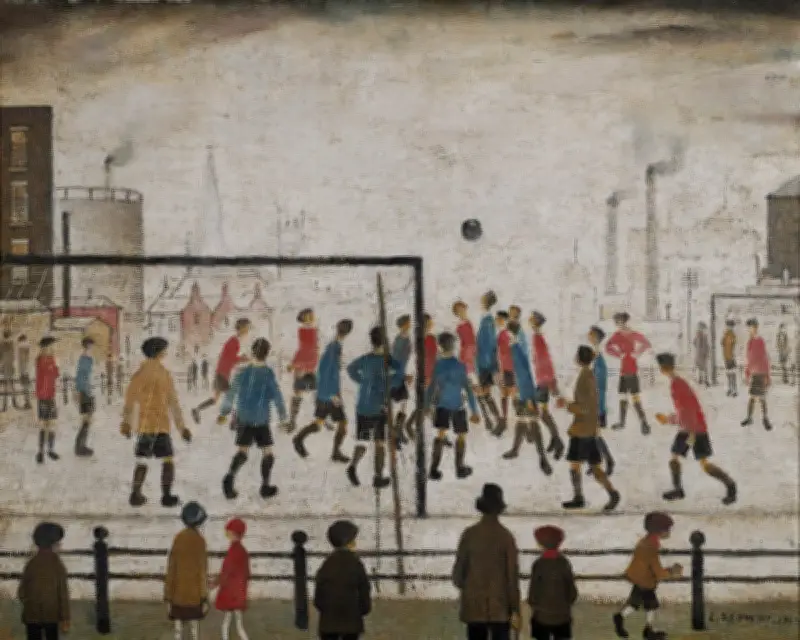
A major new exhibition at The Lowry in Salford seeks to dismantle the long-held perception of L.S. Lowry as a 'naive and uncultured' artist, presenting over 100 works that highlight his sophisticated technique and deep engagement with modernism. Running from September 2026 to February 2027, the show aims to reposition the painter of industrial scenes as a deliberate and skilled artist, not merely a folkloric figure.
Redefining Lowry's Legacy
Curator Sarah Victoria Turner explained that the exhibition challenges the 'matchstick men' cliché, which has often reduced Lowry's work to simplistic, childlike depictions. 'Lowry was incredibly well-read and engaged with contemporary art movements,' she said. 'He visited galleries frequently and corresponded with other artists. The myth of him as an isolated, untrained outsider is simply not true.' The exhibition includes rarely seen preparatory sketches, letters, and paintings that demonstrate his meticulous process and influences from French modernism and British landscape traditions.
Key Works and Themes
Among the featured pieces is 'Going to Work' (1943), a bustling scene of factory workers that reveals Lowry's ability to capture collective movement and social commentary. Another highlight is 'The Lake' (1937), which shows his experimentation with light and color beyond the industrial palette. The exhibition also includes his portraits and seascapes, often overlooked in favor of his urban scenes. 'Lowry painted a wide range of subjects, but the market has focused on a narrow selection,' Turner added. 'This show restores the breadth of his ambition.'

Scholarly Reassessment
The exhibition coincides with a growing scholarly reassessment of Lowry's place in 20th-century art. Art historian T.J. Clark, who contributed to the catalogue, argues that Lowry's work engages with the 'anonymity and rhythm of industrial life' in ways that parallel European modernists like Fernand Léger. The show also features archival materials, including Lowry's library and correspondence with the art critic Herbert Read, revealing his intellectual curiosity. 'He was a self-taught artist, but that doesn't mean he was naive,' Clark said. 'His self-education was rigorous and deliberate.'
Public and Critical Reception
The exhibition has already sparked debate among critics and the public. Some argue that the attempt to 'intellectualize' Lowry risks stripping his work of its emotional directness. However, Turner insists the aim is not to overcomplicate but to correct a historical injustice. 'Lowry has been marginalized by the art establishment for too long,' she said. 'This is about giving him his due as a serious artist.' The Lowry museum, which holds the world's largest collection of his work, expects record attendance, with advance tickets selling rapidly.
Beyond the Myth
The exhibition also explores Lowry's complex relationship with Salford and Manchester, cities he depicted for decades. It includes works from his later years, when he painted increasingly abstract and surreal scenes, suggesting a restless experimentation. 'People think they know Lowry, but they only know one version of him,' Turner concluded. 'This exhibition is an invitation to look again.'