This year's RISING festival in Melbourne, host of the newly established Australian Dance Biennale, was brimming with local and interstate dance shows. Comparatively, the international offer was much more limited, yet the return of two enfants terribles of European dance—Northern Irish choreographer Oona Doherty and Austrian maverick Florentina Holzinger—were the highlight of this rich dance program.
Hard to be Soft: A Belfast Prayer
Doherty's Hard to be Soft was made almost a decade ago. It is part of a series called A Concrete Song, in which her solo Hope Hunt and the Ascension into Lazarus put her on the choreographic map. Hard to be Soft is composed of four tableaux, each with its own distinct flavour—each unfolding in the heavy fragrance of an incense-fuming thurible.
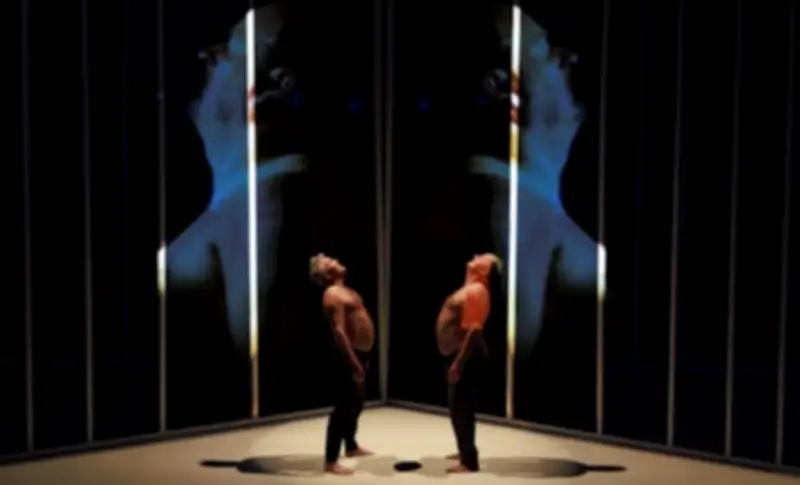
A group of ghostly figures opens the piece. Their presence already smells of churches and prayers, of troubles and mourning. The first solo, initially danced by Doherty and magnificently performed here by Ryan O'Neill, is an ode to smouldering rage and suppressed emotions. There is something pristine about this figure moving in a set that gradually morphs from a cage into a cathedral.

We hear snippets of difficult lives interlaced with soothing religious music, as a simple graceful hand gesture hardens into a threatening posturing—the kind that keeps you alive in the streets of Belfast. We can imagine those tough men and their violence, not afforded the choice to be soft. In the end, a moment of suspended grace, a dance oscillating between the sacred and the profane, and a light pointing to what may be a heavenly escape.
In the second episode we meet the “Sugar Army”, a group of young girls in colourful bomber jackets and white jeans. With slick ponytails and impeccable make-up, they dance as an assembly, moved by rules known only to them. They move with confidence, defiance even, held together by the unwritten rules of sorority. “High heels can be enough of an armour to get through a heavy day,” a voice reminds us. The solidarity that keeps this ensemble together tells the story of all those fierce women who might as well look good when everything else fails them.
In Meat Kaleidoscope, two staunch men cautiously advance toward each other. What kind of trouble will this be? John Scott and Louis Lovett, uncannily similar in the weight of their presence and the heaviness of the flesh, are fascinating as they engage in a series of aggressive tugs and hesitant embraces. One wonders which is which. Is this a father fighting a son? One brother challenging the other? This is the dance of the strong, yet it has the softness of the fallen.
Hard to be Soft reminds us to stay human and kind, and to resist the “generational cellular imbalance” Doherty poetically speaks about in a closing poem, as O'Neill returns for the final solo. Here, his dance becomes more granular and heavenly, a quietening of the troubled—a prayer for the unmoored.
A Year without Summer
Holzinger's piece starts in 1816, known as “the year without a summer”, as the sun in many parts of the world was blacked out by Indonesian volcanic ash. It was also the year Mary Shelley and her friends, stuck in a house on a lake, feared it may be the end of the world—and perhaps, when the idea that birthed Frankenstein emerged.
This is the second time Holzinger has been invited by RISING. Many will remember her blood-churning 2023 show TANZ, a hardcore take on balletic notions of bodily perfection and beauty. This piece delivers the same type of extravaganza. An all-female cast takes us on a breathtaking journey that starts as a full-blown sex orgy, evolves into a musical, and ends up as an avalanche of unstoppable bodily fluids.
There is something endearing about the mass of bodies slowly turning their tender dancing into an orgy. And even as the pace picks up, the flesh is vibrant, joyful and content—a joie de vivre for the end times. But the end times will not come, as medicine can now deal with our mortality, or so we are told. We transition into a “facility”, a clinic where doctors are sadists and “anatomy is destiny”.

The cast once again prove their talent as they form a live band and turn into singers. This section is a suite of vignettes, including one that depicts Sigmund Freud inspecting a woman's vagina in search of castrating teeth. At one point, we see performer Xana Novais have her cheeks perilously stretched by hooks, symbolising an ultimate facelift for eternity. Holzinger's piece culminates in diarrhoea and vomit as the care facility returns to everyday life. The people within face the inexorable decline of their bodily functions, while waiting for medicine to gift them an immortal condition.
Here too is something beautifully soft and deeply human. With a touch of self-deprecating humour, Holzinger dissects our surgical quest for immortality. In doing so, she leaves us pondering the stories we tell ourselves to forget that we, mere mortals, are sometimes the monsters.