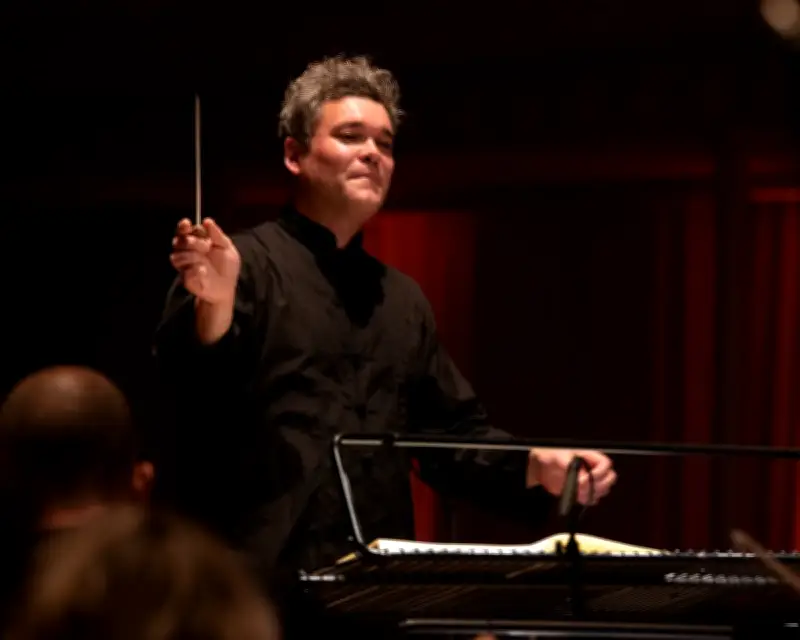
Ryan Wigglesworth, a confident figure striding through the Royal Academy of Music in London, has been a professor there since 2019. He balances his duties with his role as chief conductor of the BBC Scottish Symphony Orchestra, guest conducting internationally, regular recitals as a pianist, and a busy schedule as a composer. He is also the father of three young children, whose sleepless antics have left him bleary-eyed this morning.
Sitting at the head of the long table in the Academy's oak-panelled boardroom, Wigglesworth looks perfectly at home. But when asked if he was inevitably going to end up here, the 46-year-old squirms. 'I certainly wasn't confident as a child,' he corrects. 'I was actually very timid and shy. Maybe that helped; I just used to blend in with the furniture, so no one noticed I was there.'
He stood out sufficiently at nursery school, however, as 'a strange boy, belting out hymns,' that a teacher took notice and he was sent to audition for Sheffield Cathedral Choir. There, this son of a butcher, the only boy from 'the wrong side of the city,' was swept into an entirely new world. 'You become a chameleon in that sort of situation; you learn pretty quickly to adapt. I was very lucky that Graham Matthews took me under his wing when he saw how fanatically interested I was,' he says.

Matthews' intervention opened big doors: Charterhouse, an organ-scholarship to Oxford, Guildhall, Cambridge. But Wigglesworth's real education was always informal, first with his father's LPs and then via the radio and the music collection of the Sheffield Central Library, which he describes as 'my happy place – a total treasure trove.'
At age 12, Wigglesworth first came to Aldeburgh. 'I devoured the Humphrey Carpenter biography of Benjamin Britten, then pestered my parents until they agreed to make a trip down. It was a kind of pilgrimage.' The relationship only intensified after he met composer Oliver Knussen. 'I'd heard his Third Symphony on the radio. It knocked me for six – music I never dreamed existed. So I sat down and tried to figure out what he'd done. I then wrote him a long letter. Six weeks later an extraordinarily generous reply arrived.'
He describes theirs as 'the central musical relationship of my life,' his formative years spent sitting in rehearsals at the festival's Snape Maltings concert hall, where Knussen was artistic director for more than a decade. 'You weren't just learning rehearsal technique,' he explains. 'You'd hear a score pulled apart, see the nuts and bolts.'
Wigglesworth is back at Aldeburgh this week as featured artist, helping shape the festival's focus. 'It's a rare opportunity to wear all my different hats at once, to think deeply about programming. It's a wonderful, complex art – thinking about what piece, juxtaposed with another, can create something entirely new.'
A centrepiece of his season is Debussy's only opera, Pelléas et Mélisande, performed with the BBC Scottish Symphony Orchestra. 'I don't know many composers for whom it's not their favourite opera,' he says. 'It has this multidimensional effect, like looking at a crystal.' The performances reunite him with Rory Kinnear, who directs this semi-staging. Another familiar face is soprano Sophie Bevan, his wife, as Mélisande.
There will be Wigglesworth's own music, too, including his 2019 piano concerto, a cycle of George Herbert songs, and the premiere of a viola concerto written for Lawrence Power. 'I think all composers hope that with each new piece we're doing something different, but I genuinely do with this one. It's more spacious, less cluttered than anything I've written before.'
For a composer whose music is keenly aware of the past, Wigglesworth's starting point is surprisingly human. 'I can't write a note unless there's a specific personality I'm composing for. If I receive a commission from an individual or group I've no relationship with there'll be no ideas.'

He laments the perception of composing as a specialised business separate from music-making and life. 'Over the course of the 20th century we've somehow developed this idea that composing is a specialised business... There must be a way of joining it all up again.' He adds, 'There are so many challenges facing classical music currently, and it's tempting to retreat artistically, to become ever more conservative, but that has to be resisted at all costs. For it to survive, new music must be at its heart.'
Wigglesworth juggles dual roles as composer and conductor. 'There is never enough time for composing,' he admits. Since 2022, the balance has shifted as he took his first regular conducting position with the BBC Scottish Symphony Orchestra. 'That conductor-orchestra relationship is so subtle and hard to pin down. Every orchestra is a group of brilliant individuals, but also has a collective personality and ethos.'
He marvels at his players' chameleon quality, which will be at the fore in two Proms this summer. The orchestra's 90th birthday has prompted an unusual programme of works premiered in 1936. Later in the season, there'll be the world premiere of Brett Dean's orchestral song-cycle The World's Wife, framed by Judith Weir's Moon and Star and Elgar's Symphony No 1.
Wigglesworth is concerned about the future of classical music education. 'We've got to tackle the business of music education, to stop relying on or expecting government support. Help isn't coming. Politics is too short-termist... I so desperately want to make that my priority in the coming years.' His children attend a music academy set up by parents in High Wycombe. 'There has to be a way of expanding that model.'