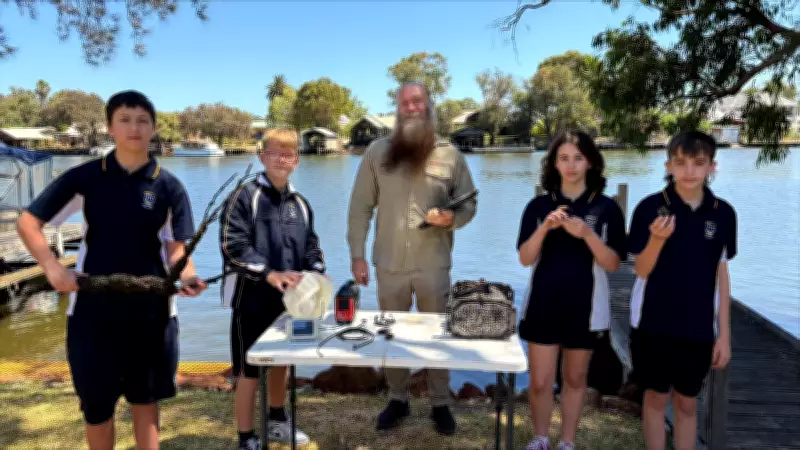
Mandurah Students Engage in Hands-On Aquatic Science Through Mussel Monitoring Program
Year 9 students at John Tonkin College in Mandurah are diving into real-world STEM education with a unique project that monitors mussels in the Peel waterways. This innovative initiative, now in its third year, provides students with first-hand experience in environmental science and data analysis.
Cybernetic Water Monitoring Project Detects Environmental Stress
The program, known as the Cybernetic Water Monitoring Project, is supported by the Alcoa Foundation and led by aquatic scientist Dr Alan Cottingham. It involves attaching sensors to mussels to capture live data, creating an early warning system for potential fish kills, which often occur without clear causes.
Dr Cottingham explained the concept behind the sensors, calling them the "Secret Spies." "Mussels close their shells when they encounter stress, so monitoring shell closure signals is an early warning system for proactive detection of environmental issues like algal blooms," he said.

Six Monitoring Stations Across Peel Region
The project has established six monitoring stations in the Mandurah area, each equipped with eight mussels. These stations are located at:
- Two stations at the Murray River
- One station at Mandurah Marina
- One station at the Serpentine River
- One station at Harvey
- One station at Waroona
This network allows for comprehensive data collection that helps measure river and waterway health while also providing insights into potential climate change impacts on aquatic ecosystems.
Bringing STEM Curriculum to Life Beyond Textbooks
Dr Cottingham emphasized how this hands-on approach addresses gaps in traditional education. "Schools are increasingly expected to develop students' data literacy, scientific reasoning, systems thinking, and understanding of sustainability and real-world decision-making," he noted.
"Traditional textbook examples often lack authenticity and fail to show students how STEM learning connects to real environmental challenges," Dr Cottingham added. "Getting kids out of the classroom and into the environment and into nature is pretty much the best classroom."
Practical Applications and Career Inspiration
For the Year 9 students, the focus has been on water testing, with participants joining Dr Cottingham on-site to examine water chemistry firsthand. This practical experience allows students to analyze numerical data, model shell opening using applied geometry, and explain biological responses and evolution in a tangible context.
"It's a great way for them to bring science to life and start to think about some of the practical applications, and even what a career in science might look like. It's a part of the program I really enjoy," Dr Cottingham shared.
Fostering Environmental Stewardship in Unique Habitats
The program not only aims to inspire future environmental scientists but also encourages environmental stewardship, particularly for the unique aquatic habitats of southwestern Australia. "This project will hopefully inspire a new generation of environmental scientists but also encourages environmental stewardship, especially of the aquatic habitats, which in southwestern Australia are really unique. They're completely different to everywhere else in the world," Dr Cottingham concluded.
Through this collaborative effort between John Tonkin College, the Harry Butler Institute at Murdoch University, and the Alcoa Foundation, students are gaining valuable skills while contributing to important environmental monitoring in their local waterways.