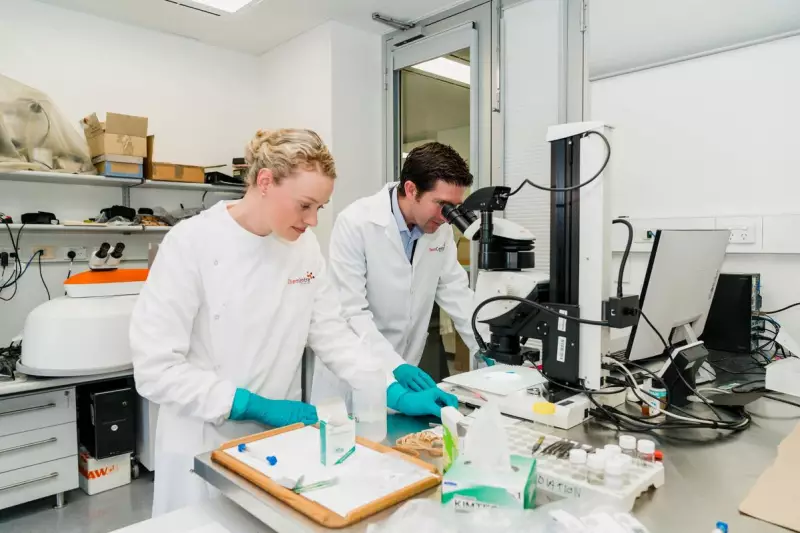
Forensic science in Australia is on the cusp of a significant transformation, thanks to groundbreaking research led by Western Australian institutions. Scientists have developed a novel method for human identification that could become a powerful new tool for investigators, particularly in cases where traditional DNA evidence is unavailable.
Proteomic Genotyping: Reading the Protein Code in Hair
The multi-partner research, spearheaded by ChemCentre’s Forensic Proteomics Research Group in collaboration with University of California Davis Professor Glendon Parker, utilises protein-based analysis, or proteomics. This technique examines the proteins within a single strand of human hair to construct a unique profile for an individual.
Lead authors of the pivotal research article, “Proteomic genotyping for individual human identification: Inferring SNPs in the absence of DNA evidence”, are ChemCentre chemists and ECU PhD students Rebecca Tidy and Romy Keane.

“What we are developing is a new forensic workflow for human identification using hair recovered from crime scenes,” explained Ms Tidy. “This novel technique is referred to as proteomic genotyping and relies on the detection of genetically variant peptides in single hair strands to infer genetic information that can then be used for individual identification.”
A Complementary Tool for When DNA Fails
While DNA profiling remains the gold standard in forensic science, its major limitation is degradation. DNA can break down over time or when exposed to harsh environmental conditions, rendering it useless for analysis.
“This is not intended to replace current DNA-based methods,” Ms Tidy clarified. “This new method is a complementary technique in scenarios where DNA is not recovered from a scene, or it is too degraded to be of use.”
The key advantage of the proteomic approach lies in the resilience of proteins. “Structural proteins persist much longer than DNA in challenging environments, remaining detectable in tissues long after DNA has become too fragmented for analysis,” said Ms Keane.
This durability makes the technique a potential game-changer for re-examining historical evidence. “Hair is always recovered from a crime scene because it is so prevalent, but historically it has been underutilised,” Ms Keane noted. “Being able to go back and look at the hair samples for unresolved cold cases, as well as situations like disaster victim identification where you’re not necessarily going to get DNA, could make an impact.”
From Lab to Courtroom: The Path Ahead
Dr Joel Gummer, an ECU lecturer and ChemCentre Forensic Science Laboratory research and innovation manager who leads the proteomics team, hailed the findings as a major step forward. “Proteins have a sequence, and that sequence is intimately connected to the genome of an individual. This process provides reliable evidence and a powerful new tool for investigations,” he stated.
Dr Gummer emphasised that while the study, published in Forensic Science International, is extensive, further validation is required. “There will be more testing and validation before being used in criminal cases. However, the technology is very promising and could one day be presented in court similarly to how DNA is, potentially transforming forensic science.”
The significance of this innovation has already been recognised, with the project announced as the WA Government Innovator of the Year at the 2025 Innovators of the Year Awards. The work of Ms Tidy, Ms Keane, Dr Gummer, and their collaborators marks a promising frontier in forensic capability, offering new hope for solving previously intractable cases.