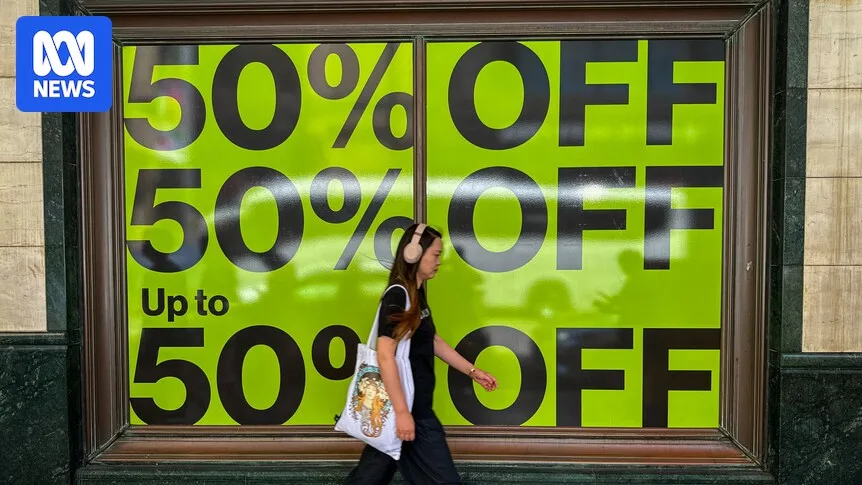
Australians are expected to spend a record $1.3 billion on Boxing Day, driven by stronger migration and higher prices, according to the Australian Retailers Association and Roy Morgan. The forecast represents a 1.8 per cent increase from last year, with food, household goods, clothing, footwear, and accessories making up the bulk of spending.
The post-Christmas shopping period from December 26 to January 15, 2025, is projected to reach $24.7 billion, up 2.6 per cent compared to the same period last year. Fleur Brown, chief industry affairs officer from the Australian Retailers Association, described the figures as a 'decent result in a really challenging economy,' noting that price rises due to inflation and supply chain costs are contributing to the record numbers.
Despite the growth, the retail industry has faced a tough year, with Australia's economy recording its weakest annual growth rate in decades outside of the pandemic. Retail crimes have also hurt businesses' bottom lines. Some economists point to Black Friday sales pulling forward spending from December to November, with the share of Q4 retail sales in November rising from 29.2-30.6 per cent in 2000-2015 to 33.3 per cent in 2023.

Retail spending rose 0.6 per cent in October and 3.4 per cent over the year, according to the Australian Bureau of Statistics. However, core inflation remains at 3.5 per cent, above the Reserve Bank's target band, and the cash rate stays at 4.35 per cent, curbing discretionary spending. High-profile retailers like Mosaic Brands and Dion Lee have collapsed this year.
Market analyst Stella Ong from Superhero noted bright spots, with retailers focused on essentials or low-cost alternatives outperforming. Wesfarmers, owner of Kmart and Bunnings, posted its highest sales since COVID-19, and JB Hi-Fi exceeded expectations due to its low-cost model. The retail sector hopes for interest rate cuts in 2025 to boost spending.