The New South Wales government is facing fierce criticism over a proposal that would effectively abolish separate strategic planning for Greater Newcastle, instead lumping it in with the Central Coast. The move, seen by local advocates as the latest chapter in a long history of Sydney-centric neglect, raises profound concerns about unchecked urban sprawl and the erosion of the Hunter region's distinct identity.
A Plan That Erases Newcastle's Independence
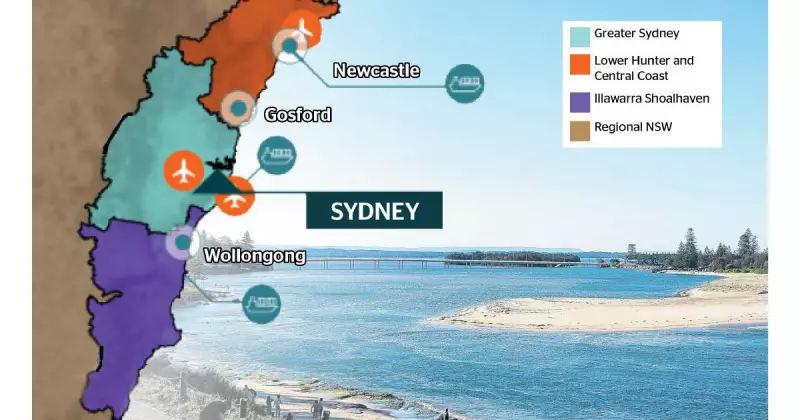
In a significant policy shift reported in early January 2026, the Department of Planning, Housing and Infrastructure proposed scrapping the standalone Greater Newcastle Metropolitan Plan 2036. Instead, future planning would be for a combined "Lower Hunter and Central Coast" region. For Newcastle journalist Bradley Perrett and many residents, this signals a breathtaking disregard from the state government.
"It expresses breathtaking contempt for us," Perrett wrote in his column for the Newcastle Herald on January 2, 2026. "The idea is that we shouldn't even get to exist as a separate entity." The existing plan was issued by the former Liberal-National government in 2017 to manage the Lower Hunter as a single economic unit, accounting for commuter patterns between areas like Maitland, Sandgate, and Wallsend.

The Drivers Behind the Merger Push
This planning change is not occurring in a vacuum. It aligns with three acute pressures that are rapidly filling the geographical gap between the Central Coast and the Lower Hunter. First, housing development is progressively consuming land south of Wangi Wangi and Caves Beach. Second, the economic rationale for the proposed high-speed rail line encourages intense development around a preferred station at Morisset. Third, and most fundamentally, the state government appears to have ceased viewing the two regions as separate.
Perrett argues the government's motivation is one of two things: either a casual, Sydney-focused decision to group "all that stuff up north," demonstrating zero regard for local identity; or a deliberate move to integrate planning because it fully expects the regions to physically merge into one continuous urban area.
The Spectre of a 180-Kilometre Urban Blob
The consequences of such a merger are stark. A combined Lower Hunter and Central Coast urban zone would create a "hideous blob" over 100 kilometres long. Given that the Central Coast is already functionally a part of Greater Sydney's outer suburbia, this sprawl would effectively stretch approximately 180 kilometres from Port Stephens to Campbelltown.
This prospect flies in the face of established planning principles that condemn urban sprawl. Such cities are less walkable, more reliant on cars, increase pollution and energy use, consume farmland and natural habitats, and become inconvenient places to live due to vast distances. "Do we really need to explain the evils of urban sprawl to the state government and especially to the planning department and its minister, Paul Scully?" Perrett asks.
A Call for a Green Belt and Separate Planning
In response, Perrett reiterates a solution he proposed weeks earlier: the immediate creation of a 20-kilometre-wide green belt around the southern end of Lake Macquarie. This would involve halting all development in that band and rezoning any undeveloped land for parkland or rural use, forever preserving a separation between Sydney and Newcastle.
He acknowledges the department's broader, well-intentioned goal to simplify NSW's complex planning policies. However, he insists the scheme must be revised. The government's "first and easiest move" is to maintain separate planning districts for Greater Newcastle and the Central Coast. The harder, but crucial, second move is to establish the protective green belt, resisting developer lobbying and foregoing potential housing land.
The column concludes with a pointed question about the government's priorities: "If NSW Labor ministers have the slightest consideration for what we think, they'll understand why they should do this. But do they have the slightest consideration for what we think?" The proposal stands as a critical test of whether the state government values the unique character of its second-largest city or views it merely as an extension of Sydney's relentless growth.