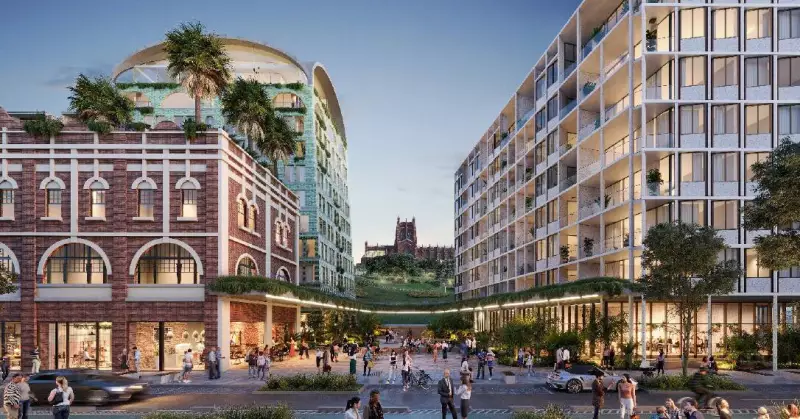
A significant legal and planning dispute has erupted between the City of Newcastle and developer Iris Capital over the final stages of the major East End development project. The conflict centres on conditions of consent that the council insists are essential, but which the developer labels as onerous and unworkable.
Appeal Lodged Over Modification Application
Iris Capital has formally lodged an appeal in the New South Wales Land and Environment Court after Newcastle council indicated it would not support a modification application for the approved stages three and four of the East End development. The modification seeks to alter certain conditions of consent that Iris describes as unreasonable and impractical.
Warren Duarte, development manager for Iris Capital, stated that the company received the draft conditions just four business days before a crucial regional panel meeting. He argued that several conditions should be amended or removed because they were not practical, reasonable, or specific enough in defining the scope of required works.

Public Domain Works at the Heart of the Dispute
One of the primary contested conditions requires Iris to complete extensive public domain upgrades on multiple streets surrounding the development site. These works include new kerb and guttering, road pavement reconstruction, foot paving, drainage improvements, and tree planting on Hunter, King, Newcomen, Laing, Thorne, and Morgan streets.
Mr Duarte emphasised that Iris is not seeking to avoid reasonable public domain works that have a clear connection to their development. He pointed out that the company has already undertaken significant public domain improvements during stages one and two of the project and remains committed to continuing this work in the final phases.
However, he raised concerns about the vagueness of some requirements and questioned why footpath areas adjacent to Iris sites were excluded from a council funding grant, while public domain works near council-owned land and other properties were included. Mr Duarte argued that some works appear to benefit other landowners without a reasonable nexus to the Iris development, yet would be carried out at Iris's expense.
Council's Strong Defence of the Conditions
A spokesperson for the City of Newcastle defended the conditioned public upgrades as critical for supporting a development of this scale and ensuring safe, accessible, and well-integrated streets and public spaces. The council warned that removing these conditions would result in an incomplete and sub-standard public domain outcome inconsistent with previous stages of the development.
More strongly, the council claimed that eliminating the conditions would shift responsibility for essential infrastructure from the developer to the council and ratepayers. This would represent an unacceptable outcome for Hunter Street Mall businesses, who have shown considerable patience while waiting for the East End project to be completed.
The council spokesperson stated bluntly that asking these businesses to now accept a lower standard of public domain after waiting so many years would be a slap in the face. This characterisation underscores the emotional and economic stakes involved in the dispute.
Design Excellence Oversight Also Contested
Another major point of contention involves design review requirements. A condition mandates that the council's Urban Design Review Panel must review the design before the submission of every construction and occupation certificate application, as well as any modification application affecting the design.
The City of Newcastle maintains that this UDRP oversight is consistent with earlier stages of the East End project and serves as an important safeguard to ensure the final built form delivers on design excellence outcomes established through the approval process. This includes maintaining the integrity of the design competition scheme that supported the project's increased height and floor space.
The council argued that removing UDRP oversight would undermine Newcastle's design excellence framework and weaken accountability for delivering high-quality built outcomes. They noted this would also be inconsistent with the approach taken for other major developments across the city.

Developer's Counterarguments and Legal Stance
Mr Duarte countered that in all of Iris's development experience, they have never encountered such an onerous condition imposed on their projects. He stated they are not aware of any prior consents that contain an obligation to revert to the UDRP for approval of construction certificates during development.
The developer acknowledged that continued UDRP oversight is appropriate where a consent is sought to be modified by further application in certain limited circumstances. Iris has no objection to consulting with the UDRP if relevant statutory requirements are triggered, but argues that council's current conditions go beyond these requirements and create an unworkable arrangement.
Mr Duarte asserted that sufficient safeguards already exist to secure the integrity of the design scheme, including retention of the competition-winning architects and private certifier. He dismissed council's claim that the design excellence framework would be weakened by the proposed modification as having no substance and being made without basis.
The development manager concluded by stating that Iris has successfully developed stages one and two of the East End project, achieving high-quality built-form outcomes that have been well received by both the community and the council. With neither side showing signs of backing down, the matter now moves to the Land and Environment Court for resolution.