Terrain Minerals Approaches Defining Moment at WA Gold Project
After years of persistent exploration and patience on the ASX, Terrain Minerals may finally be nearing a pivotal milestone. With extensive drilling underway at its Smokebush gold project in Western Australia and geological models rapidly evolving, the long-time explorer is edging closer to a long-awaited maiden resource. This achievement could transform the company's quest for discovery into a more tangible reality, marking a significant turning point in its journey.
A Journey of Transformation and Focus
Since listing on the ASX in March 2006, Terrain Minerals' early years were characterized by shifting joint ventures, changing tenement positions, and a series of management changes, often punctuated by occasional setbacks. However, the current narrative is far more focused. Under the leadership of seasoned executive Justin Virgin and a refreshed board, the company has sharpened its strategy. Terrain is now firmly committed to developing its flagship Smokebush gold project while refining its portfolio around high-impact targets and pursuing metals crucial to technology and the energy transition.
Key Developments at Smokebush
A critical moment occurred in late 2019 when Terrain secured its first interest in the Smokebush tenement suite, located in the Yalgoo Mineral Field, 350 kilometers north of Perth. This ground offered multiple opportunities, with potential for gold, silver, gallium, rare earths, and lithium. Through a farm-in deal, Smokebush became Terrain's priority project, allowing the company to earn up to 80 percent ownership after completing $250,000 in exploration. Early drilling success at targets like Monza and Paradise City, including rock chips grading up to 49.27 grams per ton gold, immediately elevated the project's profile.

Terrain quickly followed up with extensive drilling campaigns totaling 5,935 meters before acquiring full ownership a year later by purchasing the remaining 20 percent stake for 10 million shares. Work up to 2024 delivered increasingly attractive gold results, particularly at the Lightning prospect, while the Larin's Lane area in the southeast began revealing a separate opportunity for gallium and rare earths. This focus on critical minerals, especially gallium—now viewed as strategically important for technology supply chains—has helped Terrain stand out in a crowded junior mining field.
Lightning Prospect Takes Center Stage
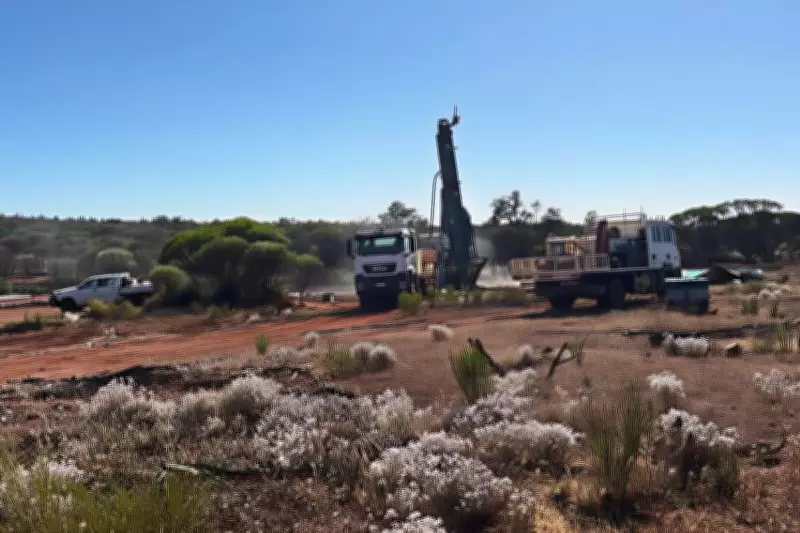
Since the start of 2025, Smokebush has become the heart of Terrain's portfolio. The Lightning prospect in the project's northwest has garnered attention with a series of strong gold and silver intercepts, putting the company firmly on investors' radar. To date, this exciting target has seen 97 reverse circulation holes and 4 diamond holes, totaling a massive 16,000 meters of drilling. Standout recent results from Lightning include 13 meters at 8.13 grams per ton gold from 122 meters, 11 meters at 6.03 grams per ton gold and 43.5 grams per ton silver from 50 meters, and 17 meters at 3.43 grams per ton gold and 17.88 grams per ton silver from 147 meters.
This work has focused on extending known mineralized zones, testing new targets, and generating geological information required for the company's all-important maiden JORC resource, expected in the coming weeks. Located in proven territory near Vault Minerals' high-grade Rothsay gold mine to the north and Capricorn Metals' Mt Gibson gold deposit, Lightning hints at becoming the next significant gold-silver discovery in the area. Adding to its credentials, Terrain secured a mining lease covering the prospect late last year, providing tenure through to 2046 and clearing a key development hurdle.
Wildflower and Larin's Lane Prospects
Seven kilometers southwest of Lightning, the Wildflower prospect is shaping up as Terrain's next priority. At the start of the year, the company completed 2,300 meters of reverse circulation drilling across three high-priority induced polarization targets, supported by strong geophysical responses. Backed by gold-in-soil anomalies and structural signatures similar to those at Lightning, the program awaits results that could indicate more gold along the same fertile trend.

Meanwhile, progress continues at the Larin's Lane gallium and rare earths prospect. A JORC-compliant exploration target prepared in late 2024 ranged from 25 to 33 million tonnes grading 880 to 980 parts per million total rare earths oxide and 19 to 21 parts per million gallium. Notably, this estimate covered only about 5 percent of an interpreted 27-square-kilometer footprint. Based on early air-core drilling through shallow regolith above fresh bedrock, the target serves as a first-pass guide to scale rather than a resource statement.
To date, Terrain has completed 101 air-core holes for 6,611 meters across three polymetallic target areas, with wide spacing designed to map geochemical and geological vectors before tighter follow-up work. The same program also probed underlying bedrock for copper, nickel, gold, and silver, following up on anomalies identified in Mobile Metal Ion soil sampling. Drilling reported traces of sulfides and alteration indications across all three target areas, with three MMI anomalies outlined, each offering multiple follow-up targets for future drilling.
Metallurgical studies are underway, supported by the Minerals Research Institute of WA and Curtin University. The geology at Larin's Lane is interpreted as potentially part of the same greenstone belt that hosts the renowned Golden Grove copper-gold-silver-zinc-lead project further north. Intriguingly, Terrain's drilling at Larin's Lane has reported broad gallium intersections, including a best hit of 16 meters grading 53.74 grams per ton gallium oxide from 64 meters depth. Gallium is classified as a critical metal by Australia, the European Union, Japan, and the United States, with uses in semiconductors and advanced electronics, making Terrain's timing notable as governments and industry push for diversified supply chains.
Regional Projects and Future Outlook
The Lort River project, about 50 kilometers northwest of Esperance, is another regional play for Terrain, shaping up as a highly prospective clay-hosted rare earths opportunity. Recent air-core drilling returned 8 meters at 4,037 parts per million total rare earths oxide, including 1 meter at 9,842 parts per million. An interpreted 66-square-kilometer clay-filled basin is guiding follow-up drilling in 2026. High neodymium and praseodymium values at Lort River compare favorably with several Australian and Brazilian peers, potentially drawing attention as the market searches for magnet supply outside China.
Beyond Western Australia, Terrain's Biloela project in Queensland spans 2,500 square kilometers and hosts multiple historic mines and targets. While early-stage, it is prospective for volcanogenic massive sulfide, porphyry, and epithermal styles of copper-gold mineralization. Terrain also holds the Carlindie lithium project in Western Australia's Pilbara, where soil sampling and a machine-learning study are underway to pinpoint targets. This ground sits along strike from major third-party discoveries and, with only shallow cover, shapes as a classic "next cycle" exploration play.
Conclusion: An Exciting Chapter Ahead
With drills probing the earth in multiple locations and assays pending, Terrain Minerals is emerging as one of Western Australia's more intriguing junior explorers. The next few months are likely to offer plenty of news flow, including pending assays from Lightning, Wildflower, and Lort River, along with ongoing metallurgical studies at Larin's Lane. However, it's the looming maiden JORC gold resource at Lightning that could truly capture market attention. Whether focused on gold, gallium, or rare earths, Terrain is chasing the metals that matter, and with a maiden resource on the horizon, the next chapter of the company's story could be its most exciting yet.