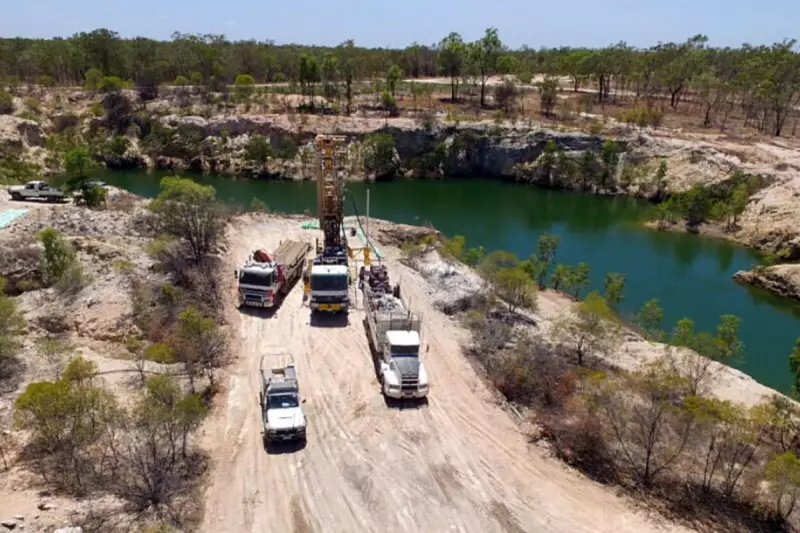
ASX-listed explorer Pacgold Limited has delivered a highly promising start to its maiden drilling campaign at the historic St George gold-antimony project in north Queensland, intersecting multiple thick zones of high-grade mineralisation beginning at shallow depths.
Strong Early Results from Initial Holes
The company reported that assays from the first two reverse circulation holes of a nine-hole program have successfully confirmed extensions of high-grade antimony mineralisation lying directly beneath old mine workings. The drilling, which wrapped up in late November, totalled a modest 826 metres across the nine holes.
The standout results included an 8-metre intersection grading 2.3% antimony from just 16 metres downhole. This interval contained an impressive one-metre spike assaying 11.9% antimony. The same hole also hit a further 3 metres at 3.7% antimony at a deeper level.

A second hole, drilled from surface, returned another 8-metre intersection at 2.3% antimony, which included a 2-metre section of even higher grade material at 8.2%.
These numbers are considered a robust validation of the company's geological theory, suggesting the historic shallow workings are merely the surface expression of a larger, under-explored system. Assay results from the remaining seven holes are still pending and are expected early in the new year.
A Strategic Metal in a Prime Location
The significance of the find is amplified by the critical nature of antimony as a strategic metal. Pacgold notes that antimony prices outside China are currently around US$50,000 (approximately A$75,000) per tonne, driven by acute supply constraints and rising demand from energy transition technologies and defence applications.
Geographically, the St George project sits within a major north-northwest trending structural corridor. This same belt hosts the company's other key prospects, Fence and Ridgeline, forming part of a mineralised zone that stretches for over 20 kilometres across Pacgold's tenement package.
Recent surface sampling at Fence and Ridgeline has already outlined extensive, untested antimony and gold anomalies. The early success at St George, located along the same structural trend, suggests the potential for further discoveries across this extensive landholding.
Next Steps and Broader Strategy
Pacgold's Managing Director, Matthew Boyes, stated the results are an excellent validation of the project's antimony potential, demonstrating strong continuity within multiple mineralised structures. The company's immediate focus will shift to geological modelling once all assays are received, which will guide the design of a follow-up drilling program.
In parallel, heritage clearances and approvals are being advanced to enable future drill campaigns at the Fence and Ridgeline prospects. Surface sampling work continues across the broader project area.
While St George is now a clear focus, Pacgold maintains a diversified portfolio. Its flagship Alice River gold project in north Queensland represents a large-scale intrusion-related gold system. Furthermore, the recent acquisition of the White Dam gold operation in South Australia, complete with processing infrastructure, provides a potential pathway to near-term cash flow to help fund ongoing exploration efforts.
For now, the market's attention remains fixed on the pending assays from St George. If they corroborate the early high-grade hits, this historic antimony field may be on the cusp of a significant new chapter.